Full article about Dominguizo: Where Cherries Ripen Below the Serra
Orchard-scented lanes and granite boulders frame Covilhã’s quiet valley hamlet
Hide article Read full article
The Valley Opens at 415 Metres
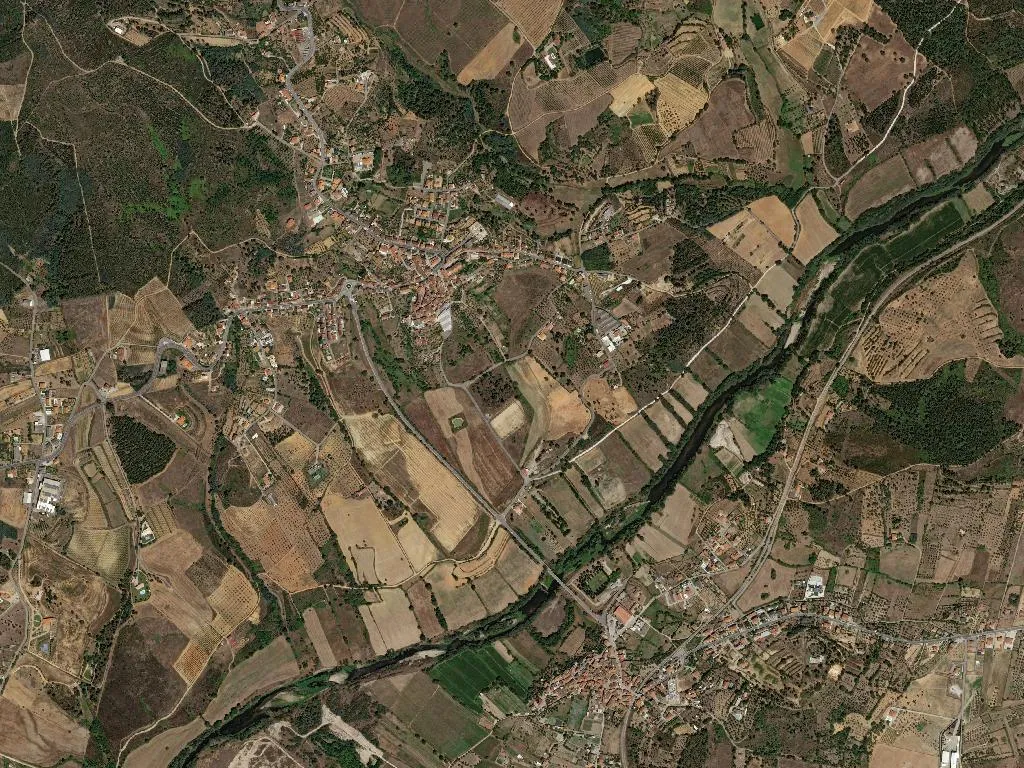
The N18 drops away from Covilhã and the Serra da Estrela suddenly steps back, letting the Cova da Beira valley breathe. At 415 m above sea level Dominguizo slips into view—white-rendered houses shuttered with green-painted iron, granite boulders nudging kitchen gardens, and irrigation channels murmuring between orchards. There is no clutch of baroque façades, no selfie-ready miradouro. Instead you get the audible hush of a parish still calibrated to harvest time, where 1,018 souls keep the same tempo as the fruit they grow.
Between Cherry and Peach
Orchards are the parish’s ledger and literature. Dominguizo lies inside the protected area for both Cereja da Cova da Beira IGP and Pêssego da Cova da Beira IGP, two designations that dictate the calendar more strictly than any mayor. In mid-May the cherry canopy bows under glossy, ox-blood fruit whose sweet-acid balance is a direct receipt for 400 m of altitude and a 20-degree diurnal swing. Three weeks later peach boughs take over, their sun-blushed globes destined for morning markets in Fundão and Castelo Branco. Walk the farm tracks at dusk and the air is thick with sprinkler droplets, cicada hiss and the scent of warm, tilled schist.
The larder widens: Beira Baixa DOP olive oil, Serra da Estrela DOP ewe’s-milk cheese slowly bloomed in humid cellars, IGP kid goat that spends Sunday morning stretched over oak embers. These are not menu props but a working supply chain you can taste in any kitchen that still roasts with firewood.
Gateway to the Mountain
Dominguizo straddles the south-western lip of the Serra da Estrela Natural Park and the UNESCO-rated Estrela Geopark. You are not yet in the granite core—those glacier-sculpted cirques lie 25 km north—but this is where the ascent begins. Trails peel off past the last smallholding, climbing through olive terraces into holm-oak and maritime-pine before the schist gives way to porphyritic granite and broom-covered highlands. Walkers on the Interior Portuguese Camino—sometimes billed the Via Lusitana—use the valley floor as a recuperative stage: no gradients, the mountain a violet bruise on the horizon, shoelaces still wet from orchard grass.
Inhabited, Ageing
Census 2021 reads like a rural obituary: 1,018 residents, 133 under 14, 299 over 65; a 12 % decade-loss but still the strongest headcount in Covilhã’s eastern parishes. Only one registered guesthouse means tourism is still measured in dinner invitations rather than bed-nights. Those who stay, or return, do so for land and parents: pruning contracts paid in cash, tractors bought collectively, WhatsApp groups that time the irrigation rota.
No curated Instagram moments here; the spectacle is functional. Café “O Padrão” pulls its first espresso at 7 a.m.; a red Massey Ferguson crosses the main street at noon; the 1942-rebuilt church bell tolls the hours with no haste. Silence is punctuation, not absence—the scrape of a harrow two fields away, poplar leaves rattling above the Ribeira da Mata, a dog announcing the post-van’s loop. When the sun slants low and the orchards glow like copperplate, you realise Dominguizo isn’t asking for footfall—only for someone to notice the transaction between light, stone and fruit that has outlasted every guidebook.