Full article about Cherry-red Paul beneath Estrela’s granite gaze
Crimson fingers, slate spire, thyme-scented lamb in Cova da Beira
Hide article Read full article
Between slate walls
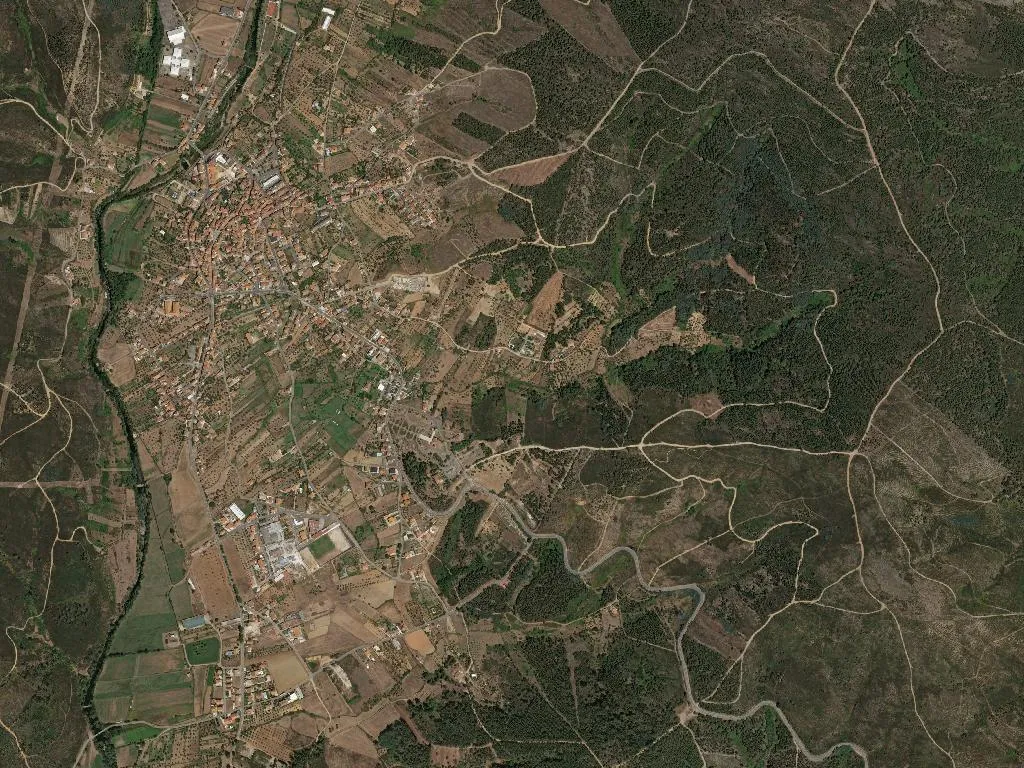
The lane drops between thigh-high walls of mica-schist, moss gripping whatever the years have loosened. At the foot of the slope that climbs towards Torre, mainland Portugal’s highest peak, Paul inhales with the slow pulse of the Cova da Beira — a bowl-shaped valley where spring smells of almond blossom and late summer carries the fug of sun-bruised fruit. The air is loamed with irrigation water; above, the mountain stands vertical guard over a valley that opens its palms wide.
Fewer than 1,400 people still claim this parish on Covilhã’s western rim, yet the place keeps its own heartbeat. The mother church appears before you reach the cluster of houses — a slender slate spire pricking the sky since 1749. Its bronze bells still divide the day, and Sunday mass gathers the scattering that remains.
The cherry that stains your fingers
In June, cherry orchards planted on ancient terraced plots deliver fruit that bursts on the tongue and prints your fingertips crimson. In back gardens, women shake out linen sheets at first light; men hose vegetable patches at six, before the sun tightens its grip. Borrego Serra da Estrela, the local IGP-protected lamb raised on these slopes, smells of mountain thyme when it roasts in Ilda’s wood oven — she who still bakes between lunch and vespers with flour ground at Teixoso’s watermill.
Requeijão da Serra, the velvety sheep-milk curd, is spooned from brown-clay pots; its gentle sourness belongs to the native Bordaleira breed. Cheese is ordered by semaphore: “Give me the one that’s had more time, Zé.”
Granite that remembers
Paul lies within the Serra da Estrela Natural Park and the fledgling Estrela Geopark, but the elders insist it is the schist that tells the truer tale — every cottage, every boundary wall, every flight of field-steps built from the ground they stand on. Rounded granite tors erupt nearby; children scale them barefoot. By October, cold needles the fingertips.
Pilgrims on the Portuguese inland route of the Camino de Santiago pass in reflective silence. Some pause at Aldeia Nova’s spring to refill bottles. Others ask where to eat. “There’s a café on the roundabout,” says Mr Joaquim, occupying his daily bench outside the church, rain or shine. “But it opens at three.”
What endures
With 494 residents over the age of 65 and barely a hundred under 18, Paul knows the arithmetic of decline — yet refuses to leave the table. One carefully restored house takes guests under linen sheets; you wake to thrush song. Two monuments are listed — the parish church and the tiny 16th-century Capela de São Sebastião — yet the real heritage is the network of beaten-earth tracks that lead to small orchards where potatoes are still earthed-up by hand and couve-manteiga kale is cut after the first frost.
At 476 m, Paul occupies a middle ground: neither plain nor mountain. From the top of Rua do Calvário, the eye inventories slate roofs, flowering cherry, the ridge that begins in morning cloud and ends in April snow.
You leave with the metallic taste of spring water on your tongue, the heft of rye-crust bread in your palm, and a hush found only where clocks are listened to, not obeyed.