Full article about São Jorge da Beira: Tunnels, Cinema & Firewater
Walk São Jorge da Beira’s Panasqueira mine tunnels, oak-lined PR4 loop and vintage cinema still pouring firewater.
Hide article Read full article
The Granite Beneath Your Boots
Granite rasps under your boots as you duck into the tunnel. Fifty metres down, the air smells of wet stone and burnt diesel – the sort of perfume that embeds itself in fabric and laughs at detergent. Your helmet scrapes the roof, a reflex flinch, and the lamp picks out white quartz veins threading through the darkness. This is Level Zero of the Panasqueira mine, where tungsten was wrestled from the earth for more than a century by men who spoke a dialect stitched together from English tooling manuals, German engineering slang and the granite-drawled Beirão accent. Eighty per cent of Portugal’s tungsten came from here; now the silence is as heavy as the schist above your head. The tour lasts ninety minutes that feel suspended outside ordinary time – a descent into a subterranean cathedral where the god is ore and the saints are rusting pneumatic drills.
São Jorge da Beira was born of this mountain and this mine. The remotest parish in Covilhã – 39 km from town, a distance that snow can stretch to 60 – was granted autonomy in 1887 because it already had enough souls to elect its own officials. The name honours the warrior saint and the Beira Interior that surrounds it on every side, but it was tungsten that gave the place body. Workers converged from every corner of Portugal in the early 20th century, built the chapel of Santa Bárbara (patron of those who descend into the dark) and installed a 35 mm cinema in the Casa de Cinema e Teatro da Panasqueira that ran until 1985. The German Bauer projector still clatters like an ageing couple during commented screenings – cinema as it was in 1950, except the ticket now comes with a glass of firewater.
Where the Ridge Opens into Trail
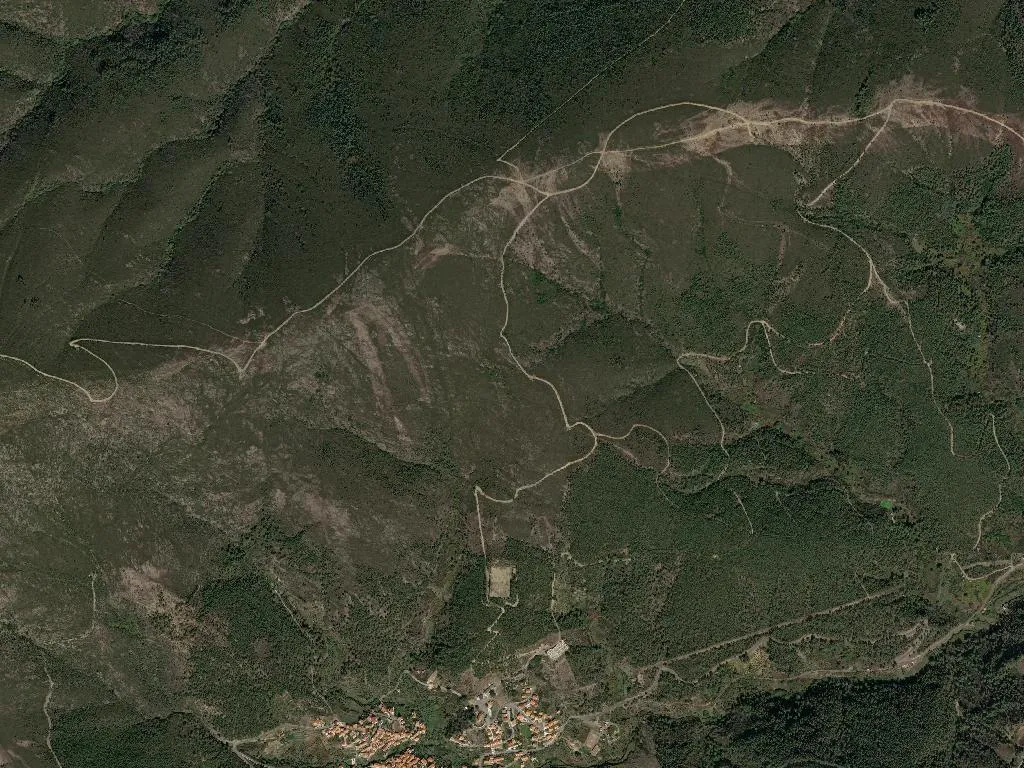
The land begins at 700 m and climbs to 1,050. Pyrenean oak, cork, black pine – the forest closes into corridors that the PR 4 Panasqueira loop cuts through in six circular kilometres. The path skirts spoil heaps, quartz blocks stacked like industrial bones, then climbs to the Caramulinho lookout. That is where the café owner walks at 7 a.m. to watch the sun rise; he claims it is the best place to understand why miners believed they were closer to heaven inside the earth. At dusk griffons glide in wide spirals above the valley, wings motionless against the light that ignites the schist – the mountain submitting its CV to anyone who can read rock.
The PR 5 Vale de Cendeiros drops four kilometres to the Alforfa river, where stone mills rot among ferns and moss. In the quartzite bedrock, fossilised trilobite footprints mark the moment when this mountain was seabed – the Geopark Estrela classifies the spot as a geosite, and touching them is to lay a fingertip on 300 million years. It is like sticking your hand into the planet’s birthday cake and finding an unlit candle.
The Grande Rota do Geopark crosses the parish on its way to Penhas Douradas. Cyclists on the “Volta às Aldeias” – 24 km linking Panasqueira, Cambões and Vale de Cendeiros – feel the granite cobbles vibrate through the handlebars. Locals call it “denture-rattling”, but the payoff arrives in Cambões, where a wooden-and-iron bandstand was hauled up from Coimbra by ox cart in 1923 – three days of ascent that must have felt like a silent-movie adventure. In even-numbered years the São João bonfire is lit in front of it, and challenge songs climb the slope as rough as the Beira Interior red that Zé from the tasca serves in a martini glass nicked from Covilhã’s casino.
Taste of Altitude
Chanfana de bode – goat stew – spends hours sealed in a clay pot with flour-and-water paste: the dish that separates men from boys and tourists from locals. Serra da Estrela DOP lamb grills over wild rosemary picked trail-side, the same plant shepherds call “dog’s ear” for the shape of its leaves. Beira IGP kid slow-roasts until the meat collapses over corn-bread migas that drink the dark juices – like swallowing a lump of mountain that dissolves on the tongue. Galician-kale, potato and bacon soup warms hands in the Casa Museológica, where miners’ lamps share a ceiling with ox-yokes – life lived on two floors in a single glance.
Serra da Estrela DOP cheese matures in a cold cellar; at Quinta da Cerdeira, a pre-booked tasting (Dona Amélia has no patience for drop-ins) slices creamy, butter-textured paste studded with crunchy salt crystals. It is a cheese that makes your eyes close as if you’re hearing fado. São Jorge tigeladas bring cinnamon and lemon zest – simple sweetness that seals the mouth after trail effort – grandmother hugs in dessert form.
Sky Without Filter
Night-time light pollution is almost nil – Bortle class 3, which means stars look like spilled sugar. The Milky Way slashed overhead feels like someone dragging a silk scarf across the sky. Astronomy sessions at Caramulinho train telescopes on Saturn and Andromeda while the serra cold nips earlobes – you end up wearing your father’s old mine coat because “up here the cold enters through the bones and leaves through the teeth”. At 21 inhabitants per square kilometre, silence is dense, broken only by the occasional bark of a sheepdog or a wooden gate groaning in the wind. It is silence you can hear, as my grandfather used to say.
When the guide finally kills the lamp at the tunnel mouth and your eyes readjust to daylight, the contrast is physical: mountain light slaps you like a white-gloved hand, and the body remembers there is still surface, still open sky, still air that does not taste of broken stone. It is like waking from a dream spent inside the earth and realising the world is larger than we thought – and that São Jorge da Beira is the place where the mountain folds you in its arms and never quite lets you go.