Full article about Dawn milk runs over medieval granite in Vale Formoso
Chestnut groves, clock towers and candle-lit feasts at 700 m in Covilhã’s twin villages
Hide article Read full article
The granite setts that funnel tractors into Vale Formoso are cold even in July. They pre-date the internal-combustion engine by six centuries but never saw a Roman sandal: this is a medieval drove-road, still the quickest way down to the São Jorge stream and the morning milk run. At 07.30 the air tastes of pine resin and wet schist; the only audible currency is the soft clink of bottles in metal crates and, somewhere upslope, the church bell that strikes twelve and seven regardless of season.
Stone, lime and memory
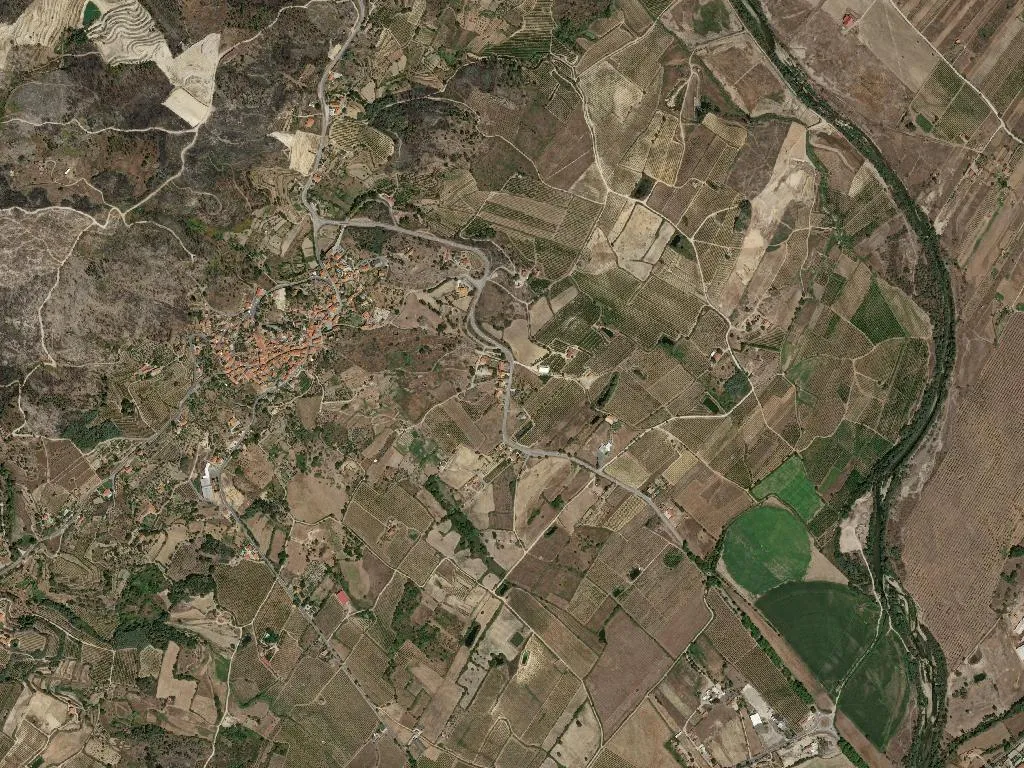
Vale Formoso and Aldeia do Souto were yoked together in the 2013 administrative shake-up, yet they have always shared the same vertical geography—two ledges on the north-east flank of the Serra da Estrela, 500 m above the Cova da Beira plain. The name Vale Formoso itself is a 1949 rebrand: until then the place answered prosaically to Aldeia do Mato—“Bush Hamlet”—until the parish council decided the new label sounded “more dignified”. Aldeia do Souto, first chartered by Sancho II in 1229, kept its arboreal designation: souto denotes a chestnut grove, even if phytophtora reduced most of the originals to stumps long ago.
Emigrants who left for São Paulo in the early 1900s sent back enough cruzeiros to build Vale Formoso’s clock tower in 1926; their names survive on blue-and-white azulejos inside. The mother church went up in 1717, its single nave barrel-vaulted in lime and chestnut beams. Beside the cemetery the tiny Nossa Senhora da Saúde opens only once a year—15 August, feast of the Assumption—when villagers celebrate with a candle-lit mass in the churchyard. Across the parish boundary, Aldeia do Souto’s Senhora do Caneiro was erected in 1683 after a vow made during a plague outbreak; São João Evangelista, finished in 1892, doubles as the stage for a living nativity every December, complete with real goats and a baby borrowed from Covilhã hospital.
Altitude husbandry
Serra da Estrela Natural Park folds around the parishes like a granite overcoat. Between 1930 and 1970 the Forestry Service carpeted the high ground with maritime pine, but pockets of native oak survive in the Souto valley, their bark still stripped for tanning. Thirty-eight olive trees are listed as centenarians in the agricultural register; the oil they yield is pressed in neighbouring villages and bottled under the Beira Interior DOP since 1996.
Livestock numbers are modest but precise: twelve registered holdings, 46 Serra da Estrela lambs (DOP) fattened on heather and rye, three Beira kids (IGP) destined for the Covilhà delicatessen at €14 a kilo. Two licensed creameries—Carlos Augusto’s and Fernanda Martins’—turn local ewe’s milk into peppery, thistle-coagulated Serra da Estrela cheese, buying litre by litre from seventeen farmers at 80 cents. The cardoon needed for coagulation is picked in June, sun-dried on Souto rooftops and sold in fist-thick bundles for €6.
Paths that stay open
Since 2018 the Interior Way of the Portuguese Camino has bisected Vale Formoso, way-marked with yellow arrows and scallop shells. Only a dozen walkers logged their names in the parish book last year, but the route gives the villages a pilgrim logic they never possessed. The official viewpoint, 640 m up, frames the Beira Baixa railway, the olive terraces of Cova da Beira and, on very clear days, the border keep at Vilar Formoso 30 km away. A kilometre east, porphyritic granite boulders punctuate the road like half-buried sculptures; UNESCO’s Estrela Geopark installed an interpretation panel in 2022, though sheep still use the outcrop as a windbreak.
Ledger of departures and returns
The census tells its own story: 824 registered voters in 2013, 616 inhabitants in 2021, 210 of them over 65. Yet the outflow has slowed. Since 2020, 23 newcomers—mostly remote workers from Lisbon and Porto—have bought empty houses for around €25,000 and discovered that council tax on a village cottage is €12 a year. João Graça, 34, came back from Luxembourg in 2021, installed a wood-fired oven and now sells sourdough loaves at Padaria do Souto; they are gone by 10 a.m. on Saturdays, bought by neighbours who once sent their children away and now queue for carob-flavoured brownies instead.
Afternoon light ricochets off whitewash; resin drifts downhill; a gate clicks shut. Vale Formoso and Aldeia do Souto keep their own quiet score—vertical, stubborn, patched with lime and memory—where choosing to stay, or deciding to return, counts as the only plot that matters.