Full article about Barroca: slate lungs of Gardunha
378 souls, zero souvenir shops—just schist walls, cherry orchards and a Camino bed
Hide article Read full article
Barroca, where slate itself breathes
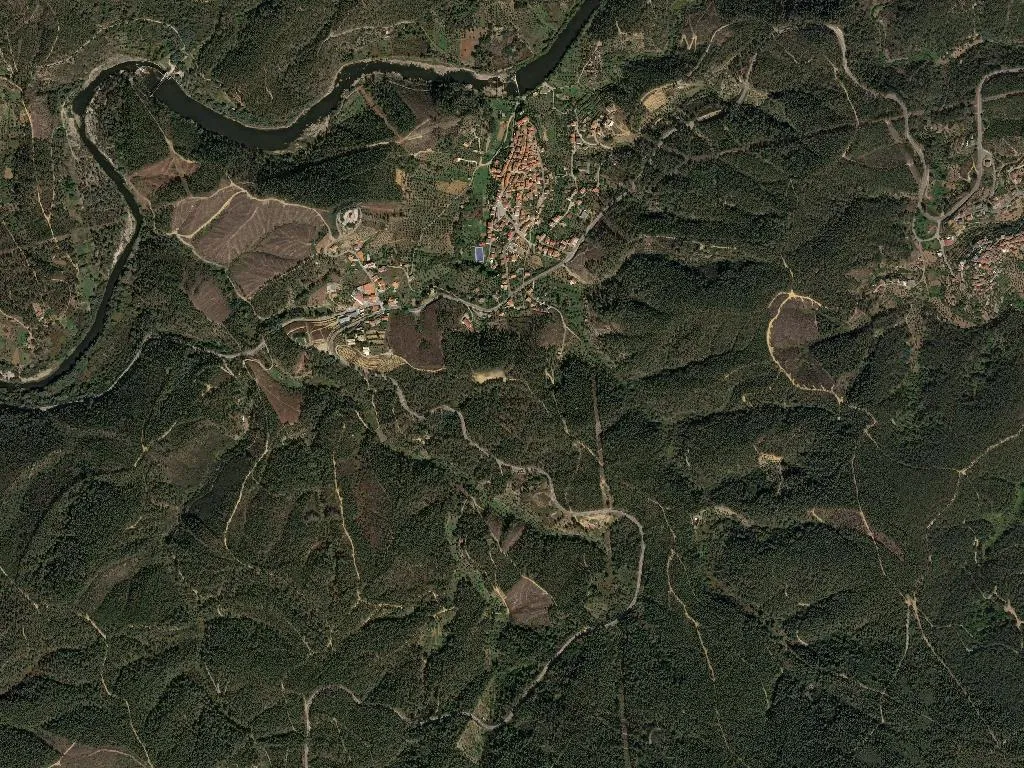
Silence arrives first. Not the empty kind, but a silence with heft, collecting between walls of gun-metal schist the way moisture pools in the joints of stone at dawn. At 460 m above sea-level the hamlet seems chiselled straight from the mountain: each house a continuation of the rock, every lane a groove worn by four centuries of boots and hooves. Dawn light slides across the slate roofs with a wet-metallic gleam. No traffic, no hurry. Only the wind worrying the gaps in the shutters and, somewhere below, an unnamed stream sliding over stone.
378
Barroca’s scale is numerical: 378 inhabitants, 2,300 hectares, 16 souls per square kilometre. You feel the maths in your footfall. Alleyways barely shoulder-wide radiate a dry heat that lingers on the palms when you steady yourself against a wall. On an afternoon stroll you may meet one person, perhaps none. Of those who remain, 196 are over sixty-five; 21 are under fourteen. The arithmetic is brutal, yet dignified: whoever stays does so by choice or by rootstock, and the village—now part of the Schist Villages Network—keeps its shape.
The pilgrims’ corridor
Barroca lies on the Interior Way, the Portuguese limb of the Camino that links Lisbon to Santiago. Walkers descend from the Serra da Gardunha with blistered feet and find, not a souvenir stop, but an interval of reality. Three village houses offer beds, bread and silence—nothing more. No spa, no laminated menu. The luxury is empirical: a clean sheet, a window you can actually open, the sound of your own tendons unwinding after 25 km of granite and cork oak.
A larder with postcodes
The slopes around the village are a roll-call of protected produce. From late May the Fundão IGP cherry orchards ignite into glossy scarlet lanterns; by July the Beira Interior high-brush peaches take over, followed by autumn apples that hold the mountain’s chill in their skins. Roast kid—Cabrito da Beira IGP—slow-turns on a Sunday spit, its scent of rosemary and dripping fat telegraphing lunch long before the church bell strikes. Olive oil arrives at the table in unlabelled bottles: Beira Baixa DOP, thick, grass-green, poured without ceremony but with the confidence that comes from a grove you can point to through the kitchen window. A small saucer of cracked Azeitona Galega IGP finishes the still-life. Wine is high-altitude, high-acid, the night-time cold locking freshness into Touriga Nacional and Tinta Roriz grapes; it is poured in measures that assume you are staying the night—because you are.
Slate above, slate below
The village palette is geological: graphite when dry, almost black after rain. Schist forms everything—walls, roofs, benches, the shallow channels that guide storm-water downhill. Moss colonises north-facing planes; the occasional whitewash around a window looks almost indecent. No architectural flourish interrupts the conversation between stone and sky. The surrounding 23 km² unfold in terraces of olive and cork, productive rather than scenic, worked by tractors no wider than a donkey cart.
The cadence of those who stay
Barroca will not reward a whistle-stop visit. There is no single monument to photograph and tick off. Instead there is cadence: the slow drag of shadow across paving, the way wood-smoke at dusk signals the day’s full stop, the hour it takes for the sun to slip down a gable end. Night, when it falls, is uncompromising. Street lighting is parsimonious; darkness feels textile. Place a hand on a cottage wall and the stone returns the day’s stored heat, a discreet pulse against the mountain cold. You leave with that sensation lodged in the palm—neither sight nor sound, simply the afterglow of black slate breathing in the dark.