Full article about Bogas de Cima: granite, galega olives & vanished biscuits
Scent of oil, iron-tasting spring, 49 pre-1919 houses clinging to Gardunha’s high ridge
Hide article Read full article
Between granite and galega olives
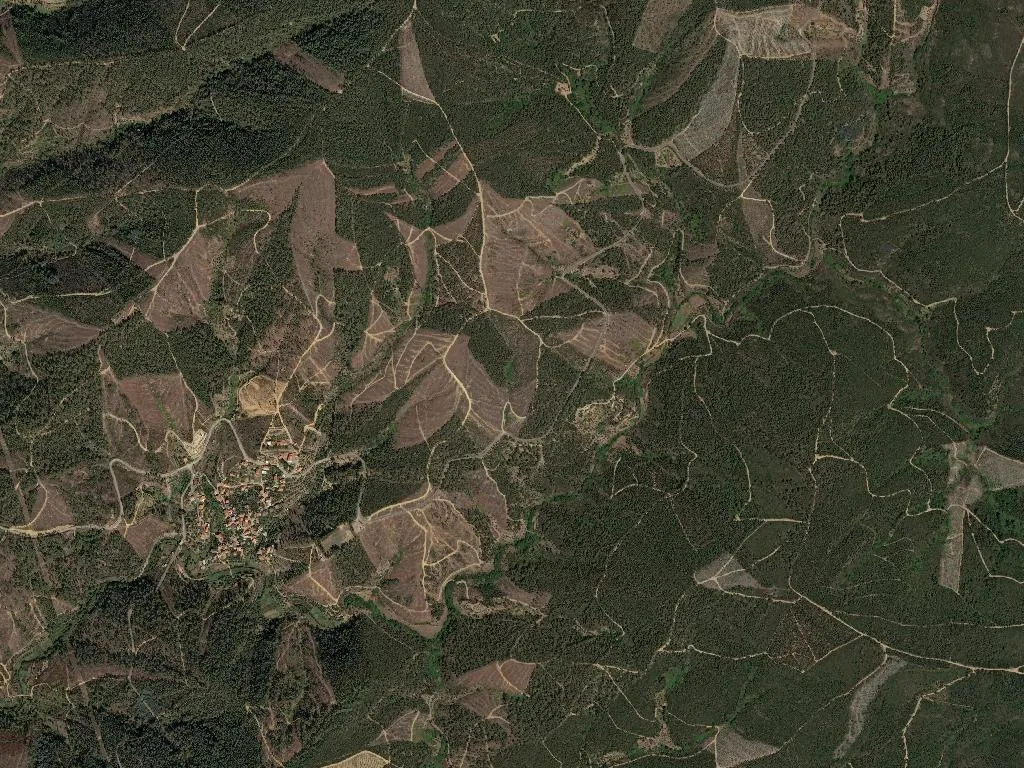
The scent of new olive oil rises from the stone press, but it is the smell of rain on schist that drags my grandmother—wool scarf knotted under her chin—out to call me indoors. At 620 m on the Gardunha range, galega olives thud onto sheets spread under the trees my uncle still prunes with a two-edged saw; the dull grind of granite millstones ricochets off the whitewash he mixed and daubed himself. This is land of terraces stitched into xisto where I once lost a school shoe, of vines gripping dust, of smokehouses where chouriço darkens month by month—and where my mother still draws water with an aluminium bucket. Three hundred and twenty-eight souls occupy a rippled plateau between Gardunha and the Cova da Beira; almost half are over sixty-five, like Sr António who used to slip me Maria biscuits in the village shop that finally shut its shutters five years ago.
The track that bisects the village
The Via Lusitana, an interior branch of the Camino de Santiago, cuts through the parish towards Fundão, its earth footpath squeezed between low loose-stone walls where I once scratched my name with a stick. The occasional pilgrim pauses at the iron-tasting spring, grateful for a route that detours well away from crowds, threading settlements where fields are still worked by animals—Mr Jaime’s donkey, which I rode at six, now pulls a single-furrow plough. The toponym pairs with Bogas de Baixo, a hundred metres lower, a medieval reminder that “upper” meant colder wind and thinner rents. There is no patron-saint festa, rare in this region, yet the hamlet carries an unusually high quota of pre-1919 buildings—forty-nine in the latest survey—holding their ground against time and departure, among them my grandmother’s house where bread still rises in a wood-fired clay oven.
Kitchens bearing Europe’s seal
At lunch, Beira kid goat is roasted in the same oven my father lights with last week’s Diário de Notícias, basted with DOP Beira Alta olive oil that pools gold against the crackling. Home-made chouriço, farinheira and blood-morcela dangle from oak-smoke rafters; the smoke still makes my eyes water when I duck underneath. In winter, chestnut soup steams in clay bowls; in summer, PGI Cova da Beira cherries are stirred into compote before dawn so the heat won’t catch the cook. The same pedigree fruit appears in sponge cakes served with coffee drunk from my grandfather’s chipped crock. On the table, Beira Interior red—trincadeira whose firm tannin once made me spit—rinses the smoke from the tongue and braces the stomach for migas: olive-oil-soaked breadcrumbs I mix myself from yesterday’s loaf.
Trails among olives and vines
The horizon is ruled by Serra da Estrela to the west, São Mamede to the south; snow is on its way when clouds snag the summits. Between wind-sculpted olives and dry-stone terraces, footpaths link Bogas de Cima to Bogas de Baixo and on to Fundão—short circuits where red kites tilt overhead, partridges sprint through rock-rose and foxes slip out at dusk. I still bear the scar from a boar’s tusk received while hunting mushrooms. Fifteen minutes away by car, June turns the Cova orchards bridal-white; as children we raided Mr Domingos’s backyard on the certainty his dog was too old to give chase. From November to January the stone mills open for first-press tastings: oil dribbled over toasted rye, the raw bitterness that once scalded my tongue now welcome. Come August, family vineyards welcome volunteer pickers, repaid with supper and unlabelled carafes under a pergola where, aged ten, I face-planted in the dust chasing a runaway bucket.
Sunset ignites the schist walls; silence is broken only by a distant bell and the un-oiled hinge my grandfather deliberately left dry so he could hear who arrived. The taste of new oil lingers, altitude cold settles on skin, and the certainty remains that here the land still dictates tempo—something I have never managed to explain to my children when the scent of oak smoke makes me cry.