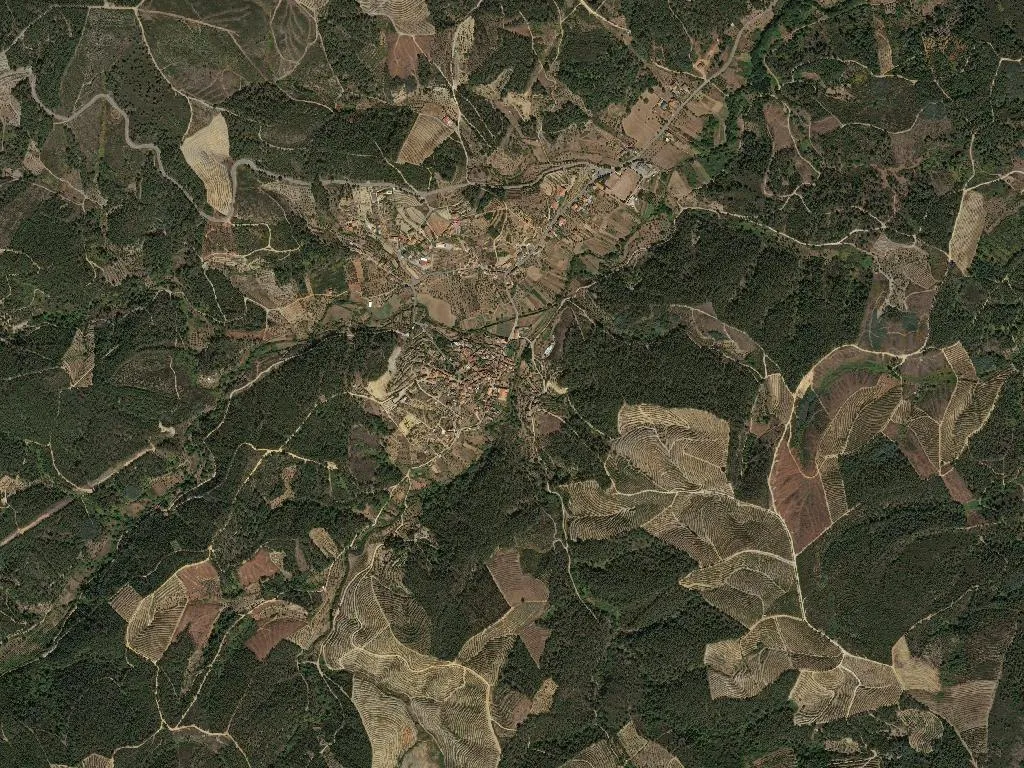
Full article about Castelejo: Cherries, Oaksmoke & Gardunha’s Watchful Ridge
Castelejo, Fundão: stone church terrace, cherry orchards, oak-fire cafés and a ridge-top village that time keeps forgetting
Hide article Read full article
Woodsmoke and Cherrybloom
The scent of split oak drags uphill from cottage chimneys and collides with the sugar-bruise of ripe cherries riding the draught from the Enxabarda stream. May has painted the orchards around Castelejo the colour of inexpensive rosé; the trees look as if they’ve dressed for a parish-hall dance, all flounce and no orchestra. Behind them the Gardunha ridge keeps its own counsel, a tight-lipped chaperone, while the church bell tolls the hours like an elderly relation who still insists on giving the day a polite escort.
High-up Histories
At 498 m your phone loses the will to live and Google politely gives up. Castelejo’s name is a contraction of the Latin castellum: a watch-tower that once eyeballed the Serra da Gardunha for strangers. Today the job falls to Arnaldo’s mongrel, who interrogates everything that moves—including the postwoman on her squeaky Honda.
For centuries the village belonged to the couto—semi-autonomous estate—of Alpedrinha. Medieval walkers on the local branch of the Via Lusitana (more shepherd’s shortcut than pilgrim super-highway) dropped coins and gossip here on their way to somewhere holier. Modern travellers do the same when they pull over for a bica laced with bagaceira brandy in Fundão’s riverside cafés.
The church of Santa Luzia is dated 1738, but the stone looks older—simply tired of being looked at. Its terrace doubles as the village belvedere: first-cigarette territory for teenagers, late-afternoon dying-ground for octogenarians. When the sun slips behind Gardunha the light turns the colour of aged aguardiente spilled across granite.
Late Harvest, Late Bloom
Altitude drags everything backwards. Olives are still on the tree in November when the Alentejo has long since bottled its oil; the cooperative press opens for a final flourish, the new oil tasted on charred pão de lenha with folar de carne, a savoury loaf whose recipe is locked inside the head of Zé’s wife.
Come May, the village becomes a teenager’s bedroom: everything suddenly, defiantly, pink. Cherry petals carpet the single-track road that links Castelejo to Enxabarda on the five-kilometre olive-trail. Children cannonball into the stream’s natural pool while parents pretend not to notice, remembering their own mid-air summers.
Torches and Off-Key Troubadours
December’s Festa de Santa Luzia is one of the few nights the houses remember electricity exists. Flares are lit “because grandfather did it so”. Sponge cake, Pão-de-Ló da Luzia, is drenched in raw oil—buttery, peppery, allegedly calorie-free.
On St John’s Eve the village sings a fragment of Cantiga de Amigo that predates the 1910 Republic. Nobody owns the lyrics; they mutate with every throat, but the sentiment—something about moonlight and unreliable boyfriends—refuses to die.
Cold Water for Tired Feet
The granite wash-house no longer entertains laundry, yet pilgrims still halt to soak blistered soles. The water is snow-melt sharp: first-kiss shocking, then strangely addictive. A bench, a fig tree and the certainty that no one is in a hurry complete the amenities.
Castelejo clocks in at 562 souls and refuses to grow. Visitors leave with the dawning sense that time here does not pass—it simply pulls up a chair beneath the olive and waits for life to happen.