Full article about Schist silence between Zêzere and Serra da Estrela
In Fundão’s forgotten corner, Janeiro de Cima & Bogas de Baixo breathe stone and water
Hide article Read full article
The schist that breathes in the silence of Cova da Beira
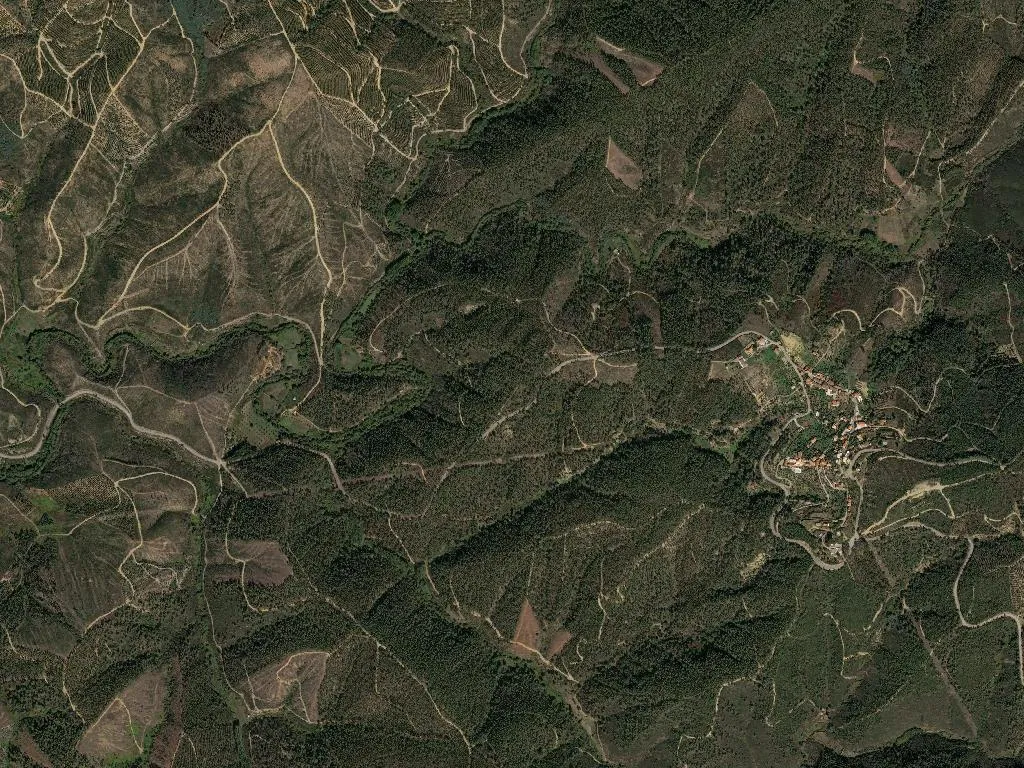
The first thing you notice is the lack of noise. No traffic, no raised voices, no low-frequency throb of a place that never switches off. What reaches you instead is the draught that slips down from Serra da Estrela, threading the lanes of Janeiro de Cima and grazing walls of dark schist with a dry, almost mineral whisper. Between the stones, moss the colour of bottle glass fills some joints; others lie open like the ribs of an old carcass. At 458 m above sea level, on the hinge between two mountain ranges, the air is less cold than simply stripped of ambiguity: a clean-edged clarity.
Where freshwater fish baptised the valley
An administrative merger in 2013 yoked two hamlets the River Zêzere had already united for centuries. Janeiro de Cima, enrolled in the network of Aldeias do Xisto (Schist Villages), owes its tag to a medieval Januário whose memory has long since dissolved into granite and topsoil; only the truncated name survives. Across the water, Bogas de Baixo carries the label of the silver-sided barbels that once flashed through these currents—bogas, a living barometer of clean water and discreet abundance. The village’s lower position gave it the modest suffix, as if geography itself had decided where pride should stop.
Four hundred and twenty-five people share 46 km²—barely nine souls per square kilometre. On the ground that translates as interval: gaps between houses, between olive groves, between footfalls. Two hundred and forty-two of them have passed their sixty-fifth birthday; only nineteen are under fifteen. The arithmetic is brutal, yet the settlements refuse to shrink into footnotes.
Walls that remember flax
The schist dwellings of Janeiro de Cima are not scenery; they are documentation. Every façade, every stone lintel, every external staircase chipped by hand tells of labour split, stacked and trimmed without industrial mortar. The architecture is functional to the point of severity: ground floor for livestock and tools, upper floor for sleeping and weaving. For generations the crop was flax. Parish-archive ledgers from the nineteenth century list field acreage, yarn counts and loom widths; the logic of the trade is still legible in the stone tanks beside the mother church, in the terraces where fibre was sun-bleached, in the narrow rooms where a loom filled the entire width. The smell of damp vegetable fibre vanished decades ago, but the structures that housed it remain, as stubborn as the schist that props them up.
Olives, orchards and the slow taste of Beira
The surrounding land arranges itself in tiers. Nearest to the villages, olives: trunks twisted into corkscrews, grey-silver foliage that flickers when the wind turns, fruit destined for Beira Interior DOP oil—both Beira Alta and Beira Baixa variants carry the seal. Above them, the fruit belt: cherry trees that powder the Cova da Beira white and rose in spring, earning Fundão its Protected Geographical Indication (PGI) cherries; apples and peaches that add crimson and gold rounds to the same label. October sun fattens the galega olives of Beira Baixa PGI, their concentrated, faintly bitter note inseparable from this hillside plate.
On the table, rural Beira Interior dispenses with ceremony. Stewed kid goat—Cabrito da Beira PGI—arrives in clay, the meat slipping from the bone at the nudge of a fork. Maranhos, stomach pouches stuffed with rice, pork and mint, smell of smokehouse and spice. Filhós, fried in local olive oil, give off the sweet perfume of yeasted dough. Wines of the Beira Interior demarcated region cut through fat with bright acidity, extending the mouthful just long enough for the next conversation to begin.
The path that cuts through forgetting
One of the quietest signatures on the territory is the inland route of the Camino de Santiago, the so-called Via Lusitana. Five scattered guest rooms—some in converted village houses, some in purpose-built cottages—give today’s walkers a bed before the push toward Compostela. Here the terrain dips and lifts; packed-earth lanes alternate with loose schist that crackles under boot. At every bend the Zêzere reveals a slightly altered geometry—now a broad bowl, now a narrow throat between scrub-covered slopes. There are no ticketed attractions, no branded river beaches, no audio guides. The activity is elementary: walk, pause, look. Dry-stone walls yellowed with lichen snake between terraces; narrow bridges cross streams you can barely hear in August yet roar after October rain. To the south-east, Serra da Gardunha rises like a dark-green rampart; to the north, the jagged line of Serra da Estrela changes hue with each passing hour.
The precise weight of a schist slab
Late afternoon, when raking light turns the walls of Janeiro de Cima into a palette of ochres and violet-grey, silence thickens until it feels almost tactile. Lay a palm on one of those slabs—rough, cold despite the day’s sun, veined with diagonals like miniature rivers. That is the specific gravity of this place: not abstract nostalgia for an emptying interior, but the concrete texture of stone someone split, someone lifted, and someone set exactly where it still stands, holding up a wall that needs no further explanation.