Full article about Chestnut-shadowed Souto da Casa, Fundão
Where chestnut boughs creak above terraced valleys and pilgrims tread the quiet Via Lusitana
Hide article Read full article
The Chestnut Script
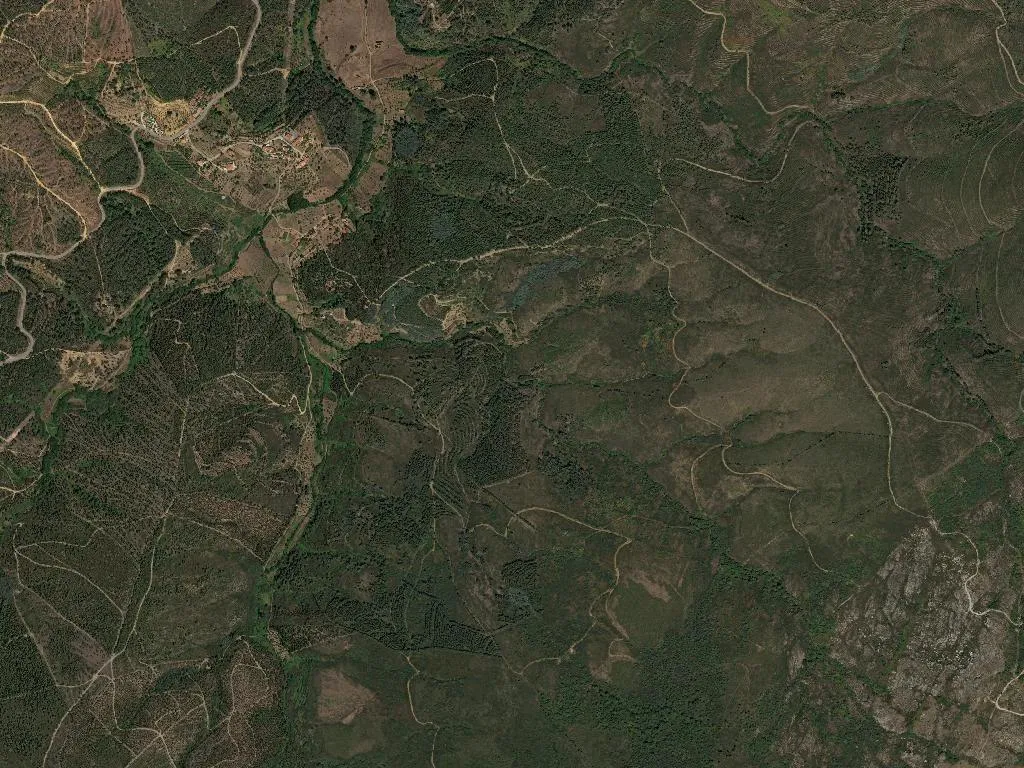
The wind combs through Souto da Casa at 612 m, scoring the air with the dry creak of chestnut boughs. Each gust writes a new line across the slopes of the Beira Interior, where April’s blossom snows on the orchards, summer chlorophyll deepens to bottle-green, and October’s spiny burrs split to reveal the polished mahogany of the nuts. Spread over almost 3,000 ha of terraces, streamlets and secretive valleys, the parish moves to a calendar older than any map.
The name itself is a deed of ownership: souto – a stand of chestnuts – and casa – the manor house that still surveys the modest parish church. No charter records the moment of birth; instead, the scatter of hamlets speaks of centuries spent negotiating gradient and season. No battlements rose here, no decisive charges were ever sounded. History is measured in grafts, compost heaps and the dry-stone walls that shoulder the hillsides.
A quieter Santiago
Unheralded, the Via Lusitana – Portugal’s interior branch of the Camino de Santiago – slips through the parish on farm tracks. Way-marked but hardly trodden, it delivers hikers to a soundscape of boots on packed clay and, somewhere below the next bend, water murmuring over schist. Pilgrims arrive unhurried; the village, still only 746 souls, has no souvenir stalls to alter their stride. Footprints here are light, and the memory they carry out is largely their own.
Altitude on the tongue
Chestnuts appear at every meal – boiled with cabbage and pork rib, puréed into soup, or crushed into the flour that thickens tigelada, a set custard scented with lemon peel. Altitude and the 20-degree day-night swing give the Cova da Beira cherries and apples a condensed sweetness, while Beira Baixa DOP olive oil lends grass-pepper notes to kid stew, slow-roasted until the meat sighs from the bone. After the first autumn rains, wild mushrooms push up beneath the chestnut litter and are folded into stews with smoke-cured sausages. Tables are laid with coarse pottery; wood smoke perfumes jumpers and conversation alike.
Gardunha’s blue shadow
Five kilometres south, the Serra da Gardunha rises to 1,223 m, its quartzite spine cooling the air even in August. No official viewpoints intrude: you simply pause where the orchard ends and the Atlantic breeze lifts your hair. Below, invisible streams sketch the topography in whispers, feeding the Ribeira de Alcongosta that slides towards Fundão. Walkers who follow the old mule paths between terraces are rewarded with a sudden widening of horizon – the Tagus valley unfurling like a parchment.
Population 746, presence infinite
There is only one registered guesthouse, and the arithmetic is stark: 243 pensioners, 73 children. Yet the orchards still fruit, the olive press keeps its DOP seal, and the Camino delivers the occasional outside gaze. At dusk, when oblique light ignites the chestnut canopy and hearth smoke stitches the sky, Souto da Casa needs no stage directions. Its theatre is the turning year, and the audience is whoever happens to be listening to the chestnuts write their slow, deliberate script across the ridge.