Full article about Ladoeiro: paprika walls & almond-mist gorges
Dawn ignites schist houses, eagles circle over shale gorges, 500-million-year stones whisper.
Hide article Read full article
Morning in ochre
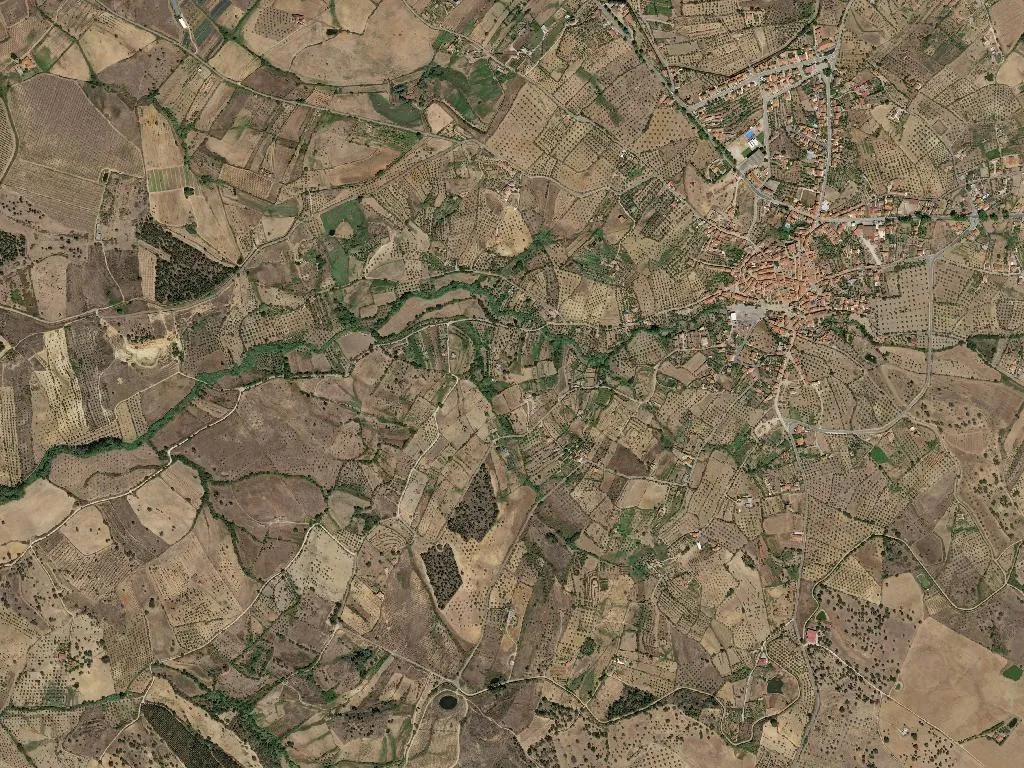
The rising sun strikes Ladoeiro’s schist walls and turns them the colour of smoked paprika. At this hour the village is so quiet you can hear the cork oaks stirring on the ridge above – a soft, papery rustle like someone turning the page of an old book. Only 1,053 people are scattered across six thousand hectares, yet the land feels inhabited rather than empty; every house keeps a courteous distance from its neighbour, every path allows you to think while you walk.
Between the Tagus and Spain
Ladoeiro sits on the eastern lip of Idanha-a-Nova, squeezed between the River Erges and the Spanish province of Cáceres. Both waterways – the Erges and the grander Tagus just beyond – are protected as the Tejo Internacional Natural Park, a craggy amphitheatre of Mediterranean scrub where Bonelli’s eagles ride thermals above beds of Ordovician shale. The entire parish lies inside the Naturtejo UNESCO Global Geopark; roadside cuts expose 500-million-year-old turbidites, and the granite outcrops carry flecks of tin and tungsten that once fed Roman furnaces.
Walking tracks drop from the village to the Erges gorge in forty minutes. In late April the opposite bank is a drift of white almond blossom that looks, from a distance, like river mist. Closer up you notice bee-eaters arrowing over the water, their wings the same turquoise as the glazed border on a Hispano-Moorish plate.
Stone, lime and belief
The parish church of São Miguel, started in the 1520s and finished a century later, mixes Manueline knots with baroque swagger. Its pale limestone blocks stand out against the charcoal schist around the square, and the walls are thick enough to keep the interior ten degrees cooler than the street outside. On Sundays the thurible releases a ribbon of incense that mingles with the smell of bread being carried from the communal bakery for the offertory.
Two smaller chapels punctuate the outlying fields. At São Sebastião the key is kept by a farmer whose family have held the office since 1897; when processions still wove through the maize plots each July, he would unlock the door so the statue could be carried out to bless the crop. Granite granaries raised on mushroom-shaped stilts recall the time when corn, not olives, paid the rent.
Tastes of altitude
Wood-fired kid is the weekend anthem here. The meat comes from Beira IGP goats that graze the broom-covered hills; rubbed only with coarse salt, garlic and a thread of Beira Baixa DOP olive oil, it emerges from the bread oven with glass-crisp skin and a centre the colour of pale rosé. While the meat rests, slices of peppery morcela and country chorizo appear from a smokehouse scented with strawberry-tree wood. The sheep’s-cheese that follows is straw-yellow and strong enough to stand up to corn bread still warm from the oven at São João do Peso, fired every Saturday and sold out by noon.
Spring brings migas – breadcrumbs sautéd with wild asparagus – and a faintly coastal dog-fish soup, a reminder that fish wagons once rattled up from Lisbon before the railway gave up on these hills. Wines are high-altitude Beira Interior reds: tense, graphite-scented, built for goat rather than the sea. When the white is good it tastes of arbutus berry and hot stone – the scent that rises from the scrub at dusk when the day’s heat finally lets go.
September’s cadence
The feast of São Miguel, on the last weekend of September, still follows a script little changed since the 1700s. After high mass the statue is shouldered through the main street, past houses hung with bed-sheet banners embroidered in gold thread. In the churchyard women ladle out sweet-potato doughnuts and plastic cups of rough red that leave violet tears on the concrete. Elderly men sing desafios – improvised ten-line verses that mock the neighbouring village for its thin olive yield or its mayor’s new tractor. At dusk the priest walks the boundary of the churchyard swinging a censer of myrrh, and the bell strikes nine times against the open plateau.
That same bell tolls the passing of parishioners – three slow strokes for a child, nine for an elder, a code everyone understands. Between sounds the village returns to its wide, deliberate silence, the kind that makes visitors conscious of their own footsteps on the loose schist. It is this balance – sound, hush, and the sense that the land will outlast every story told about it – that defines Ladoeiro more accurately than any guidebook map.