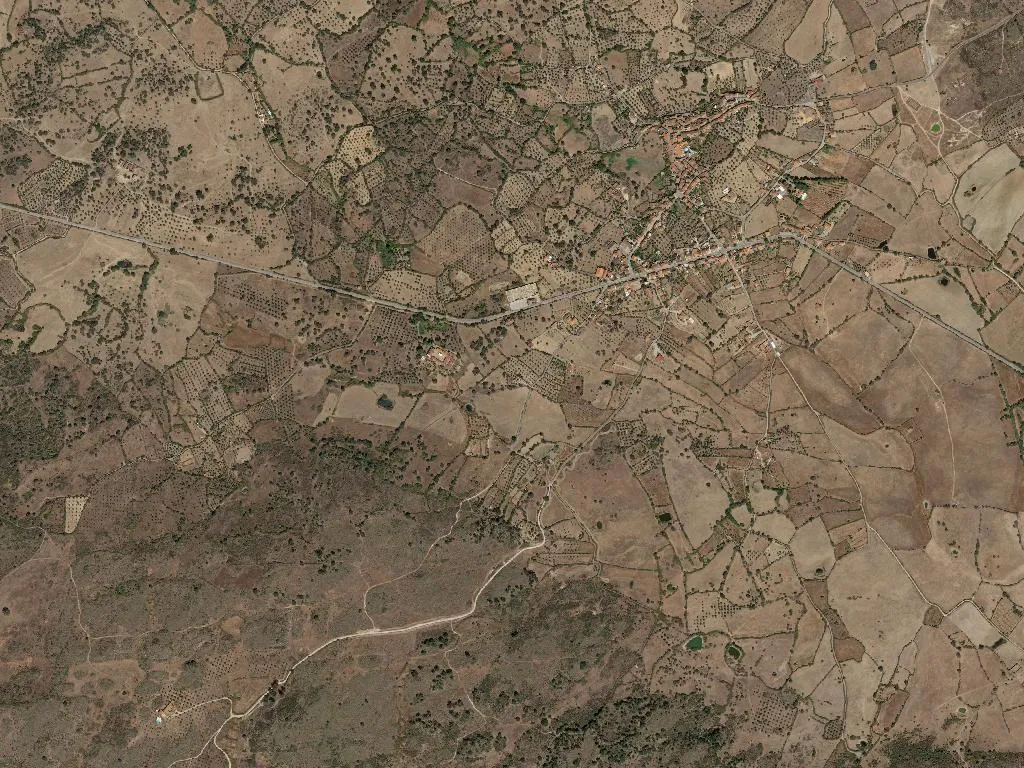
Full article about Oledo: Beira Baixa village where granite breathes
Sparrow song drifts past stone granaries, woodsmoke and 16th-century chapels in Idanha-a-Nova
Hide article Read full article
Granite, Woodsmoke, Sparrows
Dawn scrapes the plateau with the mildness of bathwater. In Oledo, silence is not absence but occupation: a sparrow practising arpeggios on a schist roof, a wooden door whose grain has been sculpted by 300 winters, a distant stream rehearsing its final aria for the Tagus. At 346 m above sea-level, Beira Baixa inhales, holds the breath, releases it slowly. Stone houses grip the slope like spectators who arrived early and never left; a plume of fireplace smoke rises ruler-straight, chalk on blue slate.
Stone & Ceremony
The parish church of São Miguel stands dead-centre, whitewashed façade murmuring rather than shouting its Baroque credentials. Inside, light slips through chiselled gaps and throws slow-motion shadows across lime-washed walls – a projection of centuries in real time. On the nearest weekend to 29 September the feast-day procession unspools at agricultural pace: heels on uneven cobbles, plainchant ricocheting between house fronts, beeswax and incense braided with the scent of turned earth. A smaller shrine, the sixteenth-century Capela de São Sebastião, stores the vows sworn before doctors were a phone call away. Around both, granite and timber granaries punctuate the fields like commas in a sentence that refuses to end.
What the ground gives back
Cooking here is geography tasted. IGP Cabrito da Beira kid, wood-oven roasted, arrives with skin that crackles like thin ice and flesh that sighs off the fork. Chanfana – goat stewed in Beira Interior red until the wine becomes sauce and the sauce becomes memory – smells of clove, bay and long Sunday afternoons. DOP Beira Interior olive oil floods warm corn-and-olive-oil cake, while filhós (winter fritters) wait their turn under drifts of sugar and cinnamon. Dessert is a cloud of sheep’s-milk requeijão drizzled with heather honey, the flavour equivalent of the bees that still detour through village gardens.
Geopark territory
Oledo lies inside Naturtejo, a UNESCO Global Geopark, and the ground beneath your boots keeps Paleozoic secrets. Schist and quartzite ridges pre-date any tavern anecdote; silver-green olive terraces and unhurried pastures look as if someone pressed pause when grandfathers still rode to market on mules. The International Tagus Natural Park begins just downslope; griffon vultures ride thermals in imperial circles, proprietors of the sky. In the smaller ribeiras, water slides over pebbles polished to eggs, reflecting the heavens like a travelling mirror – the place villagers still fetch from when August pipes run dry.
Walking the visible, hearing the invisible
With 284 souls across 27.7 km², population density is ten humans per square kilometre – more livestock than neighbours. Emptiness, though, is the wrong word. Space is what you get: room to hear your own footfall dissolve into moss, to feel morning dew surrender to granite warmth soon after noon. Trails crest into Tagus overlooks where light performs its three daily colour changes – amber, bone, bruised violet – a matinee without tickets or queues.
When the church bell strikes six, the note rolls across the plateau unhindered, skimming olive crowns and settling on schist roofs like a bird returning to roost. That echo – concrete, repeated, generation-proof – is what lingers after the road turns away. A daily, reliable “see you tomorrow” spoken to a neighbour who has already gone inside to light the evening fire.