Full article about São Miguel de Acha
Trilobite fossils, granite trails and peppery oil in Idanha-a-Nova’s near-empty parish
Hide article Read full article
A Late Afternoon Light on the Granite Walls
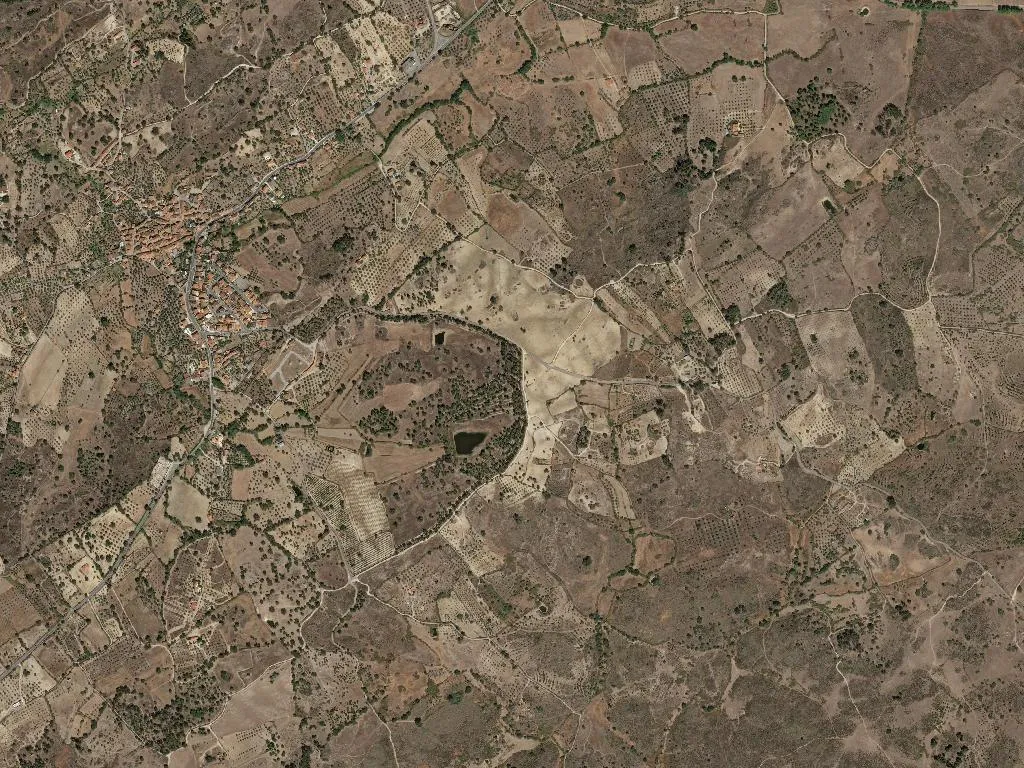
The low sun turns the cork trunks copper and the hush is so complete that every footfall on fallen leaves sounds amplified. In São Miguel de Acha’s 43 km², twelve residents per square kilometre leave enough space between houses that you measure the gaps in walking minutes and the horizon stays unobstructed. Grazing land unfurls towards the smooth ridges that define this north-eastern corner of Idanha-a-Nova, the district of Castelo Branco pressed gently against the Spanish border.
Stories Etched in Stone
Since 2000 the parish has sat inside the Tejo Internacional Natural Park; six years later it became part of the UNESCO-designated Naturtejo Geopark. The reason is underfoot: 380-million-year-old Devonian strata that record equatorial seas where trilobites scuttled. Pick up a slab on the footpaths of the Serra de São Miguel and you may find their calcified armour. The plateau’s modest elevation—400 m—creates a pocket of heat just long enough for olives and vines to prosper without irrigation, giving the landscape its open, almost African feel.
Olive Oil, Kid and High-Altitude Wine
Cooking here begins with what the land can carry. Olives of the Galega variety, fleshy and sharp, are pressed in Idanha-a-Nova’s cooperative mill, stone-walled since 1954, producing peppery DOP oils labelled Beira Alta or Beira Baixa. The same pastures support the IGP kid that appears at the town-hall feast each July—slow-roasted until the meat parts at the merest threat of a fork—and Carnalentejana DOP beef from tan-coloured cattle that still graze the oak scrub. Bottles from the Beira Interior wine region—whether tight-grained white Siria or floral red Touriga Nacional—carry the tension that granitic soils and 400 m of altitude give: a cool streak under the Alentejo heat.
Trails Where the Wind Talks Back
Walk the old shepherd routes and you share thermals with Egyptian vultures and hear the short-winged eagle’s whistle slicing the air. Dry-stone walls of schist corral nothing more urgent than sheep; the ridge gives out a hawk’s view of the Tejo valley widening into Spain. After dark the absence of light pollution turns the sky into a planetarium—Cygnus and Pegasus sharp enough to cast faint shadows on the meadows.
The Geography of Absence
Census 2021 counted 514 souls, 259 of them over sixty-five, 38 under fifteen. No public festival has been logged since 2010; the houses are too scattered, the population too thin. The origin of “Acha” is itself uncertain: a 1758 parish priest proposed Latin “acta” (records), yet the name already appeared as “Achas” in 1220. Classified as a “CULTURA” village—valued for landscape and food rather than monuments—it remains protected by logistics: the EN233-4 access road scores 30/40 for difficulty on the national survey, a natural deterrent to coach operators. Only three places take paying guests—Casa da Acha, Casa da Mata and Quinta da Serra—so silence is still the dominant currency.
The wind combs the oaks, footsteps echo on packed earth, and the territory breathes at a scale the human pulse has not yet outgrown. Stay until the granite begins to exhale the day’s heat and you understand why some maps are best read at walking speed.