Full article about Toulões: where rosemary drifts above Devonian fossils
Silent schist roofs, cork groves and goat slow-roasted in Beira smoke
Hide article Read full article
The scent arrives before the view
Rosemary hits first—dry, resinous, laced with road dust—then the land unwraps itself. A limestone lane wriggles between loose-stone walls until Toulões decides to appear: single-storey schist houses limewashed the colour of barley, roofs scaled in curved Moorish tiles mapped by moss, olive trunks corkscrewed by winters older than any living memory. At 330 m the light of Portugal’s interior drops vertically, carving granite thresholds into sharp black geometry.
Roots in the schist
The name drifts back to Latin “Tolosum”, hinting at settlement long before charters were kept—Roman, possibly Visigothic, certainly present. In the medieval checkerboard of border defence, the hamlet sat just inside the orbit of Idanha-a-Nova’s hill-top fortress, a watchpost on the old Castilian line. There are no castles here, no bell-towers for postcards—only the sediment of continuity: 226 people, 142 of them over 65, still tending the same Ordovician slate soils. Six children play in the packed-earth square—small enough to count on one hand.
Cork groves, canyons and Devonian fossils
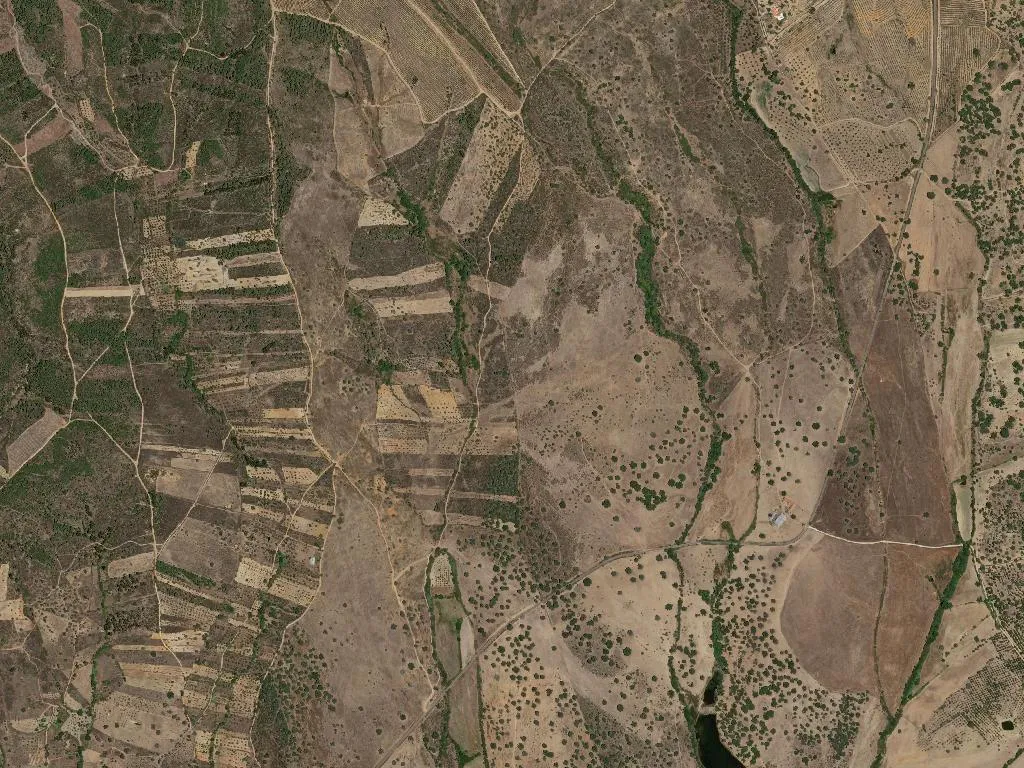
The parish spreads across 3,672 ha of cork and holm-oak montado, centenarian olive terraces and white rock-rose that flashes like chalk against the green each spring. It lies within the Tejo Internacional Natural Park where the Erges and the Taghe slice quartzite cliffs a hundred metres deep—thermal lifts for griffon vultures, ledges for shy Bonelli’s eagles. Naturtejo Geopark lists the ground itself as living heritage: Devonian fossil beds poke through the paths; 300-million-year-old Carboniferous amphibian prints record a time when this plateau was steamy swamp.
Shepherds’ trails—now signed PRs—thread Toulões to Idanha-a-Nova in two quiet hours. Density is 6.15 people per km², which translates as horizon without pylons, fenceless skylines, only the antique outline of field and tree.
At the table: Beira kid goat
Cooking here is necessity elevated to ritual. Roast IGP Beira kid spends three hours in a wood oven until the skin lacquers gold and the flesh blushes rose. In winter, chanfana—goat stewed overnight in red clay and red wine—arrives at table straight from the pot. Black-pork charcuterie darkens in an oak-smoke loft; the same carvalho flavours the linguiça and paio that emerge glossy and pungent. DOP Beira Alta olive oil, thick as late-harvest Chardonnay, sinks into warm maize bread, while plump IGP Beira Baixa Galega olives—green, fleshy, faintly bitter—sit in a chipped white bowl. Local Trincadeira–Tinta Roriz reds feel almost Nebbiolo-tannic; they demand protein and patience.
Late afternoon, sun grazing the schist sends olive shadows right up to the walls. Somewhere a wooden door slaps stone—one dry crack ricocheting across the empty square. It is the same report that has sounded for centuries, and it still defines Toulões: the discreet insistence of those who stay.