Full article about Cambas: granite silence above the Zêzere
Paleozoic crags, Galega olives and kid roast scent a village of 254 souls in Oleiros.
Hide article Read full article
Granite, wind and absence
At 457 m the air thins just enough for the breeze to carry a blade. Cambas sits on a slab of Paleozoic granite that pushes through the schist like bone through skin, its five-thousand-hectare parish scratched by gorse, holm oak and the faint silver of old olive trunks. The 2021 census records 254 souls; only four are under fourteen. You can walk the cobbled lane at school-home time and hear nothing but boot soles and the echo of a television behind a half-open shutter.
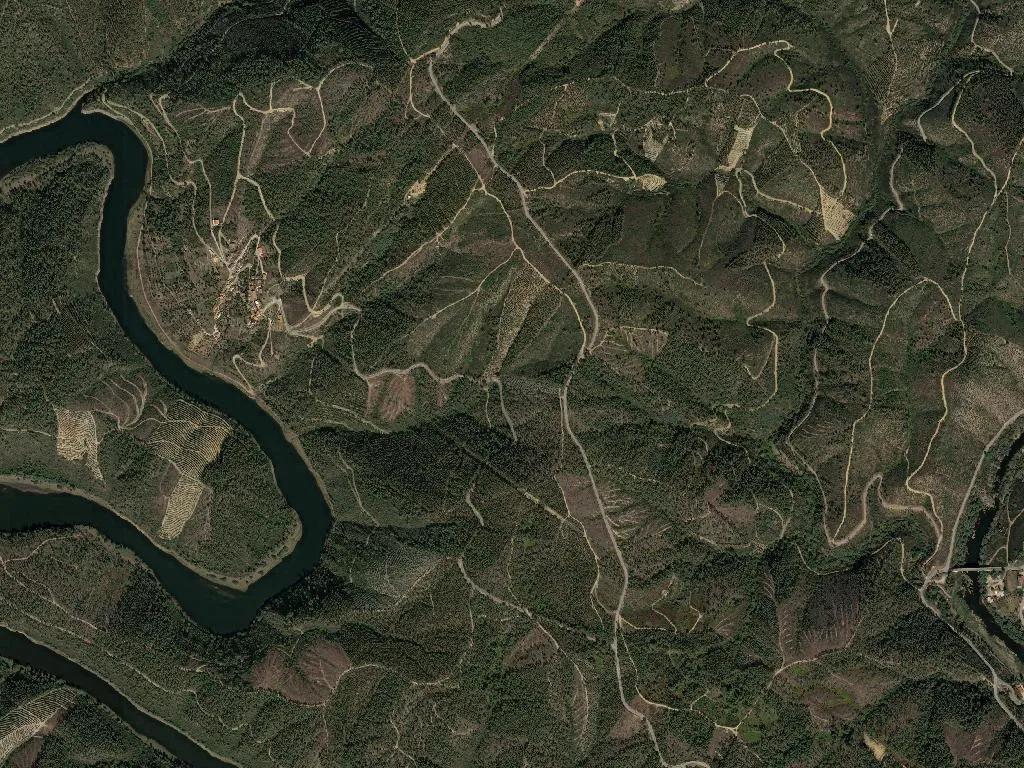
The Naturtejo Geopark – a UNESCO-braced canvas that sweeps across six municipalities – frames the village. Fossilised brachiopods are clamped inside roadside crags, souvenirs from a 400-million-year-old sea. Below, the Zêzere coils through the Garganta geomonument, its meanders so tight the river seems to tie and untie itself before reaching the Tejo.
Oil and kid
Orchards of Galega olives – the IGP-protected variety of Beira Baixa – grow low and wide, their trunks cork-screwed by decades of Atlantic storms and summer drought. Fruit is taken to the cooperative press in Oleiros where granite millstones turn at the pace of a metronome, releasing an oil with a peppery catch that lingers at the back of the throat.
Local herds of IGP Cabrito da Beira graze the same scrub, browsing rosemary, thyme and rockrose. On feast days the animal is slow-roasted in a wood-fired clay oven until the skin lacquers and the ribs retain just enough chew; it arrives at table on a terracotta dish still hissing with garlic and rendered fat.
Footfall on the Via Lusitana
The Interior Portuguese Way – a quiet branch of the Camino that slips inland from Lisbon to Santiago – crosses the parish on a farm track barely two metres wide. Yellow arrows are daubed on gateposts and granite outcrops; pilgrims meet more sheep than people. The soundtrack is boots on quartz gravel, the creak of a rucksack hip-belt and, somewhere down-slope, the river sliding over slate.
Cambas offers no gift shops, no pastel-coloured facades. What it gives instead is the scrape of reality: woodsmoke at dusk, a sky so dark the Milky Way looks wet, the ache in your calves when the track tilts skyward and the knowledge that somewhere still exists where dinner is dictated by the season and the door latch is lifted by hands shaped to it over generations.