Full article about Orvalho’s Dawn Drips from Pine Needles to Schist
Follow the Ribeira do Orvalho to a hidden waterfall and a granite village frozen in dew
Hide article Read full article
Dawn on the needles
A pine sighs overhead, then comes the hush of running water. It is not the roar of a river, only the low, steady syllables of the Ribeira do Orvalho as it threads through schist and moss. At first light, beads of the night’s breath still cling to every needle; only when the sun tops the ridge do they let go and fall, soft as punctuation. The parish is named after that daily drip: orvalho – dew – a climatic fact, not a literary flourish, repeated each morning since these valleys first grew a forest.
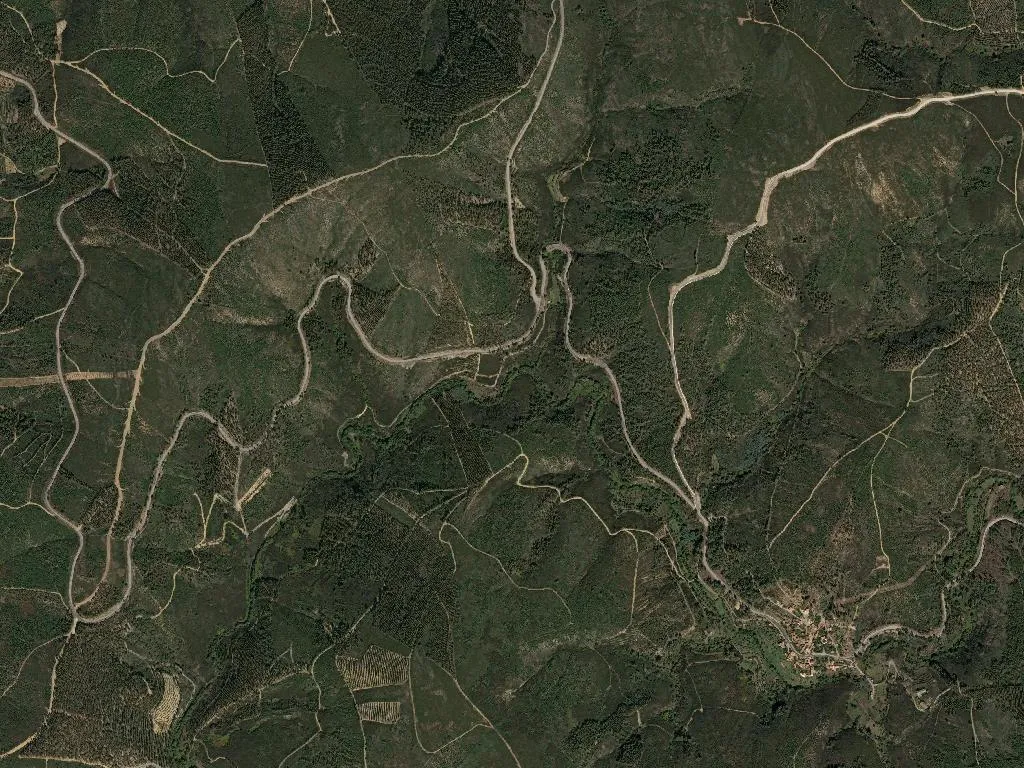
Orvalho sits at 610 m on the Beira Baixa plateau, 33 km² of creased relief where maritime pine outnumbers people. Cork oak, scattered olives and impenetrable rock-rose fill the gaps; the stream slices the territory into narrow corrugations. Where it drops 25 m in three quick steps it forms the Fraga de Água d’Alta waterfall, a curtain of water hidden inside a green amphitheatre of ferns. No river-beach cafés, no ticket office – only the smell of wet stone warming under pine shade and the sound of water striking slate.
The old kernel and a tower that keeps time
The settlement coagulated in the fifteenth century around the granite portico of São Bartolomeu. Inside, a gilt-less altarpiece carved from dark oak still carries the original tempera reds. Opposite, the bell-tower rises sheer from Largo Nossa Senhora de Fátima, its whitewash blinding against terracotta roofs. Between the two monuments runs a short street of manor houses – armorial blocks eroded by wind, sash windows the colour of North-Sea petrol, doors that groan on hand-forged hinges. From the nearby belvedere of Cabeço do Mosqueiro the view stacks successive ridges of pine until the Serra da Estrela floats up like a paper cut-out. The Tour of Portugal flew past this parapet in 2022, awarding Orvalho a third-category mountain prime; for twenty minutes television helicopters thudded above the chimneys, then the silence re-inflated.
Flax, loom, hands that remember
There is no procession with brass bands, no fireworks in mid-August. What survives is subtler: the whisk of linen being woven. In winter, wood-framed looms are carried into the only heated room of the house; women in their seventies beat weft across warp, producing raw-flax towels, kitchen cloths and sheets wide enough for a marriage bed. The shuttle clacks in a minor key; beeswax keeps the thread from snapping. Maria de Lurdes, number 14 Rua da Igreja, will unlatch the door if you knock before five, happy to let you finger the rolls of cloth that smell of cedar and old iron.
Galician olives and kid roasted clay-pot slow
The kitchen larder is governed by IGP labels. Galician table olives – firm, jade-green – arrive with corn-bread still steaming from wood ovens. The new olive oil, thick and peppery, stains cabbage-and-bean soup a glossy bronze. Kid goat, certified Beira IGP, is either blistered in a brick oven or stewed in a black clay pot with garlic and sweet paprika. Black-pork charcuterie seasons in smoke-blackened attics; ewe’s cheese hardens on deal shelves; curds drain in muslin until they collapse into requeijão. Sunday breakfast at Café Central pairs filter coffee with a copper-pot quince jam made by the proprietor’s wife. Ask for a bolo de ferradura – a buttery spiral that flakes like mille-feuille – or walnut biscuits that dissolve into sandy crumbs on the tongue.
A branch of the Interior Way
The lesser-known Caminho Interior de Santiago – the Via Lusitana – cuts straight through the village. Pilgrims appear at twilight, rucksacks powdered with quartz dust, boots leaving perfect prints on the damp calçada. There is no municipal albergue; knock at the parish council and you will be directed to Dona Alda who rents a spare room and bakes a sponge cake for breakfast. Night noise is restricted to wind combing the pines and the occasional dog reminding the valley it is still awake. Without light pollution the Milky Way lies overhead like spilled sugar; older residents still call it o caminho de São Tiago, Santiago’s road.
When you leave, what lingers is the creak of a loom in a darkened sitting room, the resinous tang of pine smoke at dusk, footfalls echoing in an empty square – and, come every dawn, the same cold dew sliding off the needles to wet the stones before the sun has time to dry them.