Full article about Benquerença: the village ants forced into being
Stone lanes, fire-ant lore and a concrete church float above Penamacor’s silent sierra
Hide article Read full article
Morning in the village that ants built
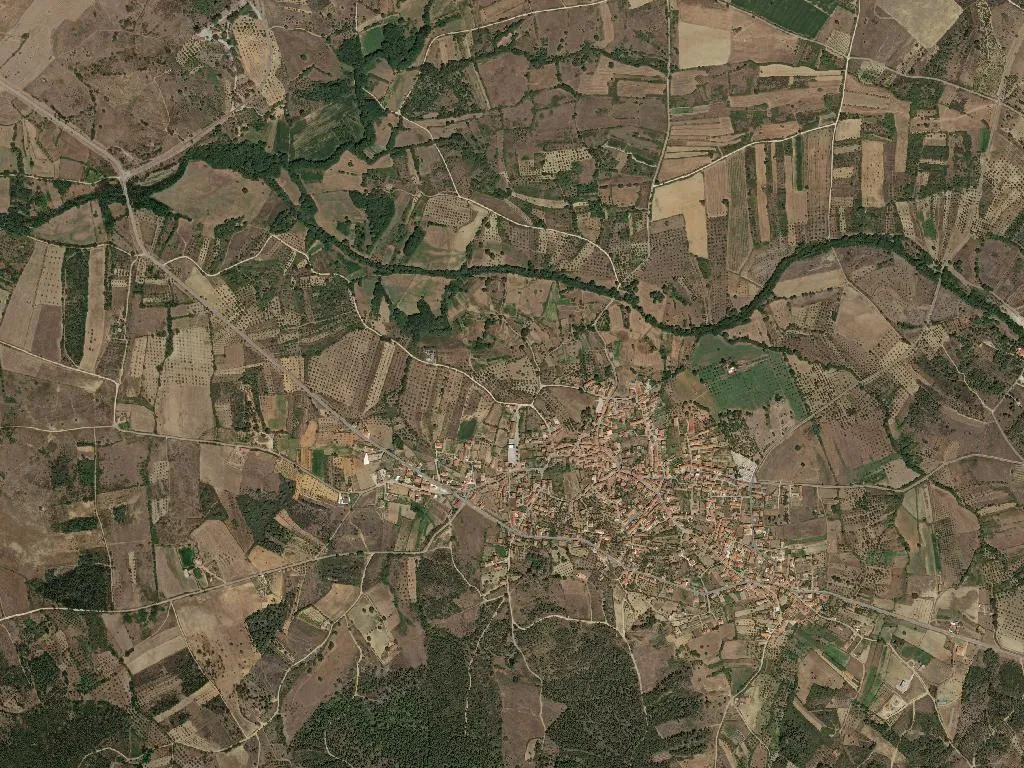
Woodsmoke and damp schist drift through lanes barely wide enough for a donkey. At 461 m above sea level, Benquerença’s wrought-iron balconies throw lattice shadows across the granite setts, shifting by the minute as the sun climbs over the Serra da Malcata. A single door thuds shut; a dog gives one business-like bark. Nothing else. Halfway between Penamacor and the Spanish ridge, the village counts 463 souls—and its origin story reads like folklore drafted by a tax inspector.
When fire ants rewrote the map
Until the 1620s the place didn’t exist. Three separate hamlets—Aldeia Velha, Aldeia Nova and Outrelo—plus a lone manor called Benquerença grazed this upland. Then the red fire ant arrived. Parish minutes from 1623 record “creatures that gnaw the eyes of children”; by 1630 the settlements were empty. Forty-seven families regrouped 300 m south of today’s Senhora da Quebrada chapel, around the manor’s reliable spring. A royal charter of 1634 baptises the new conglomerate “Benquerença”—Portuguese for “good neighbourliness”—a rare case of an insect driving urban planning.
Modernism among the olive groves
You expect schist and slate; you get reinforced concrete and a floating bell tower. Nuno Teotónio Pereira—later co-designer of Lisbon’s underground—finished the parish church in 1957, replacing a 14th-century chapel. Inside, his walnut Stations of the Cross and an oak Crucifix earned an honourable mention at the 1965 São Paulo Art Biennial. Fifty metres away, a 1774 stone cross still bears the inscription: “This cross was erected by devotion of all parishioners.”
The communal olive press (1892) keeps its original granite trough and wooden screw; the chapel of Senhora da Quebrada commemorates the locust swarm of July 1900—“after the procession of 15 August, not one locust remained.” Festa da Senhora da Quebrada follows Ascension Sunday; Nossa Senhora das Neves is feted on 5 August with a boys’ bonfire and a torch-lit procession carrying the statue to every street corner.
Sulphur springs and a three-metre cascade
Eight hundred metres downstream, the river-beach “O Moinho” occupies the wheel-house of a mill retired in 1954. The pool stays at 18 °C even in August, fed by a São Facundo brook waterfall just high enough for a jump. Since 1981 the parish has lain within the 231-ha buffer zone of the Serra da Malcata Nature Reserve—think Iberian lynx territory, though the cats keep to themselves.
Beside the chapel, a thermal spring gushes at 32 °C. An eighteenth-century report promises it “cures the stone” (kidney gravel). The Benquerença Water Company, floated in 1923, never bottled a drop; the water still spills, rich in 2.3 mg/L sulphur, the only such source in Portugal’s interior.
Dusk ignites the church’s whitewash. Behind the apse, where the manor once sheltered families fleeing ants, wind combs the silver leaves of thousand-year-old olives. Benquerença remains what panic and solidarity created: a village that chose congregation over dispersion.