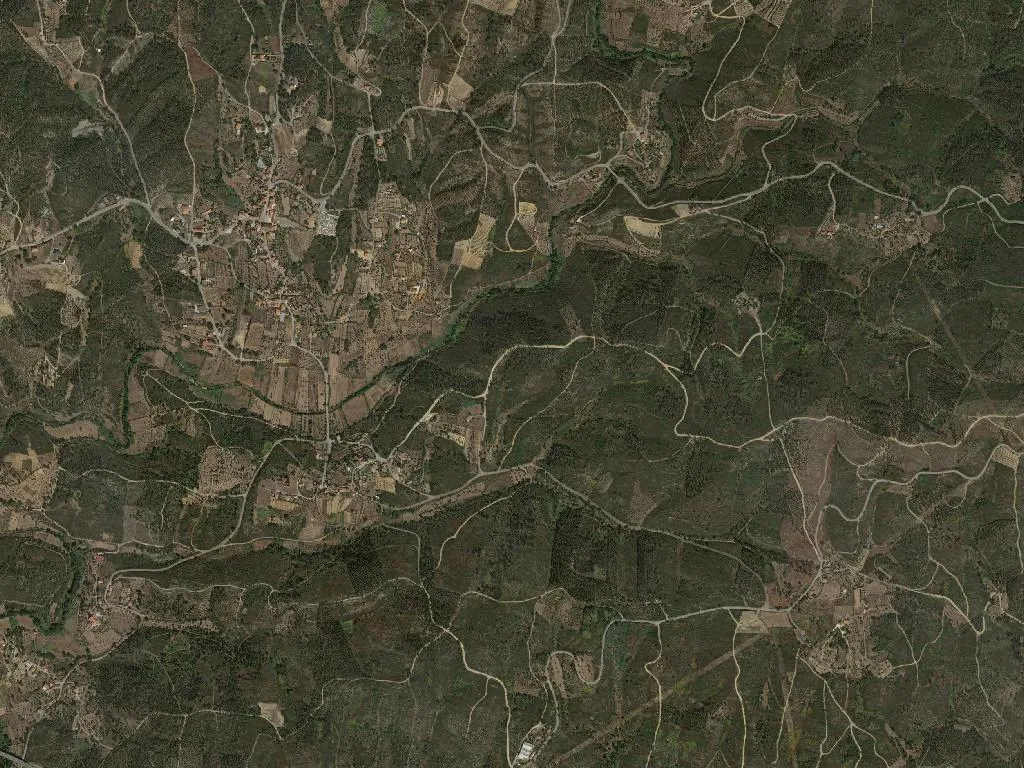
Full article about Várzea dos Cavaleiros
Knights once clashed on this Sertã flood-plain; today oak smoke curls past stone chapels and black-s
Hide article Read full article
The parish bell tolls three times. Its echo slides down the valley until it meets the Tamolha stream, where water rushes between slabs of black slate. Dawn in Várzea dos Cavaleiros smells of wet earth and oak-kindled smoke—someone has fired up a wood oven, perhaps for maranho, perhaps only to toast yesterday’s cornbread. Above the olive terraces a pair of red kites mew, the only punctuation in a hush that feels older than the village itself.
A name won with swords
The place owes its surname to a 13th-century skirmish: knights of the Hospitaller Order routed a Castilian raiding party on this flood-plain and the land, until then simply “Várzea” (the flood-plain), acquired a rider—“of the Knights”. A Benedictine monastery rose here in the 1400s, vanished two centuries later, yet lingered long enough to baptise the hamlet of Mosteiro de S. Tiago. Inside its tiny chapel a slate gravestone records a land grant signed by the same military order that gave the parish its fighting name. Population followed the Reconquista footprint; the parish later became a commandery of the Crato grand-priory and today belongs to the Diocese of Portalegre-Guarda.
Stone, water and small devotions
The 18th-century mother church stands austere in the village centre. Step inside and a gilded baroque retable flares against limewashed stone; 18th-century saints still occupy their niches, unmoved by centuries of processions. Local faith, however, scatters across the countryside: São Carlos in Isna de S. Carlos, São José in Maljoga, Nossa Senhora da Agonia on the Pereiro ridge—each chapel its own feast-day, each hamlet its protector. A granite bridge of the same century throws a single arch over the Tamolha, sturdy enough for modern tractors yet built for ox-carts. Downstream, ten water-mills can still be traced; some have been recuperated as weekend houses, others survive as moss-cushioned walls of stacked schist.
What arrives on the table
Maranho da Sertã IGP is not a literary flourish but a parcel of goat-rice-mint stuffing sewn into lamb stomach and oven-roasted until the skin crackles. Kid goat—Cabrito da Beira IGP—appears either stewed or slow-roasted, served with wilted potatoes and a thread of Beira Interior DOP olive oil pressed from local galega olives between October and December. Soups are substantial: dogfish thickened with dark rye bread. Smoked charcuterie—wine-laced chouriço, flour-bound farinheira, cumin-scented blood pudding—hangs in kitchen chimneys. Finish with pumpkin jam studded with pine nuts and a thimbleful of medronho or orange-peel firewater, distilled in copper stills behind the barn.
Trails, streams and passing pilgrims
The Tamolha Stream Loop strings together eight kilometres of water-mills, irrigation leats and schist slabs where holm oaks and cork trees grow at wind-slanted angles. The trail lies inside the Naturtejo / Serra da Estrela Natura 2000 site; at first light it belongs to red kites, white storks and little owls. Cave-dwelling bats roost in the Corga do Moinho gallery. Walkers often meet pilgrims too: the Interior Way of St James—Caminho Interior de Santiago—crosses the parish on a medieval cobbled stretch, a reminder that Europe once moved on foot.
A calendar that still turns
29 June: St Peter, parish patron, is paraded through the streets followed by a fair, fireworks and concertina reels. Easter Sunday: the Compasso choir visits every house with sung blessings. August: locals tramp the three kilometres to Mosteiro de S. Tiago for an overnight vigil, reviving a devotion first noted in 1470. Christmas: living nativities occupy the village squares. Epiphany: the Three Kings go door-to-door with song sheets and sherbet. Shrove Tuesday ends with tin-masked caretos rattling off satirical verses that still make grandmothers laugh.
The scent of new olive oil—green, viscous, clinging to skin and shirt—announces harvest season. Once smelled, it becomes a passport: you will always know when you are back in Várzea dos Cavaleiros.