Full article about Anobra: where olive streamwater whispers 800 years
Low-lying schist lanes, Roman echoes, camino footfall, church bells over olive groves
Hide article Read full article
A stream that remembers everything
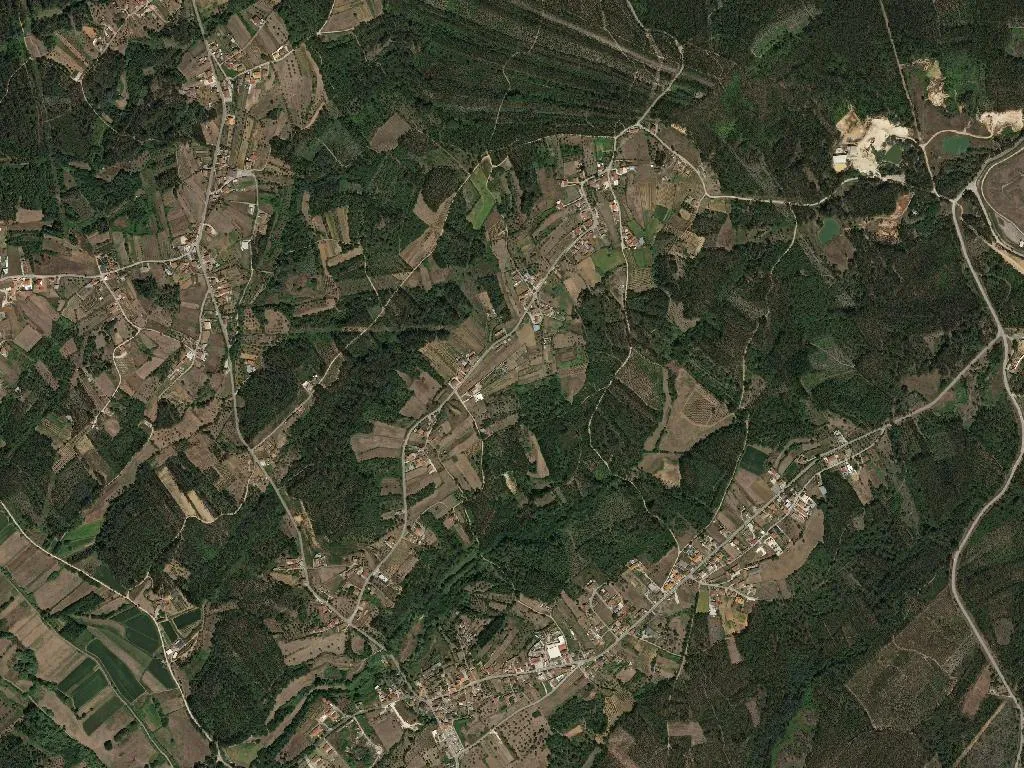
Dawn hesitates over Anobra. The little stream slides between olive groves, releasing the scent of wet schist, while church bells ring white against a Beira Litoral sky that can’t decide if it is pewter or pale limestone. Pilgrims on the Central Portuguese Camino shuffle past, rucksacks swaying like pendulums counting down the kilometres to Santiago. At only 56 m above sea level the land rolls instead of rushes; nothing here competes for your attention, yet the ground feels deliberate, as if it has already watched eight centuries pass and is in no hurry to surrender the memory.
Three charters, no town status
The place first appears in 1086 as “Anlubria villa”, the suffix –briga betraying a pre-Roman hill-fort culture that once ringed northern Portugal. Royal charters arrived twice from Afonso III (1271, 1275) and once from Manuel I in 1514, yet Anobra never graduated to full “vila” or municipal seat. It remained legally tethered to Coimbra, an anomaly that shaped a collective temperament: acknowledged, even favoured, but happy to stand just outside the circles of power. The parish church, a longitudinal block of whitewashed stone with a tiled two-slope nave and three-slope chancel, is listed by the state for its sober Romanesque bones. Along the lanes, granite milestones still mark distances to long-forgotten fairs, quiet reminders that traffic once thickened here.
The mason who carried limestone to Lisbon
João de Anobra, a 16th-century stonemason, left his fingerprints on Belém’s Jerónimos Monastery. Local heraldry honours him with a single column shaft—an emblem of a man who learnt to read grain in schist but earned his living carving lioz limestone 200 km south. He is the exception: Anobra produces few headline names, preferring incremental craftsmen—wall-builders who balance field stone without mortar, bakers who slide dough into wood ovens before the cockerel imagines daylight.
Goat stew, egg sweets and olive oil you can pour on toast
The kitchen draws from vegetable plots, cork oak meadows and the grey-green olive terraces that dapple the parish. Chanfana—goat slow-simmered in black clay with red wine, garlic and mountain herbs—tastes of smoke and Sunday patience. Winter evenings belong to lamb stew thickened with bread; summer lunches to tomato soup with a poached egg sliding across the surface like a small sun. On feast days the pastry trays fill with pastéis de Santa Clara (frilly-edged custard tarts), velhoses de ovos (citrusy egg cakes) and cavacas de Lameira, a brittle sugar shell that shatters between the fingers. Virgin olive oil, cold-pressed in the cooperative, is sold in unlabelled bottles at the Saturday pop-up market; pour it over toasted village bread, add a pinch of salt, and you understand why locals keep a second bottle by the stove. Drop into Pastelaria O Pingo Doce—yes, that really is its name—and ask for bolinhos de amor, the doughnut-sized cousins of the Berliner minus the jam. Sixty cents each; eat two.
Paul de Arzila: water, quiet, wings
North of the settlement the Paul de Arzila wetland spreads like a secret delta. Spoonbills, purple herons and the occasional greater flamingo wade through shallows no deeper than an ankle boot. A raised wooden hide lets you watch without trespassing; arrive before ten o’clock or cycling groups flush the birds into sudden commas of flight. Bring binoculars—even the scratched pair from the glove box—and sit on the bench until the only sounds are wing beats and reeds brushing shinbones. The Aljez stream, a Mondego tributary, threads between rock-rose scrub and small riverside vineyards; farm tracks double as footpaths and splice into the Camino as it crosses the hamlets of Lameira de Cima and Caneira.
Evenings, drums and living memory
Founded in 2014, the local ethnographic group is staffed by weekday electricians, nurses and supermarket cashiers who swap uniforms for hand-woven waistcoats on Saturday rehearsals. They revive call-and-response songs, wheel dances and the art of weaving straw into donkey saddles. Evening conversation still turns on phrases such as “vai comer pedra” (“it’ll eat stone”—cold coming) or “dia de São Lucas” (sun and rain taking turns). The Assumption procession on 15 August is the annual homecoming: flights are booked from Paris, Stuttgart, Newark. Mass in the open starts at nine, but the real liturgy is the night-time arraial when Jerónimo’s cellar wine meets Celeste’s sarrabulho rice, a pork-blood dish no one has ever successfully reverse-engineered. Through the year drum corps and rusga bands tramp between Lameira, Caneira and Casal da Amieira; the primary-school-turned-rehearsal-hall leaks syncopated thuds you can follow like bread-crumbs. Population: 1,249, more over-70s than under-18s, yet tradition is still transferred mouth to mouth, like a candle that refuses to gutter.
When dusk settles, wood smoke climbs the lanes and the clop of a single pair of hooves ricochets between stone walls. Anobra offers no spectacle, only equilibrium: the exact weight of schist, the unembellished flavour of chanfana, and, above the reeds, the soundless glide of a heron deciding where memory ends and night begins.