Full article about Furadouro: bell-echoes over limestone terraces
Above Coimbra’s ridge, schist lanes lead to spring water, wheat stairs and a silence you can almost
Hide article Read full article
The Weight of Quiet
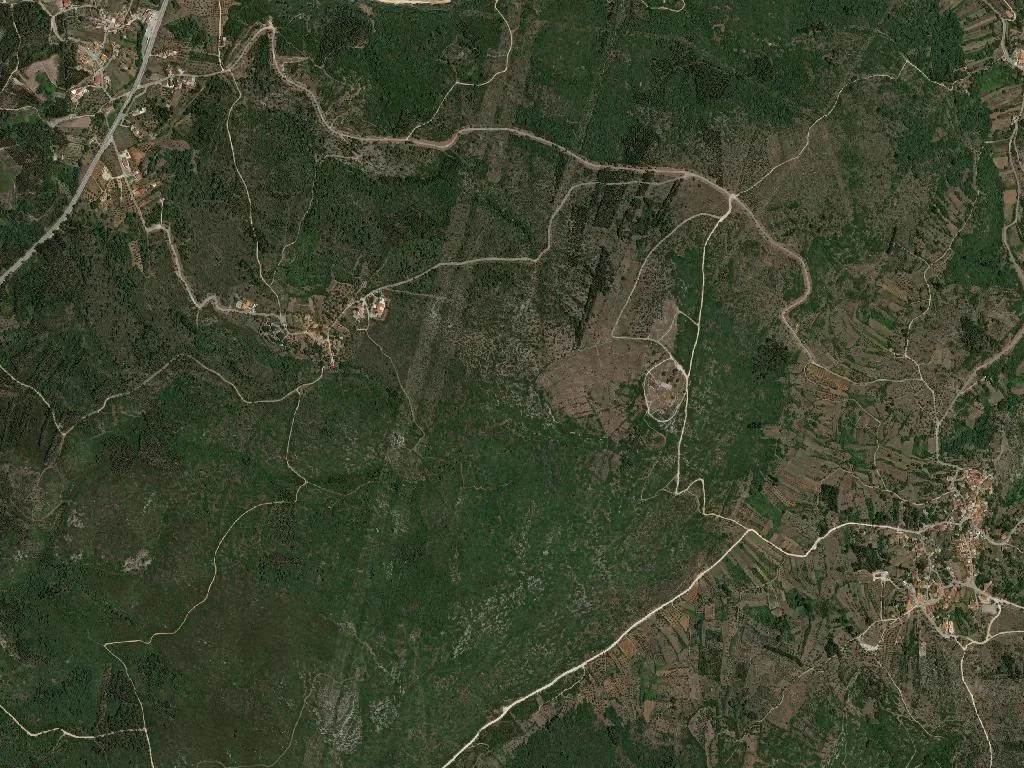
Silence here has mass. It is not the absence of noise but the presence of wind that climbs the São Miguel streambed, the distant creak of an iron gate at the Matos estate, the bell in the unseen tower of S. Sebastião counting the hour everyone hears. Furadouro sits on schist and limestone at 340 m, where the air thins and the chill of the Sicó ridge slips into autumn afternoons long before sunset. One-hundred-and-eighty-three people share 1,436 hectares – numbers that translate into elbow-room, long sight-lines, the luxury of distance.
On the Pilgrims’ Slant
Two Santiago routes knife across the parish: the Central Portuguese and the lesser-known Torres Way. Yellow arrows daubed on granite walls point walkers west, yet few tarry. Some pause to refill bottles at the spring on Rua da Igreja; others lean into the shade of Nossa Senhora da Conceição’s chapel. At noon the white limestone throws light back like a blade; at dusk it glows like bread cooling on a hearth.
The land arranges itself in terraces – irregular staircases of wheat and rye, holm-oak and stone-pine clumps holding the horizon like full stops. Limestone dictates the grammar: olive trunks corkscrewed by drought, fig trees levering cracks in bedrock, dry-stone walls that meander rather than march. There is no coastal geometry here; every field answers to slope, to the stream’s stubborn choice of course.
Vertical Time
Sixty-six residents are over sixty-five; twenty-three are under fourteen. The inverted pyramid is familiar to rural Portugal, yet Furadouro refuses hollowed-out abandonment. Smoke still rises from chimneys, vegetable plots are banked and hoed, paths are scythed clear. A density of 12.7 souls per km² becomes measurable distance: a five-minute walk to the nearest neighbour, the church bell a full second late to the last house on Rua do Cabeço.
Granite thresholds dip in the centre, polished by generations of clogs. North-facing roof-tiles accrue moss in graduated lichen stripes. When dusk settles and wind drops, hearth-smoke climbs straight up – a plumb-line forecasting frost.
Geography of the Essential
There are no ticketed monuments, no glossy leaflets. Instead you get lanes where the only traffic is a 1979 Bedford tractor or a mastiff that barks once, then sulks. Altitude grants Furadouro a climate of its own – neither mountain nor plain, but a hinge where seasons click audibly into place: January’s razor cold, August’s dry heat that splits the topsoil, March’s sudden emerald after the first steady rain.
Walking here is physical grammar: calves burning on the haul to Alto do Mato, wind bracing the crest, the loam smell that rises after September’s first downpour. Nothing more – and nothing less.