Full article about Lavos: Where the Atlantic Writes on Sand
Lavos, Figueira da Foz, offers empty Costa sands, a 1743 church risen from dunes, and nightly xávega net hauls unchanged for centuries.
Hide article Read full article
Salt wind before the sea
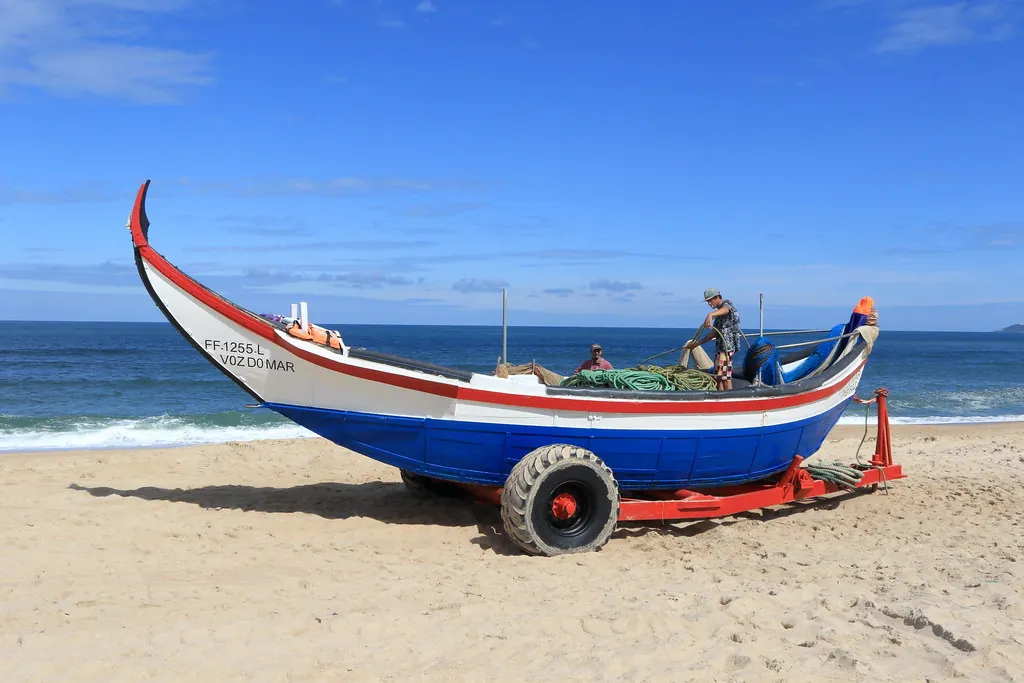
The Atlantic announces itself long before you see it. It slips through the Maritime pines planted centuries ago to fix the dunes, rattles their crowns and drags the scent of resin and brine across the road. Then the treeline fractures, sunlight floods the windscreen, and the Costa de Lavos unfurls – eleven kilometres of pale, almost empty sand hammered by unbroken rollers. No apartment blocks, no promenade, just low dunes, the dark commas of xávega nets waiting for the next tide, and gulls stitching the air with their needles.
The village the sand tried to bury
Lavos’ name remembers water – either from the Latin lavare, to wash, or from a Moorish woman called Lavi. King Afonso II raised it to town status in 1217, yet its real story is a slow-motion retreat from its own shoreline. Three times the settlement shifted inland as the dunes advanced; the current Igreja Matriz da Conceição, built in 1743, marks the last evacuation. Its lime-washed bulk sits in the geometric centre of today’s village, while its predecessors sleep somewhere beneath compacted metres of sand.
In September 1800 eight hundred redcoats of the 60th Royal Americans waded ashore here, the vanguard of what would become Wellington’s Peninsular army. Headquarters tents sprouted along the Mondego estuary while flat-bottomed boats ferried horses and nine-pounders onto the open beach. Nothing commemorates the landing today – only the geography explains the choice: a navigable river, firm sand for artillery, and a horizon wide enough to spot French pursuers.
Hand-over-hand with the tide
When moon and luck align, the xávega still goes out. A single wooden trawler arcs through the breakers, pays out a kilometre of net, then turns shoreward. What follows is part haul, part liturgy: thirty men ankle-deep in foam, hauling hand-over-hand, rhythm set by a single shout. Bystanders are expected to join. The net emerges like a dripping manuscript – flounders, sea bream, bass, and, if the Mondego is feeling generous, silver eels fattened in the river’s upper reaches. They will reappear at supper in ensopado de enguias, a clay-pot stew scented with bay and piri-piri.
Eels may be traditional, but oysters are the new arrival. Sub-tidal racks anchored just beyond the surf produce Crassostrea gigas with the faint iodine snap of pine-smoke. Order them opened to order at Rosa’s beach hut – no Tabasco, just a squeeze of lemon and a glass of chilled Bairrada brut. Inland, the same Atlantic breezes that season the oysters fatten Marinhoa cattle whose DOP-certified beef ends up in four-hour stews darkened with massa de pimentão. Festival days bring trays of walnut cakes and pastéis de feijão, the delicate bean-paste tarts that travelled south from nearby Torres Vedras two centuries ago.
Between estuary and Jurassic cliff
Lavos occupies a slim forty-square-kilometre wedge between two water worlds. Southward, the Mondego broadens into salt-marsh threaded with tidal channels where avocets and black-tailed godwits rise in nervous clouds. Northward, the Cabo Mondego headland rears up in tilted Jurassic strata – 160 million years of ammonite time pressed into limestone and shale. At low spring tide you can pick belemnites from the foreshore as easily as shell fragments.
Walk east along the beach at dusk and your footprints may be the only ones. The sand is firm enough for a steady pace; oblique light stretches dune shadows into long purple bands; the surf drowns every other sound. Pine-trunk boardwalks cut back through the forest Bonifácio de Andrade e Silva planted in the 1790s to nail the sand in place. Today the trees form a dense, dark-green tunnel, their straight red trunks ribbed like Doric columns.
Each August the Festa da Conceição pulls emigrants back from Lyon, Newark, Maputo. For three nights sardines blacken over open fires, the parish council bar serves bagaço at cost price, and a lawyer from neighbouring Buarcos plays accordion until the carousel stops. Then the village subsides into its tidal heartbeat. At dawn, autumn fog lifts off the estuary and swallows the church tower; by nine the sun has burned it away, warming the whitewash and drawing the first fishermen into António’s tavern for a second coffee laced with aguardiente. They check their phones for the surf forecast, not the news. Out beyond the breakers the nets are already laid, waiting for the next haul.