Full article about Santana: windmill plains where rye meets Atlantic pewter
Between Jurassic cliffs and rye-sway fields, the camino trades sand for soil
Hide article Read full article
The tarmac of the EN111 uncoils for twelve kilometres from the Atlantic-front promenade of Figueira da Foz, then slips onto the narrower EM596. Three kilometres later, at a modest 34 metres above sea level, the air changes: less salt, more loam. Stone walls shoulder newly hedged pasture; a windless windmill, sails removed, stands like a forgotten watchtower. Larks replace gulls, and the only soundtrack is the sweep of air across the coastal plain.
Where farmland meets ocean
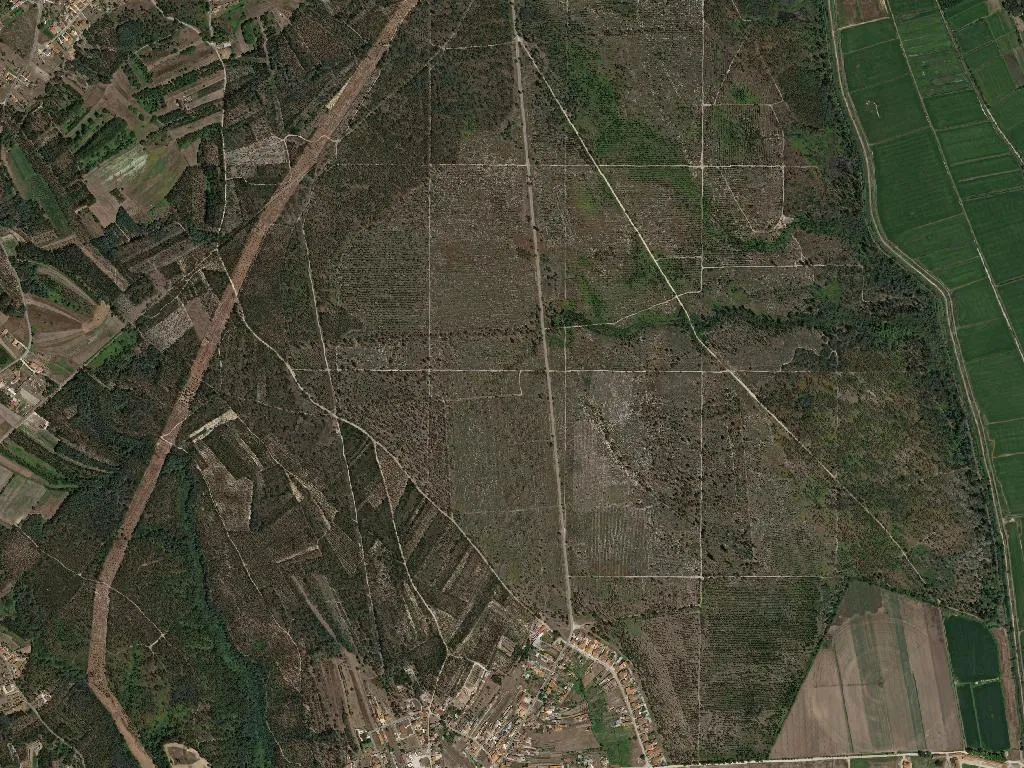
Santana occupies a liminal strip of the Coimbra district—close enough to the Atlantic for its weather systems, yet anchored to the Beiras’ small-scale farming grid. Some 1,500 hectares of rotating rye, maize and clover roll inland, interrupted only by wind-pruned umbrella pines. On lucid winter mornings the horizon dissolves into a pewter-blue seam: the same ocean that hurls spray over Buarcos’ sea wall just eight kilometres away. That proximity is underscored by the nearby Cabo Mondego Natural Monument, whose 180-million-year-old Jurassic cliffs first signalled to British surveyors in the 19th century that Portugal’s strata told a story older than the Atlantic itself.
Footfall of pilgrims
The Portuguese Coastal Way to Santiago cuts straight through the parish, but here the camino is stripped of bar-badge bravado. Pilgrims arrive dusted with sand from the beach section at Mira; by the time they reach Santana their boots carry topsoil instead of silica. Waymarking is discreet—yellow arrows painted on electricity poles, a single scallop-shell tile beside a barn door. No albergue dormitories; instead three timber-clad guest units—Quinta da Fonte, the renovated olive-press cottage Casa do Lagar, and the straightforward Peregrino studio—offer bed-length balconies overlooking rye that ripples like water in the northerly wind.
The path itself is a working right-of-way: farmers move Marinhoa cattle along it, the mahogany-coloured breed whose DOP-labelled beef appears on Coimbra’s better menus. Walking here means sidestepping cow pats and negotiating electric-fence loops, not ticking off scenic lookouts. The reward is a slow reveal of an agricultural littoral few visitors realise exists.
The productivity of silence
There are no visitor numbers because, frankly, there are hardly any visitors. Santana’s rhythm is set by tractor timetables and the evening drift of cattle toward milking sheds. Houses remain whitewashed annually—lime wash, not boutique white—because the Atlantic still hurls salt across the plain. The only café doubles as the feed-merchant’s office; espresso comes with a background soundtrack of weighing scales clicking out seed grain.
Come late afternoon the low winter sun sidelights every ridge and furrow; shadows stretch until they tangle in the stone walls. It is then, in that honey-coloured glare, that the parish discloses its discreet magnetism: not a place to be discovered, but a place that simply continues—season after season, harvest after harvest—quietly productive, stubbornly alive.