Full article about Cadafaz & Colmeal: granite villages where time smoulders
Stone hamlets of Góis echo with goat stew, church bells and wildfire-scarred hills
Hide article Read full article
Granite, smoke and silence
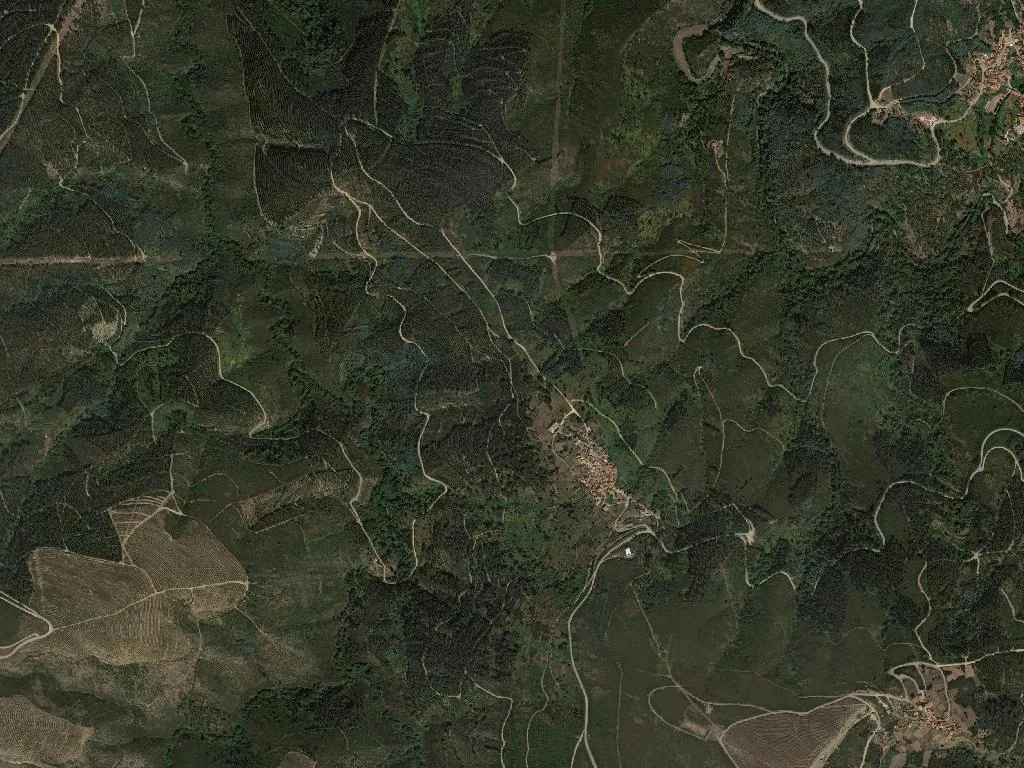
The dawn mist unravels slowly through the pinewoods, revealing the schist roofs of Colmeal one slate at a time. On the slopes, bottle-green gorse gives way to charcoal scars where wildfire has passed. Sound is rationed: only the hush of the stream below and, drifting across the ridge, the single bell of Cadafaz church marking time for 320 people scattered across 7,015 hectares of mountain.
Cadafaz and Colmeal were fused into one parish in 2013, yoking two medieval settlements whose names still whisper their past—Cadafaz from the Arabic ad-duff al-azraq, “the blue rock”, Colmeal from the straw (colmo) once thatched across roofs. Density here is 4.5 souls per square kilometre; the average altitude 637 m. Roads corkscrew into valleys so tight that winter sun barely warms the stone.
Stone that endures, stone that speaks
The 18th-century mother church at Cadafaz is a plain Beira rectangle, but its baptismal register tells a louder story: 173 parishioners are over 65; the primary school closed for lack of children. Inside the chapel of São Sebastião, processions still weld together those who stayed and those who return for the July festa. Along the tributaries of the Ceira, pack-horse bridges of unmortared granite arc over water cold enough to numb ankles; beside them, watermills stand hollow, their grindstones moss-covered since the last wheat was milled in 1983.
Abandonment is a village in itself. Covas do Lobo is down to two occupied houses; the rest are pad-locked doors and glassless windows staring out like empty eye-sockets. Census night records only ten dwellings lit.
Clay-pot goat and mountain smoke
Chanfana—kid or billy goat braised overnight in red wine, bay and piri-piri—simmers in black clay pots when the parish throws its August feast. In smoke-blackened larders, chouriço and blood-morcela sausages hang like burgundy icicles; goat cheeses cure on ash planks. Winter pig-killings still follow the lunar calendar, the mountain air providing the only refrigeration needed. Quince and pumpkin jams are stacked in pantries, each jar labelled in the angular script of someone who learned to write with a dip-pen.
Trails between green and grey
The way-marked Ribeiro de Colmeal footpath shadows the stream for 8 km, climbing through surviving oak on north-facing slopes, then breaking out onto fire-savaged ridges where pine trunks stand silver against the sky. Wild-boar prints stitch the mud; short-toed eagles ride the thermals above. Mountain-bike tracks loop over schist slabs, dropping into hamlets where the only traffic is a resident mule. Late-afternoon wind carries resin and woodsmoke from the few chimneys still breathing—slow-burning eucalyptus and chestnut warming walls two feet thick against the 3 a.m. frost that arrives without apology.