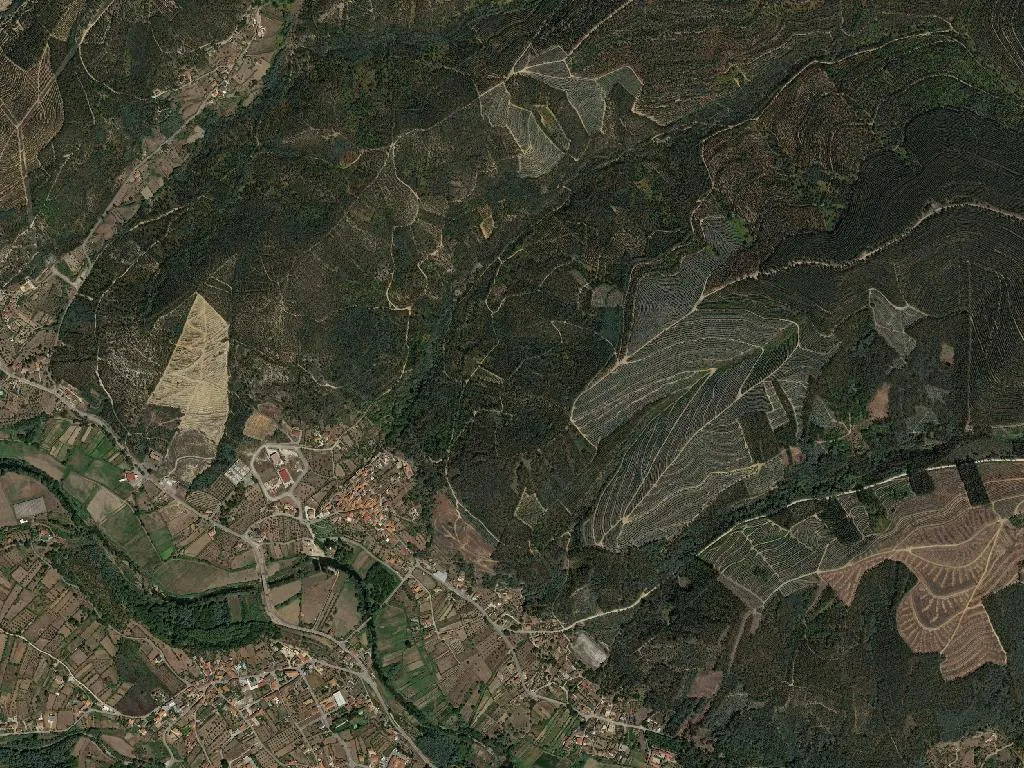
Full article about Vila Nova do Ceira: where the river writes the rules
Stone cottages lean to the Ceira’s icy rush, roasting goat scents drifting from timetabled taverns
Hide article Read full article
The granite of the bridge hoards the afternoon heat. Beneath it, the Ceira races past—so cold that even in August your calves tighten when you step in. Everything in Vila Nova do Ceira tilts toward that water: the lane of low houses, the parish church, the bakery that smells of cinnamon an hour before it opens. In February the river swells and cellar floors in the oldest quarter glaze over with a film of silt; locals keep the wellingtons by the bed, just in case.
A parish invented to fill an administrative gap
Lisbon bureaucrats created the parish in 1847 by stitching together three hamlets no neighbouring council could be bothered to govern. The “new” in the name is relative: the arched bridge already counted a century, and the charter of nearby Góis dates from 1280. Liberal soldiers filed through here during the 1832-34 civil war, requisitioning chickens and leaving typhoid in their wake. Inside the 18th-century Igreja de São Pedro little remains of the original baroque: the roof collapsed in 1913, the gilded woodwork burned in 1956, and a concrete altarpiece arrived with the Estado Novo in 1962. The result is stone scrubbed clean, plain pine pews, and a single azulejo panel rescued from the rubble. The whitewashed Capela de Santo António is locked except for baptisms and funerals; ring the caretaker the day before.
Mountain flavours, strictly timed
Sunday lunch at O Céu is goat roasted until the skin shatters—book by Thursday or you’ll be handed a polite “esgotado”. Chanfana, the district’s clove-dark goat stew, arrives in a clay pot still bubbling from the wood oven; order half a portion each or you won’t make it past the espresso. The village butcher unlocks at 7 a.m. and pulls the shutter at 1 p.m.; his peppered blood pudding appears on Wednesday mornings and is usually gone by nine. Góis sponge cake, airy as a well-proofed duvet, is only baked at Padaria Gomes on Fridays and Saturdays. Miss the slot and you’ll have to make do with supermarket brioche all week.
Following the river into the laurel forest
The signed trail begins behind the church, an eight-kilometre loop with 300 m of climb. The first two kilometres shadow the water, passing three gravel beaches where walkers plunge in; locals insist Poço do Bacalhau is the deepest and stone-free. Then the path veers uphill through a tunnel of Portuguese laurel, a Tertiary-era relic that survived the last Ice Age in these valleys. Four watermills survive along the lane—two still grind maize when the flow is high enough. From the Carrascal lookout the view stretches south to the white houses of Góis and, on very sharp mornings, east to the glint of snow on the Serra da Estrela. Pack water: there is no café between the bridge and the miradouro, and the red-and-yellow waymarks are fading; GPS is a sensible back-up.
Demographics louder than the church bell
Officially 931 people live here, but 336 of them have already passed retirement age. The primary school closed its first cycle three years ago when the roll dropped to twelve; the remaining infants now catch the 7.15 a.m. bus to Góis. The pharmacy keeps Saturday half-day, shuttering at 12.30 sharp; after that, prescriptions mean a forty-minute drive to Coimbra or Lousã. Hunters’ voices fill the Clube de Caçadores bar from six o’clock, while the centre café opens at nine and doubles as the village’s only Wi-Fi hotspot. On the first Sunday of every month the riverfront fills with folding tables: goat’s cheese from Arganil, heather honey from Lousã, and the best smoked chouriço for fifty kilometres, driven down from Pampilhosa da Serra by Zé Manel himself.
After dark the Ceira sounds different—water released from the upstream dams lifts the level by a hand-width. The only other noise is the occasional two-stroke whine of motocross bikes bumping over the track that ends at the abandoned textile mill, their headlights sweeping across dark windows before the valley settles back into absolute silence.