Full article about Indigo Palheiros & Cobalt Lagoon, Mira
Stilted cottages, salt-tinged wind and Easter processions at Praia de Mira
Hide article Read full article
The Breath of the Tides
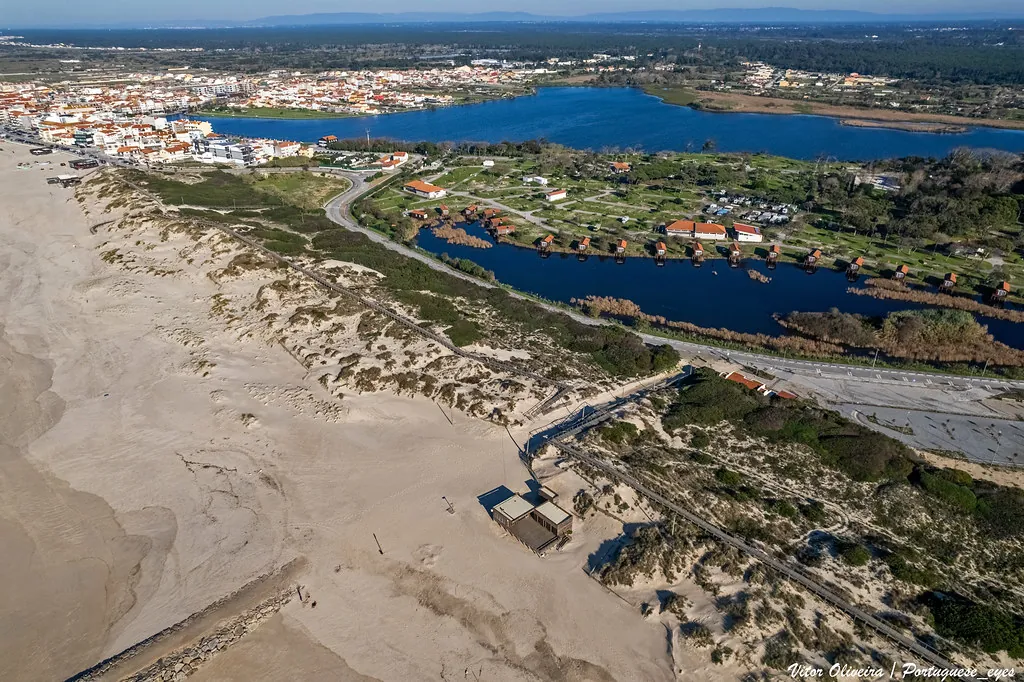
The east wind carries the scent of salt and sun-split pine. At Palheirão, cottages perch on stilts above the dune, their boards painted the exact indigo of naval uniforms and the white of fresh whey. Sand drifts through gaps no one bothers to caulk; the Atlantic keeps its own time. Three kilometres west of the parish centre of Mira—population 3,246, six metres above sea—this ribbon of coast hangs between the Barrinha lagoon and a five-kilometre blade of white beach that earns Blue Flag status almost every year.
Houses that breathe with the tide
The palheiros are not museum pieces. Built on pine piles and roofed with osier thatch, they were engineered to shrug off damp Atlantic air and the blown sand that would bury brick in a season. Three of them now shelter the Ethnographic Museum (free entry); inside, walls are quilted with hemp nets, iron hooks the size of a man’s forearm, and eel traps woven from willow. The air smells of resin and of time deliberately left unwound. Above them, the Chapel of Nossa Senhora da Conceição crowns the dune like a miniature Faro lighthouse, keeping watch over both lagoon and ocean.
Human fixation on this sandspit predates the Romans—Neolithic shell middens have been found a short walk inland—but it was the Atlantic fishery that shaped the village. The name Mira comes from the Latin mirare, to gaze, and there is plenty to look at: northwards, the Barrinha’s cobalt tongue snakes through glasswort and saltpans; westwards, mellow rollers unfurl for 200 metres, ideal for first-time surfers and the local body-board school.
Procession to the sea, stew on the table
On Easter Sunday the statues of St Peter and the Virgin are carried down the wooden walkway to the tideline, where the priest blesses the painted wooden saveiros that still trawl for lamprey and sea bass. August brings the Festa de Nossa Senhora da Conceição: mass in the dune-top chapel followed by grilled sardines and chilled lager at long trestles under fairy-lights. July, though, belongs to the Festa da Barrinha—three days of concerts, cane-rod canoe races and eel caldeirada ladled from clay pots wide enough to bathe a toddler in.
Eel is sovereign here. Fried in hot olive oil until the skin crackles like crackling, or simmered into a brick-red stew thickened with tomato, onion and yesterday’s bread. Clam xarém, a polenta-like porridge, is stirred for an hour until it reaches the colour of burnished ivory. On beach-side terraces, charcoal-grilled sea bream arrives with warm cornbread and tomatoes that still hold the morning sun. Finish with Aveiro’s IGP ovos moles—candied yolk pressed into rice-paper shells that dissolve on the tongue like communion wafers.
Boardwalks, bikes and flamingos
A 14-kilometre timber cycle lane uncoils south from the main beach, flush enough to roller-skate on. Pause at the cantilevered viewpoints and you’ll see stilts poised like calligraphy, flamingos flushing rose against the reed beds, and samphire bending in the breeze. The GR 57—Caminho do Atlântico—continues to Gafanha da Boa Hora, never straying more than 100 metres from water that smells of iodine and marsh gas.
Rent a Canadian canoe at the Barrinha and you can paddle a figure-of-eight through channels where the only sound is the dip of your blade and the indignant squawk of a crested coot. Summer weekends draw families from Coimbra and Porto, but even then the lagoon feels half-inhabited, its mirror surface broken only by a stand-up paddler and the occasional fisherman wading waist-deep with a hand-net.
Where time sticks to the timber
After six o’clock, when the sun loses its punch, walk the sandy lanes between the palheiros. The boards still radiate the day’s heat, exhaling a sweet, almost burnt-resin perfume. Through half-open shutters you’ll catch the same Vagos FM jingle, the clink of a coffee cup, and murmurs about tomorrow’s catch or the wind that’s forecast to swing south-westerly. Wheelbarrow tracks left earlier are already soft-edged, reclaimed by drifting sand. It is then you realise Praia de Mira is not the Instagrammed Atlantic backdrop; it is this breathing timber, these lives pinned to a dune, and a clock that runs on lunar time.