Full article about Lamas: Portugal’s Silent Green Floodplain
Low fields, 17th-century church, 771 neighbours: Lamas breathes slow life below Serra da Lousã
Hide article Read full article
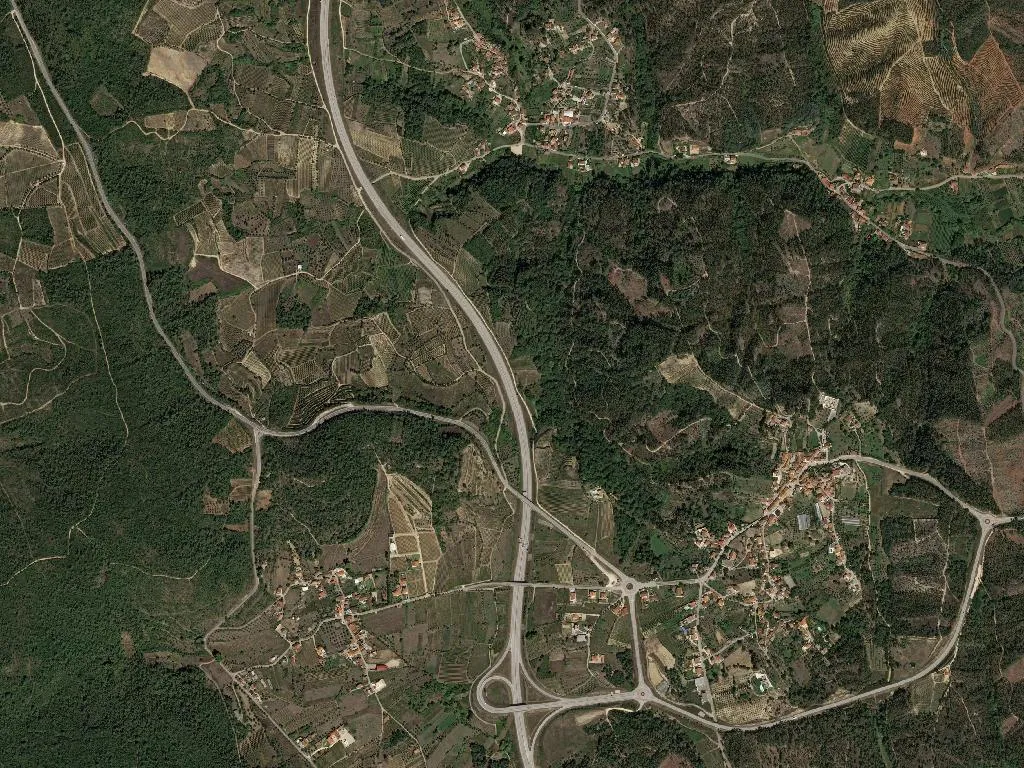
The road drops between cultivated banks and the valley opens wide, stippled with eucalyptus stands and parcels of maize that still cling to the last vivid green of summer. Lamas spreads across the flatlands – faithful to its Latin root, lama: low, damp, pliable ground. At only 180 m above sea level the landscape exhales differently from the Serra da Lousã rising to the south. There are no knife-edge ridges or vertiginous lookouts, only the calm horizontality of a parish built on working fields.
Low land, long memory
Written records begin in 1601, yet occupation is certainly older. The mother church of São Miguel, erected in the seventeenth century, organised communal life around the agricultural calendar. Place-names betray an intimacy with soil and water: Lamas is where rain lingers, where earth holds moisture, where crops demand patience and an almanac’s knowledge.
Today 771 residents share 1,566 hectares – a density of 49 people per km² that leaves generous silence. More than 230 are over 65, a ratio that mirrors the greying of Portugal’s interior but also the resolve of those who stay. The 69 children under fourteen keep the primary school and kindergarten alive, classrooms where futures are still sketched in coloured pencil.
The visible everyday
A stroll along Rua da Igreja reveals quiet contrasts. Granite-and-lime houses alternate with later brick additions, vegetable plots stretch behind low walls, and dirt lanes link hamlets whose names hint at small histories: Casal Novo, Portela, Forno. There are no blockbuster monuments or way-marked heritage trails, yet the architecture of daily life discloses itself to anyone who pauses: schist walls dividing properties, stone wells, a weather-worn wayside cross where the road tilts toward Vilar.
Accommodation is modest – a dozen registered dwellings, mostly cottages and spare rooms – but ample for travellers seeking an unobtrusive base. Café Central on the square pours a proper Delta espresso and will sell you a packet of broa for the road. Miranda do Corvo lies seven kilometres away; to the south the forested ridges of the Lousã massif promise footpaths and broad views.
Earthbound rhythms
Life is still timed by harvests and seasons. Cultivated plots are not scenery but subsistence, memory, identity. Maize dries on threshing floors, vegetable gardens feed family tables, and smokehouses hold January sausages made when the cold tightens and the matança do porco pulls generations around the same table. You will find no restaurants in guidebooks, only kitchens where food is cooked as it always was: bean rice, wood-oven kid, dense dark cornbread.
Lamas’ silence is never vacant. It is punctuated by a distant dog, a tractor churning soil, the church bell marking the hour and the Angelus. At night the darkness is almost total; starfields open above the level fields. There is no hurry here, only the awareness that every gesture – sowing, reaping, rebuilding a wall – enters a continuum handed down and received. When rain falls on the low land the smell of wet clay rises, thick and ancient, reminding you exactly why the place is named what it is.