Full article about Aldeia das Dez: where the bell’s echo never dares return
Stone hamlet clings to a shadowed ridge above the Alvôco, its 474 voices wrapped in schist
Hide article Read full article
The bell that swallows its own echo
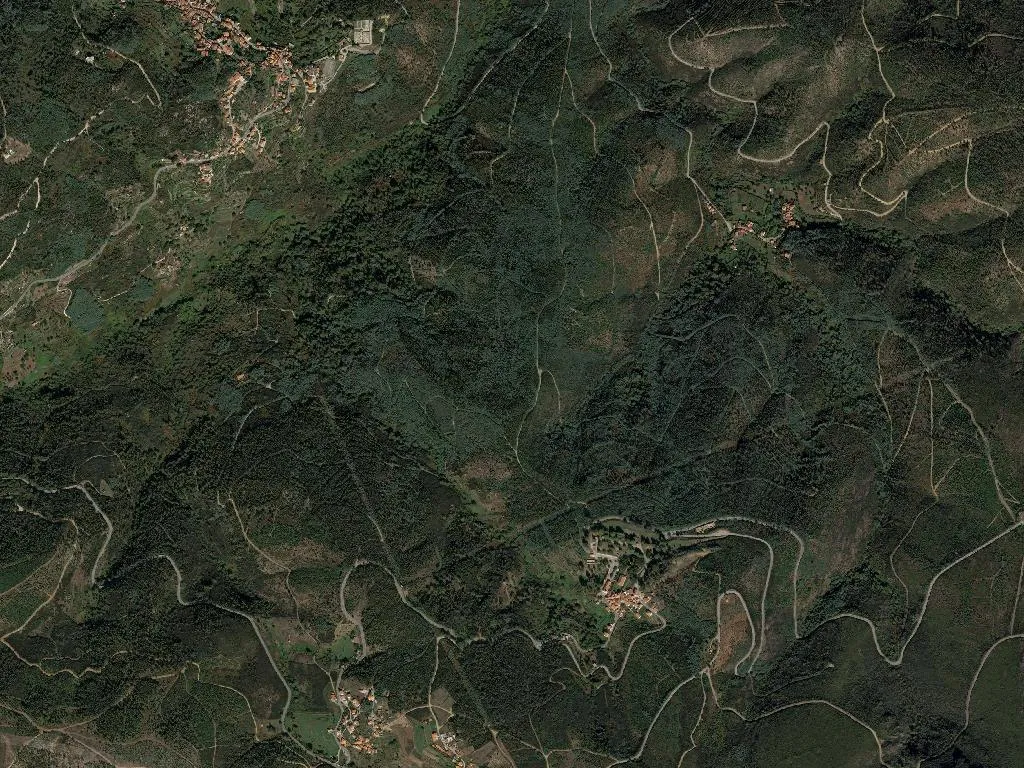
The single bronze bell in the tower of São Bartolomeu drops a low C-sharp that rolls down the quartzite ridge and vanishes into the Alvôco valley before any answering echo returns. After that, only the wind moves—dry, constant, interrogative—slipping between walls of gun-metal schist that tighten into lanes no wider than a donkey cart. At 594 metres above sea-level, on the north flank of Monte do Colcurinho, 474 residents (2021 census) occupy a stone amphitheatre that faces away from the sun and towards its own reflection in the river it cannot hear. Dawn arrives in two instalments: first a blade of white light between the peaks of the Estrela Geopark, then a hesitant warmth that takes until coffee time to burn off the damp held overnight by the slate-dark houses.
A place without a name
In the 1527 national census the hamlet appears simply as lugar dalldea—“the hamlet place”—with 49 souls and no distinguishing adjective. The suffix “das Dez” (“of the Ten”) surfaced a century later. Linguists favour the evolution of the medieval surname Diez (Portuguese Dias) that clung to the toponym; villagers still prefer the tale of ten local women who unearthed a Moorish hoard on Colcurinho and divided it into ten sworn secrets. Either way, people were here long before ink: a Luso-Roman hill-fort crowns the neighbouring spur, and a hacked-out stretch of Roman paving still stitches the village to the bridge at Avô three kilometres away. Parish status came in 1543, when the Bishop of Coimbra prised the settlement from Avô’s ecclesiastical grip; after a brief re-annexation in 1594, autonomy was restored for good in 1603. Isolation lasted longer—until 1899, when the municipal road to Ponte das Três Entradas was finally finished. Curiously, public lighting arrived first: on Christmas Eve 1812, olive-oil lamps turned the schist streets into a living nativity.
The phosphorus works
In the 1860s this scatter of smallholdings became an unlikely industrial hub. Two match factories employed around fifty workers—mainly women—who fed phosphorus and potassium chlorate into cast-iron presses. By 1890 one plant had upgraded to safety matches, a technology so new that Lisbon newspapers reported it as a scientific marvel. The smell of sulphur drifted through chestnut smoke; the mechanical clack of splint-cutters replaced the sound of cowbells. Today the larger building is a private house with geraniums on the sills; only the unusually wide doorways betray where wagons once rolled out crates of fósforos bound for Coimbra and Porto.
São Bartolomeu’s swollen dome
The 18th-century mother church commands the only flat acre in the village. Single-naved, five-baroque-altared, it was erected between 1727 and 1764 on the footprint of a 13th-century chapel. Inside, a Mannerist panel shows the apostle flayed alive—Saint Bartholomew draped in his own skin like a macabre overcoat—painted with surgical detour-your-eyes detail. The bell-tower finishes in a bulbous granite dome, more Kremlin than Minho, visible from every switchback on the EM-508. In the sacristy a rare 18th-century Saint Theodore, sword across his knee, guards a chest of embroidered capes smelling of incense and mothballs. A few steps down the slope, the tiny Calvary chapel houses near-life-size polychrome figures of Christ, Mary and John; in half-light their glass eyes appear to track the penitent.
Quartzite, lamb and cheese that runs
Monte do Colcurinho is a dorsal fin of quartzite grafted onto the Açor range. White ribs of stone jut through gorse and heather, giving walkers the illusion of striding across a petrified whale. The EM-508 itself doubles as belvedere: pull in at the lay-by above the cemetery and the Alvôco valley peels away in geological layers—blue-grey schist, green shale, river-mist silver. Four kilometres downstream, Alvoco das Várzeas has a sand-bottomed river beach and a medieval pack-horse bridge; four kilometres uphill, the thermal spa of Caldas de São Paulo trades slate for sodium-rich water at 38 °C.
On dinner tables the mountains speak DOP and IGP. Order Borrego Serra da Estrela—milk-fed lamb slow-roasted until the skin shatters like caramel—and it arrives with a puddle of melted Queijo Serra da Estrela that has surrendered its centre to gravity. The cheese’s orange rind and viscous interior taste of thyme and thistle rennet; follow it with a spoonful of requeijão drizzled with heather honey and a glass of Dão red cool enough to make the tannins shiver.
Walking without purpose through dark walls
The old quarter rewards aimless drifting. Schist darkens to charcoal when it rains, then bleaches to mouse-grey under slanting afternoon sun. Thirteen guest beds—spread between a converted olive press, a weaver’s cottage and the Quinta da Geia manor—ensure the village never tips into museum hush. Population density hovers at twenty-five per square kilometre; you feel it in the polite pause before a door opens, in the unhurried arc of a cat crossing the lane, in the median age—sixty-seven—of the parish council. At dusk, when the valley below has already turned ink-black, the bulbous dome of São Bartolomeu catches the last light the colour of wet slate. The air cools, carrying smells of earth, moss and, if someone has lit the hearth, burning oak. That is the final scent before sleep—not the sulphur of matches no longer made, but the older perfume of wood that has always warmed this stone theatre, and always will.