Full article about Avô: Echoes of bells & vines in the Alva valley
Granite crosses, 1513 pillory and chanfana clay pots scent this Coimbra village above the river.
Hide article Read full article
Three bells from the parish church strike the flagstones of Praça da República and the sound lingers, as though it recognises every house. In Avô, the echoes do not fade: they glance off the 1513 pillory, drift down Rua de Baixo and expire beside the granite wayside cross where, on Sundays, the priest still sprinkles holy water on tractors. Morning light rakes across the terraced vines, drawing shadows that are already shrinking – August, and the sun gives no quarter.
A princess between banks
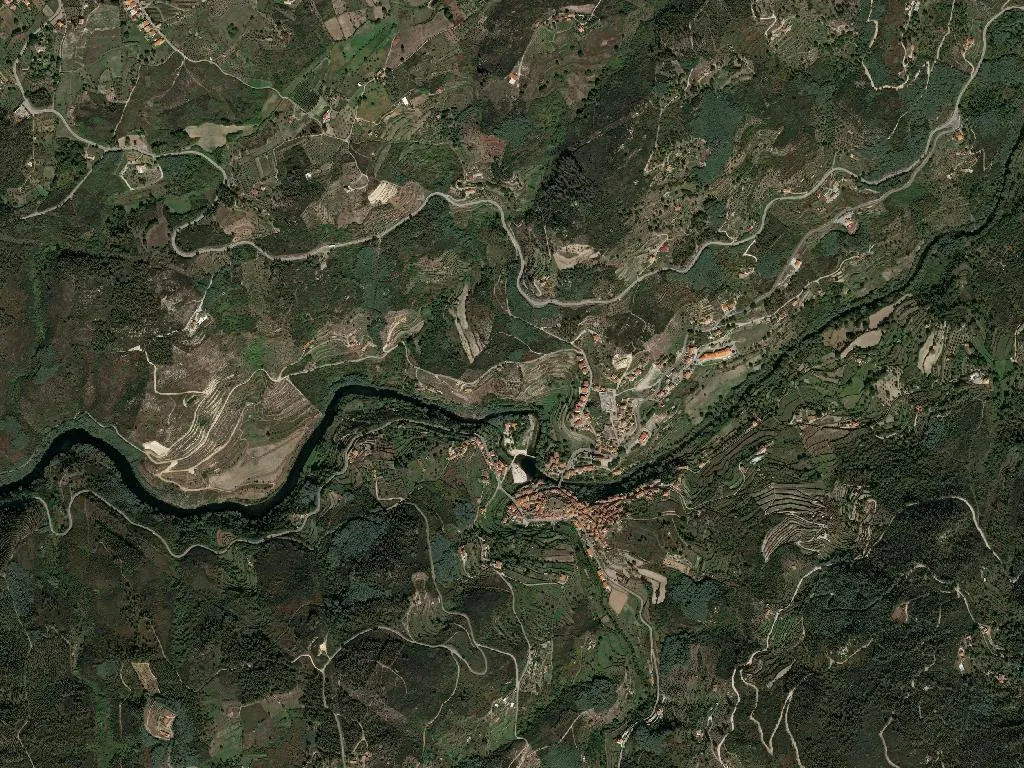
The Alva runs low, as it does most summers. The four-arched bridge ordered in 1805 by the Mondego regulating board – after its medieval predecessor was swept away – still carries heavy traffic to the N17. From the narrow deck you look down on the schist walls that the AVA wine-growers’ co-operative has rebuilt since 2018, returning vines to slopes the Estado Novo once cleared for eucalyptus. On the far bank stand the Resende olive trees: centenarians with twisted trunks catalogued by the town hall in 2021 after a residents’ petition.
Gold leaf and an old charter
Inside the mother church, the gilded woodcarving of the high altar dates to 1743 – paid for with Brazilian gold by Abbot Inácio de Andrade e Sousa, great-grandson of an explorer. The 1214 royal charter is kept in Coimbra’s district archive, but a parchment facsimile made in 1964 hangs here, when Avô still had its own judge. The pillory lost its crown in 1756, toppled by the earthquake that also felled the bell tower; the one you see today is an 1882 reconstruction, the second “8” in the date crudely carved. From the castle viewpoint, where King Dinis raised a fortress that the French dynamited in 1810, a 2019 plaque reads 470 m above sea level – someone has sprayed out the final zero.
Clay pots and red wine
Chanfana – goat stew – spends seven hours in a Molelos clay pot. Zé Manel’s wood-fired oven still operates on Saturdays, though he no longer accepts groups larger than twenty. The meat comes from Joaquim’s goats in Travanca de Lagos; the wine is Quinta dos Carvalhais, served on tap since the restaurant installed the system in 2022. The Serra da Estrela DOP cheese is still delivered daily by the cheesemaker from Lapa’s milking shed, but the apples are no longer from Beira Alta – the PGI lapsed in 2020, so they buy cheaper fruit from Celorico.
Memories that travelled far
Father António de Andrade was baptised at the font just inside the sacristy door – the 1580 entry is written in humanist script. He left for Rome in 1600 along the Roman road that passes Ponte de Mucela; today it is a faint track ignored by GPS. In 2020, the Estrela Geopark classified the black schists of Foz de Vintém as “a site of international interest”, but the interpretation board has already been stolen twice.
The afternoon drifts. At the picnic park beside the bridge, the Spanish family who rented the Casal houses with a pool are packing away 25 cm trout – the legal limit confirmed yesterday by the APA warden. The low Alva exposes riverbed stones; someone has tossed in another bottle of “Vinho Verde” that was never from around here.