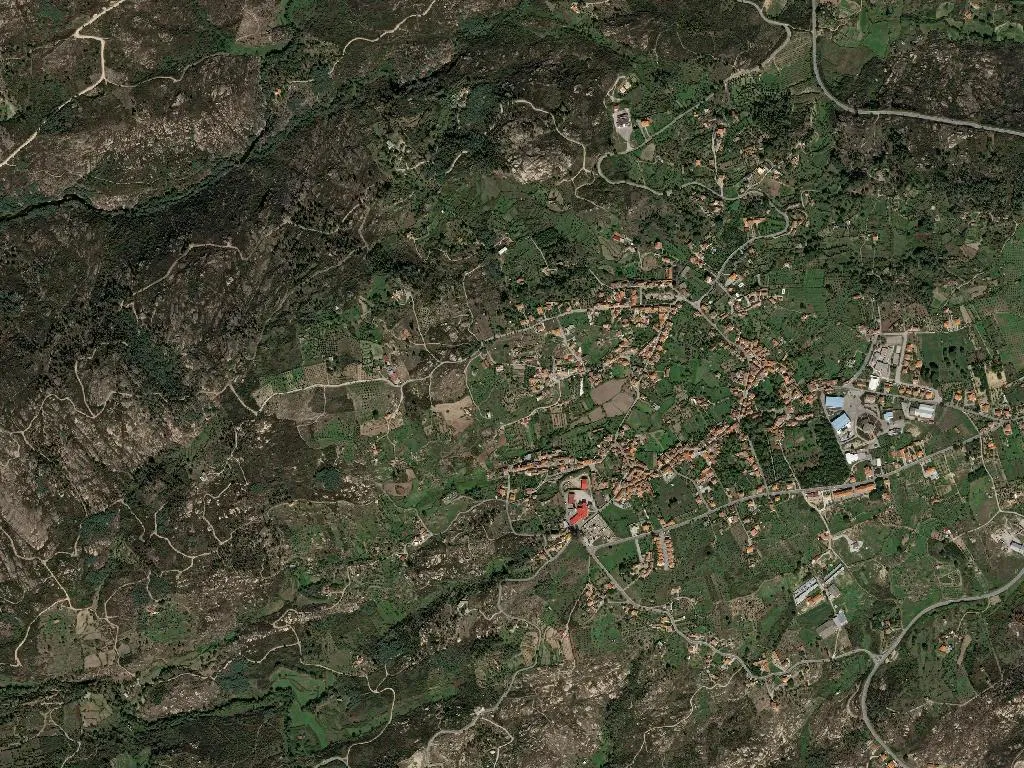
Full article about Lagares: Where Church Fountains Outnumber Cars
Morning pears, 16th-century saints and gorse-grilled kid in a forgotten Beira village
Hide article Read full article
Apple crates and morning ritual
A Beira Alta produce lorry unloads crates of Rocha pears outside the village grocery-café. It is 9.30 a.m.; the driver is already late, but the man leaving the tavern is not. He lingers to swap the price of milk and the state of the maize fields. The church fountain still flows as it always has—cold water, seventeenth-century stone, no ornament.
What once was
Lagares was a municipality until 1836. It had its own judge, notary, jail. A royal charter of 1514 elevated it to town status; today only the street plan and a Roman altar embedded in the church wall remain. The University of Coimbra once issued rulings from here, so locals still say “go study in Lagares” when bureaucracy looms.
Inside the church two saints survived every refurbishment: a fifteenth-century St Michael (sword missing, dust accumulating) and a 1530 St Sebastian (broken arrows, unflinching gaze). On the forecourt the flagstones are loose; catching your heel in a gap is considered a Lagares initiation rite.
Water, woods, pasture
Village fountains are counted by the dozen—São João (1905), Feira (1928), Rossio (1950), Sardão, Copinho—used for watering vegetable plots, rinsing laundry, arranging assignations. Beside the cemetery a eucalyptus grove stands dead but upright; the native oak gives shade to the sheepdogs that wait for their shepherd in the square.
Altitude is 387 m: maize terraces, irrigated meadows for cattle, pasture for lambs bound later for the communal oven at Forno da Ribeira. Geopark trails cross gorse-covered hills; red-legged partridge rise at Sunday gunshots. There is no beach, no beach-bar soundtrack—only the low throb of a John Deere disturbing the hush.
Table
Set menu: kid goat grilled over gorse embers, river-fish stew, baby-goat bean casserole. Served with boiled potatoes and Dão wine that begins literally the moment you cross the road south. Finish with curd cheese and house pumpkin jam—the squash from the garden next door, the cinnamon from the supermarket in Tábua. In December those with canes make filhós doughnuts; those without buy pre-soaked rabanadas slices from the bakery.
After six o’clock
The brass band rehearses Wednesdays at the community hall; the folk group on Fridays. No pilgrimage since 2019—too few bearers for the statue. The sports pavilion hosts futsal on Saturdays; the bar opens only if you phone ahead. The granite-cube playground is empty by seven, but doubles as overflow parking on Mass days.
When the bell strikes six the sheep file themselves back to the fold. The hare that darts across the N17 does not wait for an audience—gone into the scrub before the first set of headlights appears.