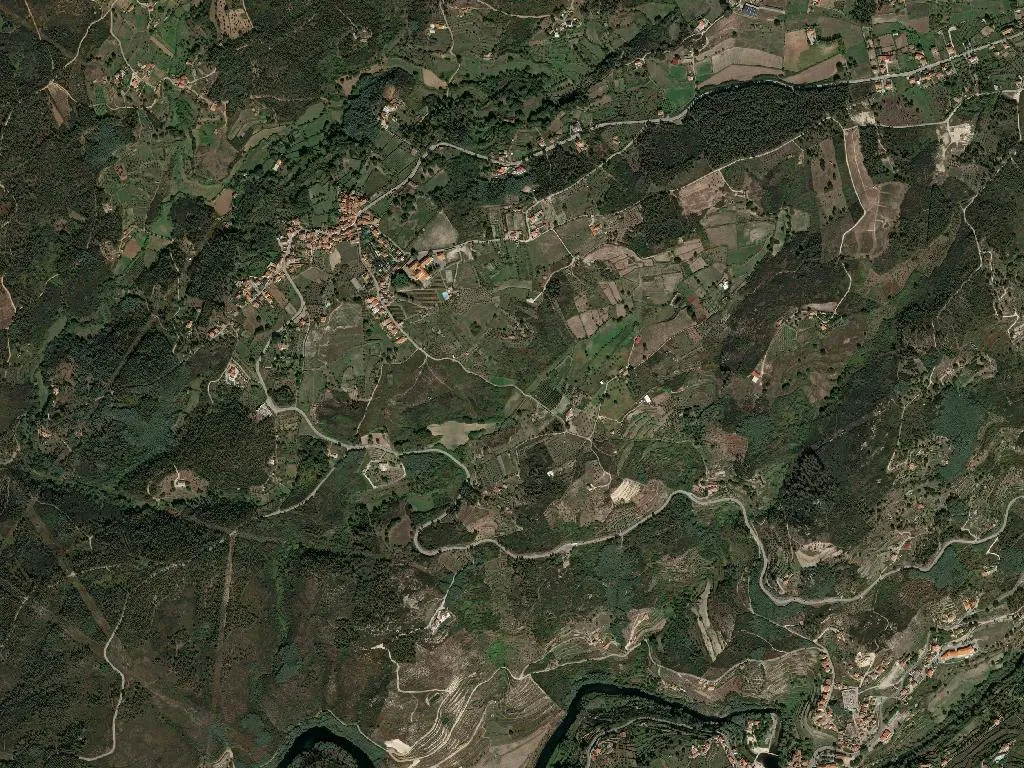
Full article about União das freguesias de Santa Ovaia e Vila Pouca da Beira
Oak-smoked cheese and phoenix forests rise from 2017’s ashes in Oliveira do Hospital’s twin-village
Hide article Read full article
Smoke, Stone & Second Growth
A ribbon of oak smoke unspools from the chimney of a stone cottage, braiding itself with the scent of Serra da Estrela cheese as it ripens in an adjoining fumeiro. Between Santa Ovaia and Vila Pouca da Beira, 411 m above sea level, the colour wheel is simple: grey schist where fire has bared the bones of the land, and the luminous green of chestnut and oak suckers that have learnt to sprint upwards after each blaze. The two villages—amalgamated into a single civil parish in 2013—add up to 846 inhabitants who treat resilience as an everyday craft.
Scars that Sprout
The parish keeps two calendars: the Gregorian and the pyric. On 15 October 2017 a wall of flame barrelled 45 km across the Serra do Açor in under eight hours, reaching Santa Ovaia at 4.30 p.m. Fourteen houses were lost, 85 % of the olive groves and 230 ha of pine. Five years later, a 2022 fire consumed 180 ha of Vila Pouca’s maquis and eucalyptus but halted 300 m short of the village core. No lives were taken—an achievement locals recite the way other people quote football scores.
Walk the unsignposted rural tracks today and the arithmetic of recovery is visible. Three-month-old Quercus robur seedlings nudge aside charcoal, strawberry trees resprout from lignotubers, and 450 new oliveiras have been tallied on the Quintas da Veiga and do Ribeiro since 2019. The sub-text is geological: schist flakes off the low dry-stone walls like pages from a book that refuses to end.
A Kitchen Without Footnotes
There are no licensed restaurants here; flavour is negotiated privately. Lamb certified Borrego Serra da Estrela DOP grazes the Quinta do Cabeço until 90 days old, then spends four hours in a wood oven scented with hillside rosemary. Wheels of Queijo Serra da Estrela DOP from Quinta da Fonte slumber 60 days in a schist cellar until they can be trowelled onto still-warm boroa bread. Thursday is requeijão day: curds drained in muslin, served an hour later with Serra do Açor heather honey.
October brings chestnut soups made with the longal variety from the Seixo estate, the broth darkened by curls of black-pork blood morcela. Chanfana—goat stewed for six hours in Touriga Nacional from the cooperative Adega de São Gião—arrives at table in black Molelos clay, the glaze crazed like the surrounding fault lines. Dessert might be a reineta apple from a Santa Ovaia orchard, baked with Ceira cinnamon or simmered into compote with Serra walnuts. Maria do Carmo Domingues, 78, still bakes communal bread every Saturday in the 1948 oven her mother taught her to use in 1958; recipes travel by muscle memory, not WhatsApp.
Granite that Remembers
Since 2020 the parish has sat inside the Estrela Geopark, its spine formed by the Vilarica shear zone. Two kilometres north-west of Vila Pouca, the Pedras Lavradas outcrop is 320-million-year-old granite polished by Devonian weather into whale-back domes. The 7.3 km parish footpath linking the two settlements climbs to Portelo da Serra (570 m), where the view frames the glacial cirque of the Estrela massif. Medieval pack-animal trails—one drops from the chapel of São Sebastião to the Alva stream—are still cobbled in water-smoothed schist laid four centuries ago.
Festivals Measured in Flames
Public festivity is calibrated by wood piles, not crowd size. Since 1755 the procession of St Sebastian on 20 January has filed round Santa Ovaia’s lanes, a plague-vow that became habit. In Vila Pouca the blessing of the São João bonfires began in 1923 after a run of bumper harvests; on the night of 23 June three pyres are still lit—by the village pond, on the church square, outside the abandoned primary school. No amplifiers, no wristbands: just the crackle of oak, the church bell cast in Porto in 1892, and the smell of resin that will linger on coats all the way home.
The bell still tolls at 7.30 a.m., noon and 7 p.m., dividing a silence so complete you can hear fodder being unwrapped in distant cow sheds. Between strokes, the wind carries damp-earth scent from yesterday’s rain and the faint sweetness of pine sap. It is that precise olfactory chord—smoke, humidity, new resin—that tags your luggage and your memory, proof that 846 people continue to draft their story between ashes and first leaves.