Full article about Fajão-Vidual: The Quiet Ridge above Alva
Where beech roots sip secret springs and 275 souls guard 8,000 silent hectares
Hide article Read full article
Fajão-Vidual: Where the Mountains Breathe More Slowly
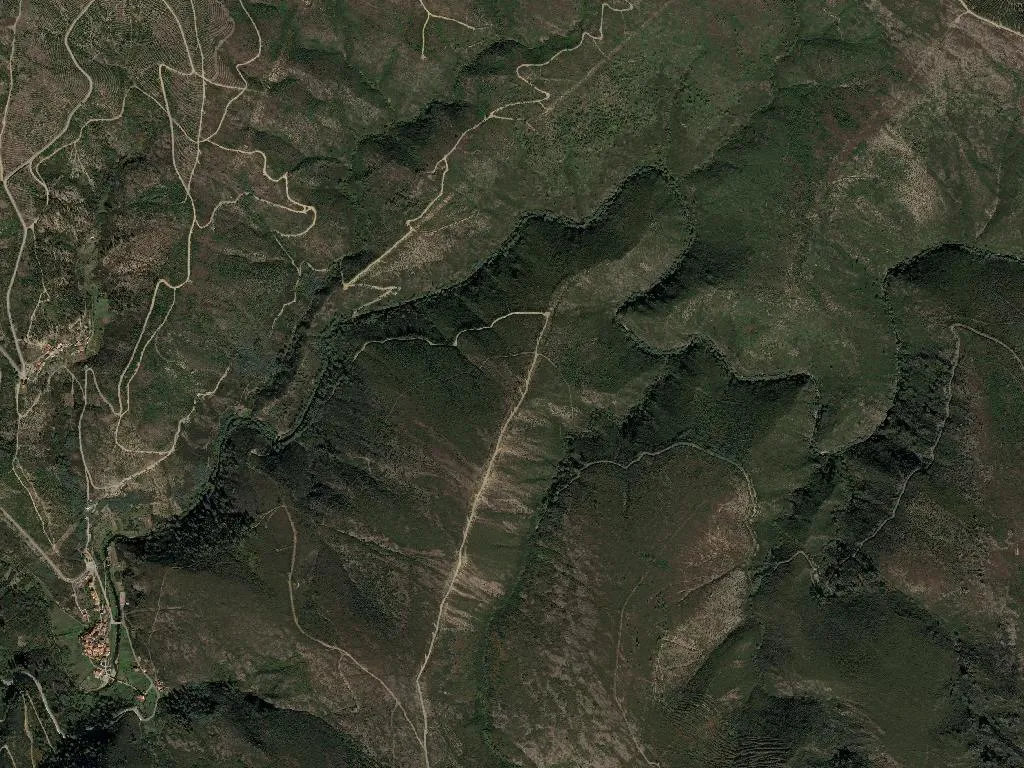
The first thing you hear is water. Not a river in full voice, but a thin, subterranean thread slipping between moss-slick stones and the pale roots of beech trees. Then the hush settles — a silence so complete it seems to have mass, pressing down like the mist that rises from the Alva valley on winter mornings. At just under 700 m, the parish of Fajão-Vidual occupies a ridge in the Serra da Pampilhosa where only 275 people share 8,000 hectares of heather, broom, pine and chestnut — three and a half souls every square kilometre, a statistic that explains everything and nothing about what it feels like to stand here.
The village you once reached only by foot or boat
For centuries arrival was an act of endurance. No road threaded the mountain; there were footpaths cut into schist or, alternatively, the cold green artery of the Alva, poling upstream against the current that eventually feeds the Mondego. The isolation was absolute, almost monastic, yet it became a preservative. Ways of doing, singing, curing sheep’s-cheese with the right pinch of salt survived here long after they disappeared elsewhere. Local memory claims that by the mid-1800s the parish supported two primary schools — one in Fajão, one in Vidual — an improbable luxury for so scattered a population.
Today the village belongs to the Schist Network and asphalt uncoils through the pines, but the sensation remains: you step off the map into an older cartography where co-ordinates are given by the angle of a slope, the arc of the sun, the permanent whisper of water that named the place — Fajão from the beeches and the springs, Vidual from the “vidos”, the vital sources.
Stone, lime and the hand that carved the cross
The mother church of São Pedro stands with eighteenth-century restraint, a provincial baroque that dispenses with the gilded theatrics of the lowlands. Thick walls, lime washed to a damp grey-green, keep the interior cool even in July; light enters sideways, filtered and indirect. Beside it, a 1700s calvary rises at the crossroads, vertical as a compass needle planted to outlast any generation.
In Vidual the chapel of São Sebastião hugs the ground, a rural building with folk-carved corbels that looks as if it germinated from the same soil as the surrounding chestnuts. Stone troughs lie scattered across the terrain, their basins polished by decades of use, each attached to a half-forgotten story that older hands can still pinpoint with a sweep of the arm toward the valley.
Clay-pot goat, cheese on slate
Nothing in Fajão-Vidual announces itself. You eat what you find. Chanfana — goat or billy stewed for hours in red wine and garlic — murmurs inside a clay pot sunk in the wood-oven until the meat surrenders and the sauce reduces to a velvet ember. Bean soup with kale and chouriço arrives steaming, thick with the scent of bacon and finely shredded greens that marks every mountain kitchen. Roast lamb emerges with glass-crack skin and translucent fat. Rye bread, dense as damp earth, is torn not sliced.
Then the cheese: ovelha cured on wooden shelves where altitude and humidity do what no refrigeration can replicate. Requeijão, almost sweet, is eaten with a dab of pumpkin preserve or alone on that same rye. Orange pastéis and walnut cake end the meal with the restrained sweetness of people who use what the land gives and nothing more.
The trail that drops to the Alva
Set out on the Fajão footpath and the landscape peels away in layers — first knee-high heather and gorse aromatic under the sun; then pine plantations where light falls in slanted bars; finally ancient chestnut groves whose trunks twist like battered doors. You pass stone mills and water-hammers being reabsorbed by bramble and fern; grindstones glint between fronds. In the ravines Bonelli’s eagles ride thermals in slow circles. Wild boar, fox and genet leave prints in the damp earth, glimpsed only as movement at the corner of the eye.
In summer the Alva offers amber-coloured pools reached by signed tracks — water so clear the stones seem magnified, cold enough to stop your breath before it becomes bliss. Higher up, temporary mountain mirrors form shallow ponds ringed by close-cropped turf where you can spread a towel and hear nothing but wind and, perhaps, the keening of a kestrel.
The festival of home-comers
On 29 June the feast of São Pedro compresses months of absence into three days. Emigrants return — from Coimbra, Lisbon, Paris — and the village refills with voices, concertinas, desafio singing that ricochets between schist walls. The procession squeezes through lanes barely two shoulder-widths across; the fairground lights up at dusk. In January São Sebastião summons Vidual to a quieter rite, warmth coming from mulled wine and bodies pressed together in the tiny chapel.
Someone in Fajão-Vidual still weaves wool. Someone still knows the exact beat of the loom, the right tension of yarn. These are skills not learned from manuals but by repetition, by watching, by the patience of people whose horizon is a ridgeline and who feel no urgency to be anywhere else.
When evening light copper-plates the heather and the Alva valley fills with blue shadow, the first sound returns: water threading between stones, older than every ledger and map. That is the pulse of Fajão-Vidual — not a clock, but a spring.