Full article about Janeiro de Baixo: granite hush in Pampilhosa’s folds
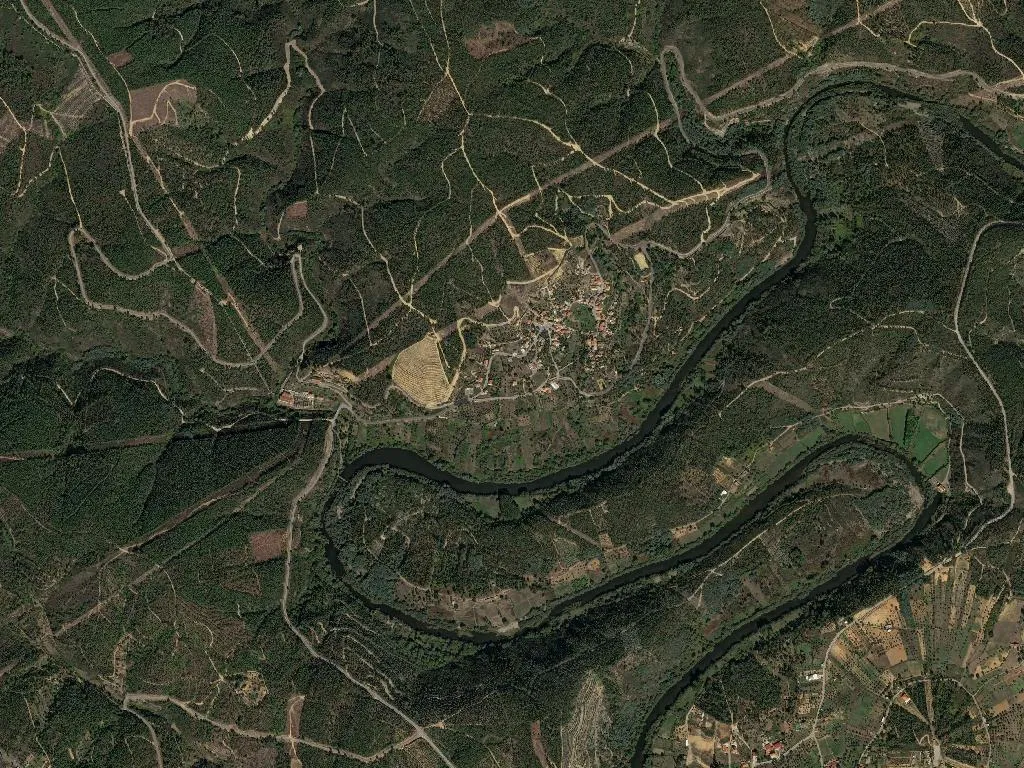
Janiero de Baixo, Pampilhosa da Serra, is a 355 m granite hamlet of 533 souls, Moorish-pan roofs, blood-sausage smoke and echoing church bells.
Hide article Read full article
The grey granite of the cottages drinks the dawn light while Sr. Arménio’s hearth-smoke climbs lazily into the cold mountain air. Janeiro de Baixo wakes without haste, folded into the tight valleys of Pampilhosa da Serra at 355 m above sea-level. Silence here has mass — broken only by the distant toll of the Igreja de São Tiago or the hush of the Ribeira de Janeiro slipping unseen through pine and oak.
The parish spreads across 4,122 ha of ridge and maquis, its density barely thirteen souls per square kilometre. Of the 533 inhabitants clocked in 2021, nearly half are over sixty-five. They are the remains of a story every English reader will recognise from the Highlands to the Dales: the quiet exodus of the young, the stoic stay of the old. Only thirty-one children still call the place home; their voices ricochet up Rua da Igreja and Rua do Cabeço like rare birds.
Stone, Slate and Memory
Traditional dwellings still own the horizon. Forget the second-home colonies that colonise other Portuguese ranges — here the letting stock is five houses, no more. Walls are quarried granite and schist, shutters warped by a century of winters, roofs tiled in narrow “Moorish” pans that moss soon stitches into the mountain. Behind the houses pocket-sized vegetable plots defy the gradient: winter cabbages, turnips, potatoes clawing at lean soil.
The parish name — “Lower January” — is shared, five kilometres up the EN233, with Janeiro de Cima. The split dates to the thirteenth century and mirrors the brutal topography; even the “lower” village sits 355 m up, forcing the CM1045 road to corkscrew, footpaths to climb, and viewpoints to drop suddenly into gorges where November mist lingers until coffee time.
Living on Mountain Time
Daily life keeps its own metronome. Conversations happen leaning against low garden walls where late sun warms the granite. Cooking is mountain cooking: blood sausage studded with rice from the hamlet of Candal, kid roasted over bay-scented logs at O Céu da Serra — the parish’s only restaurant, open weekends only. Mid-week you eat in someone’s kitchen, at a table where lunch is liturgy, not refuelling.
Surrounding nature invites aimless walking. The Janeiro de Baixo Mills Trail is eight kilometres of pine shadow and quartz outcrop, fording the stream three times on stone slabs, opening into clearings where quiet feels physical. This is not an instant-Instagram landscape; its rewards demand patience: the filigree of moss on slate, the glide of a short-toed eagle, the iron smell of November rain on schist.
The Weight of Years
Low head-count and relative isolation shielded the village from the ugler shocks of modernity, but the bill arrives all the same. Services are skeletal: the last café lowered its shutters in 2019, the GP holds court on Monday afternoons, Coimbra lies forty-seven kilometres away. Opportunities orbit elsewhere; the young follow. Those who remain — mostly septuagenarians — carry a living memory of what was and what was almost.
Night cold drops fast. Fires are fed, shutters drawn. In the deserted lanes only the wind and the occasional bark of Sr. Joaquim’s dog. Janeiro de Baixo offers no spectacle, no curated comfort. Instead it grants the rarer gift of slipping, if only for an evening, into a place where human scale still governs, where Sr. Arménio’s smoke still rises, deliberate, against the pewter sky of the Serra do Açor.