Full article about Carvalho: Red-Earth Hamlet Above the Mondego
Terraced schist, granite troughs and 677 souls in Penacova’s high olive country
Hide article Read full article
Red Earth and Holm Oak
The terraces drop away like red-oxide steps, each one held up by dry-stone walls that have forgotten the masons who built them. Between the schist shoulders, holm oaks—carvalhos—stand so close their canopies knit into a single verdant ceiling. Terracotta soil, the colour of Devon fieldware, pushes against the green until the eye loses track of where leaf ends and earth begins. A stream mutters somewhere far below; overhead a raven turns, its call dry as slate.
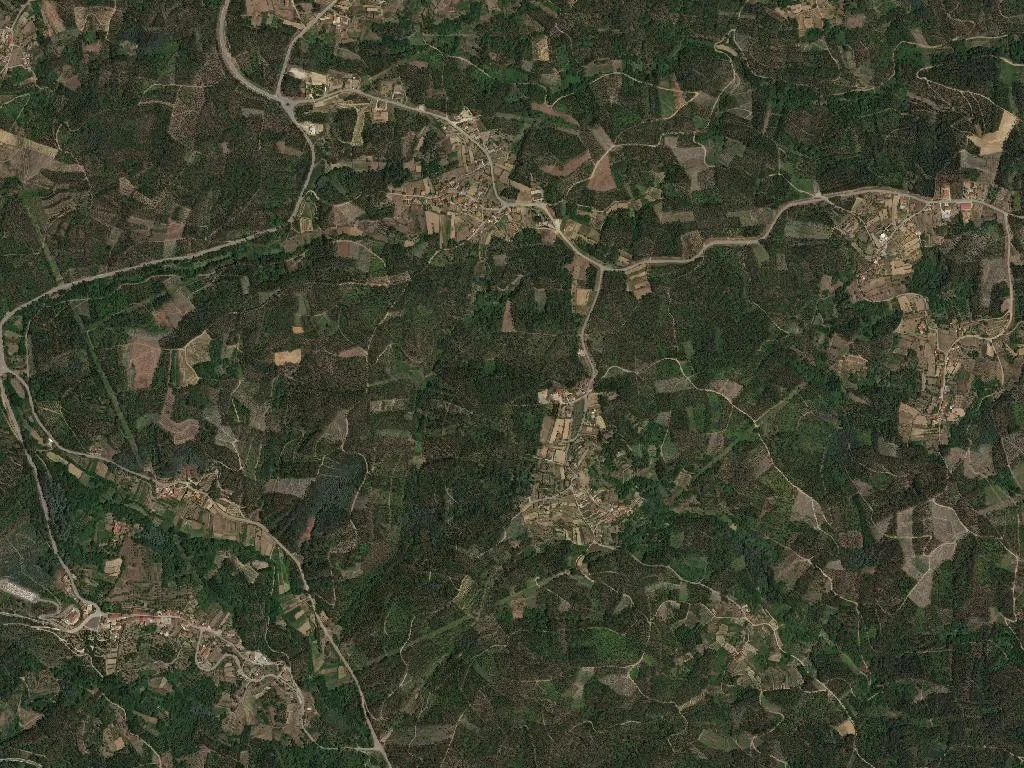
Carvalho spreads across 3,000 hectares of corrugated upland in Penacova municipality, averaging 259 m above the Mondego basin. Only 677 people remain—268 of them past retirement age—giving a density lower than the Scottish Highlands. Houses appear singly, whitewashed cubes with straw-coloured chimneys, linked by dirt lanes that follow the contour lines rather than the clock. When the mist lifts you can count the olive groves by the number of donkeys nodding between the trunks.
Stone That Works
Granite here is not picturesque; it is infrastructure. The parish’s one listed building—an unadorned 16th-century chapel—uses the same stone as the animal troughs and the collapsed olive press whose circular grinding stones still lie like millstones in the long grass. Walk far enough and you’ll find crosses hacked straight into roadside outcrops, their edges softened by lichen rather than devotion. No interpretation boards, no audio guides: just the click of a walking pole on quartz veins that glitter like mica in a school lab.
The Torres variant of the Portuguese Camino cuts through without fanfare. Yellow arrows are sporadic; way-finding relies on the smell of eucalyptus drifting up from the valley or the sudden sight of the Mondego glinting 400 m below. Three converted farmhouses take walkers—no swimming pools, no yoga shalas, just stone floors, ironed sheets and a breakfast of coffee thick as bitumen.
What the Season Gives
There is no restaurant row. Instead, knock on the door with smoke curling from its eaves. Inside, black-pork chouriço hangs over an open hearth until oak smoke lacquers it mahogany. The olive oil comes from the Mondego co-op in nearby Penacova: viscous, peppery, leaving a catch in the throat like good Riesling. On Thursday the pot holds couves and turnips from the garden; on Saturday it might be wild boar if the neighbour’s son had a lucky shot. Pudding is a tangerine, quartered, its skin thrown back on the wood stove so the oils sweeten the room.
Outside, the marked trails are few. Old mule tracks tunnel through gorse and bramble, reopening on sudden vistas of scree and water. Spring brings yellow explosions of Spanish broom; in October the arbutus berries bleed on your boots. GPS falters under the oak canopy, so navigate by the tilt of the land and the temperature drop that tells you a stream is near. Somewhere below, barbel still flick through pools the colour of bottle glass.
Dusk tilts the light until the red earth glows like ember. A dog barks once, more out of habit than threat, and the first blue ribbon of wood-smoke rises straight up in the still air. Carvalho offers no souvenirs, no sunset viewpoint car park. It simply keeps its own time: pruning knife, threshing floor, the slow return of moss across the granite.