Full article about Penacova: Granite Steps, River Glow
Cobbled lanes tumble to the slow Mondego in a Coimbra mountain village scented by water.
Hide article Read full article
Stone Steps to the River
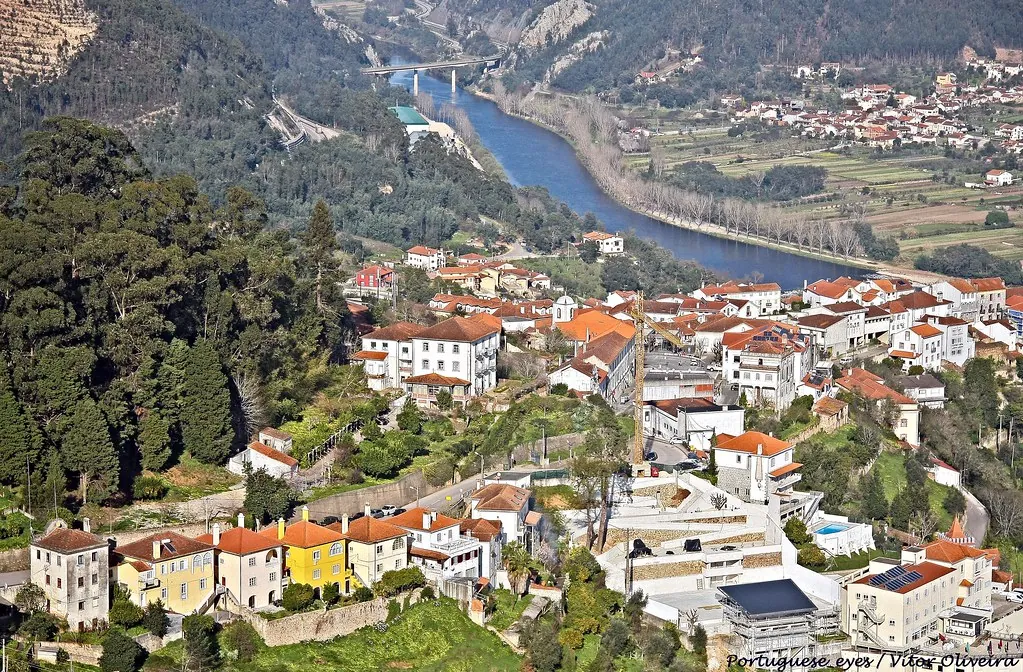
The cobbles drop in uneven flights until they meet the Mondego. By the time the water reaches Penacova it has shed its mountain restlessness; the current slows, the channel widens, and late-day light lays a sheet of polished brass across the surface. Opposite bank and village rise together—eucalypts and umbrella pines climbing a green amphitheatre, white houses terraced into the slope like bleachers facing the water. Even on cloudless mornings the air smells of wet stone and running water, as though the river had left its scent hanging in the streets.
Penacova still orients itself to the water. Where the Mondego meets its tributary, the Alva, the settlement began as a military crossing, became a trans-shipping point for cork and olive oil, and now watches canoe paddles replace oxcarts. Yet the proportions remain human: 2,824 residents across 32 km², a density low enough that conversations carry across lanes and every other gateway reveals a vegetable patch of cabbages and scarlet-runner beans.
Granite & Gradient
The old quarter climbs in lanes so narrow the granite doorsteps spill into the carriageway. The parish church of São Pedro, granted protected status in 1982, is less a monument than a palimpsest—Romanesque base, Manueline window, Baroque bell-cote—its stones patched rather than replaced. Grandeur is supplied instead by topography: houses pinned to the escarpment, retaining walls becoming terraces, streets contouring like lines on an OS map.
From the river-edge garden belvedere the view slips downstream until the water disappears round Cabo do Boi. The valley is a lesson in deep time—Jurassic schist planed by Ice-Age floods, then stitched into human time by vine trellises and olive terraces. Dawn can erase the whole scene under a reservoir of fog, leaving only the distant snowline of the Serra da Estrela floating like an unmoored battleship; by six o’clock the same day, raking sun sets the river on fire.
Current Affairs
Over the last decade the Mondego has acquired a second life. The 13-kilometre glide from Penacova to Casal da Misarela is Portugal’s most forgiving white-water narrative—no grade higher than a ripple, yet enough flow to carry a family downstream in under three hours. The 1947 river station, once the terminus for steam packets bringing university supplies to Coimbra, now rents sit-on-top kayaks for €15 an hour. Neoprene figures weave between herons and the occasional river beach; SUP boards lean against parked cars like casual sculptures.
Accommodation has followed the paddles: 27 small units—apartments, guest houses, a hostel in a former primary school—booked solid between May and the first autumn rains. The Torres branch of the Camino de Santiago cuts through Rua da Igreja, adding a parallel stream of walkers whose boots leave a faint dust of Castile on the granite.
The Quiet Arithmetic
Demography tells a different story. Only 277 children under 14; 859 residents over 65. The tally is visible in the measured shuffle up Rua Direita, in the card games outside Café Central, in the way the centre empties after the 6 p.m. news. What looks like decline feels more like an equilibrium: grandchildren return for August, Wi-Fi routers blink in ancestral kitchens, and the bakery still sells bolos de arroz still warm at seven in the morning.
Darkness settles early. When the last lights go on across the slope, the river becomes an absence, a low black gloss at the foot of the village. The only soundtrack is wind moving through eucalyptus on the opposite hill—an unbroken hush that seems to emanate from the valley itself. No one hurries. Tomorrow the Mondego will still be running, carrying leaves, sky fragments and another day measured out in ripening oranges.