Full article about União das freguesias de Gesteira e Brunhós
Carolino rice fields, Marinhoa cattle and thistle-rennet Rabaçal cheese in Soure’s quiet parish
Hide article Read full article
A winter hearth in the Mondego floodplain
Wood-smoke uncoils above a pantile roof, slow as thought, dissolving into the December sky. Between the hamlets of Gesteira and Brunhós the Baixo Mondego has finished its yearly cycle: the paddies that glittered emerald in August are now steel-coloured mirrors, each furrow holding a precise replica of the low cloud. The only sound is the hinge-cry of gulls that have traded the coast for inland fields, following the river upstream until the land flattens and the Atlantic weather stalls.
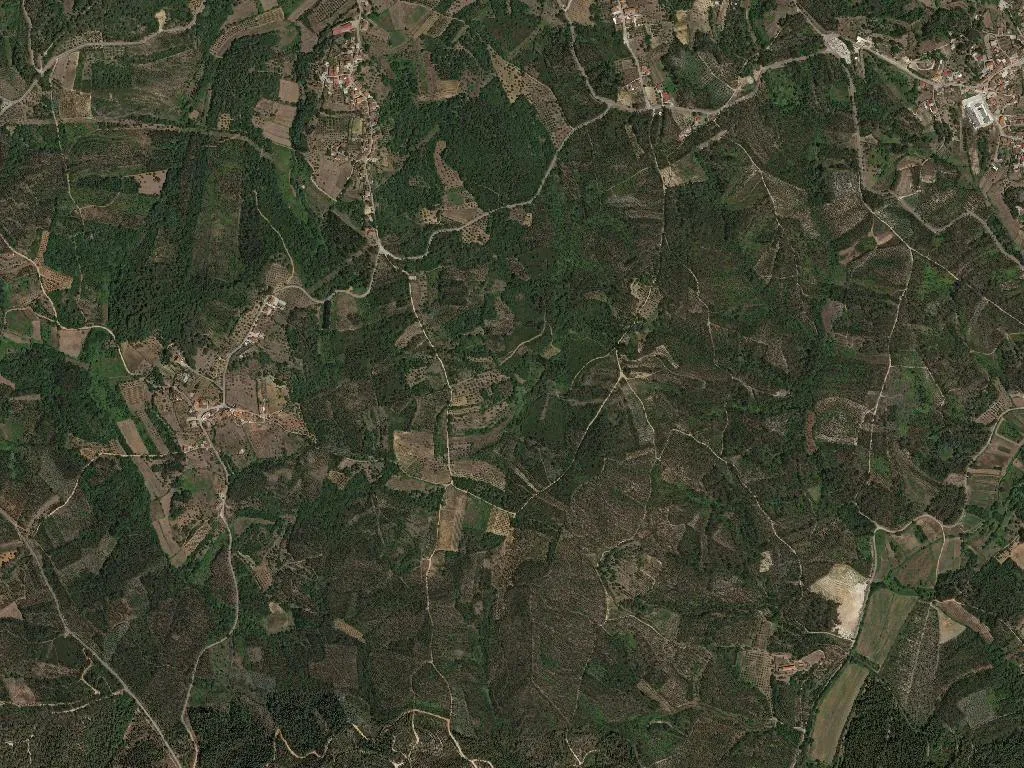
The combined civil parish counts 954 souls across 16 km², an area only fractionally larger than the City of London yet with a population density of 60 per square kilometre – room enough for cattle to contemplate the horizon. At 91 m above sea-level the oceanic air arrives unobstructed, carrying the same humidity that fattens the Carolino rice and drapes the Marinhoa cattle in a fine, dark coat. The breed, protected under Portugal’s DOP scheme since 1996, grazes the same alluvial pastures that once fed Coimbra University’s medieval colleges.
Rice, duck and a sheep-goat cheese
Local cooking does not announce itself; it surfaces. In kitchens where the mantelpiece still holds a ceramic pig-shaped salt cellar, granddaughters measure the exact rinse that leaves starch clouding the bowl – the only way to achieve the creamy suspension demanded by arroz de pato or the blood-enriched cabidela. The grain itself, Baixo Mondego’s Carolino, carries a mother-of-pearl tip that collapses into the stock without surrendering its spine.
Twelve kilometres east, Rabaçal’s Benedictine monastery ruins overlook dairies that mix sheep and goat milk into a semi-soft, butter-yellow cheese. Cut in rough shards, dribbled with olive oil from neighbouring oliveira centenária trees, Queijo Rabaçal DOP tastes of thistle rennet and the limestone meadows that ring the monastery’s broken cloister.
A geography of footfalls
Walk the parish lanes at 15:00 and the loudest noise is your own boot on basalt cubes prised loose by winter rain. Whitewashed one-storey houses stand shoulder-to-shoulder with 1970s brick annexes; behind corrugated gates, pear trees are espaliered against the wall in the Portuguese fashion, while cabbages grow in ruler-straight lines that would gratify a draughtsman. Forty-two per cent of residents are over 65 – a cohort that remembers when the IC2 was still the royal road to Porto and Lisbon. They sweep doorsteps, water geraniums in broken terracotta, and pause at thresholds to assess the sky.
The CM-1050 and CM-1051 run ruler-straight between eucalyptus and pollarded willow, telegraph poles counting down the kilometres to Soure, whose 12th-century Templar castle once guarded these floodlands from Moorish incursions. Today the same flatness that invited invasion now invites storks: their platform nests crown every second pylon, twigs rattling like dry bones when the wind sets the Mondego rice reeds hissing.
Slowness as methodology
There is no visitor centre, no interpretive board, no gift shop. To know the place you must walk the levees where grey herons stand motionless, feel the chill ascend through the soles as dusk lowers, watch the sky flare peach and violet across water that only moments earlier looked leaden. The light turns faster than you can describe it, transmuting the ordinary into geometry: a lone hay bale becomes a Henry Moore, the irrigation ditch a Pollock of reflected clouds.
Authenticity here is not performance but repetition – the same sowing, flooding, draining, harvesting that fed the monks of Rabaçal and now supplies restaurants in Bairrada and Coimbra. Few who eat the finished rice will ever see the exact field, feel the clay squeeze between fingers, or catch the scent of fertile silt stirred by the first spring plough. That sensory ledger belongs to the 954, and to whoever lingers long enough for the smoke from a winter hearth to vanish into the colourless sky.