Full article about Arrifana’s Dawn: Silence Carved in Granite
In Vila Nova de Poiares, Arrifana wakes to chapel bells and pine-cooled air
Hide article Read full article
The Weight of Sunlight
Dawn slips in sideways through the gaps in the timber shutters, laying pale rulers across the uneven boards. Outside, the bell of São Vicente — a modest 1835 rebuild of a chapel first raised two centuries earlier — releases a single, metallic note that ricochets down the valley until the pine-covered folds absorb it. Arrifana wakes without urgency, at the tempo of someone who can calibrate the exact heft of each season.
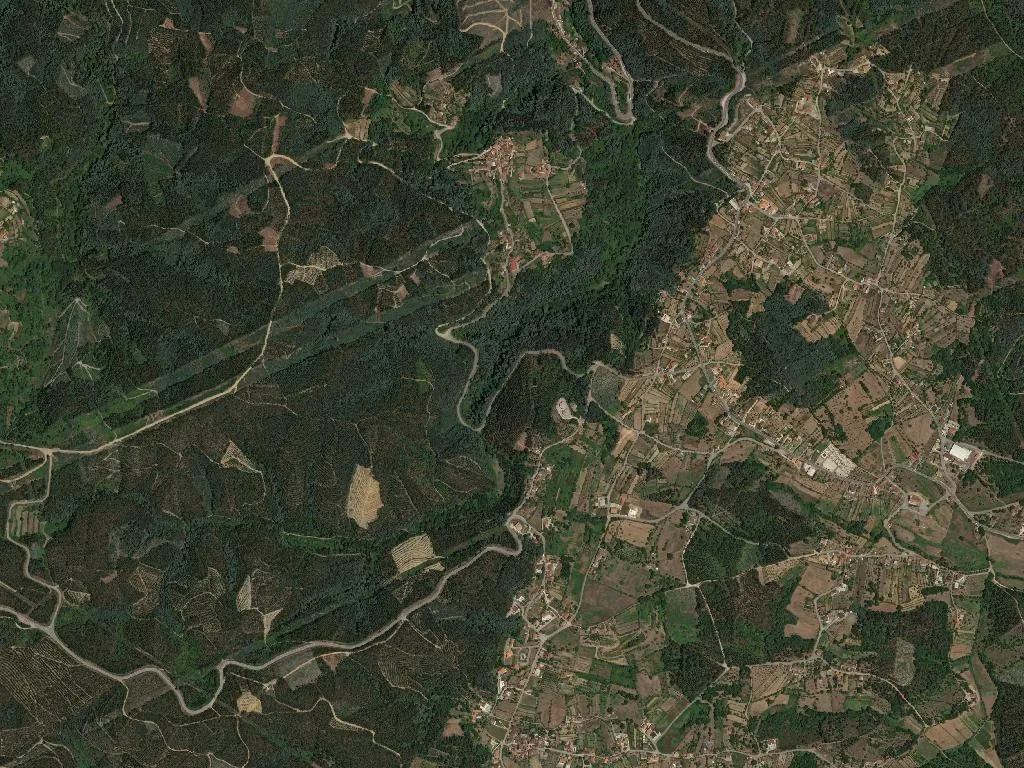
The civil parish stretches across 23 square kilometres of creased granite, averaging 200 m above sea-level. Population density hovers at fifty souls per square kilometre, low enough for silence to feel like topography. The 2021 census counted 1,219 inhabitants; 364 are older than 65. Their sun-creased faces and slowed gestures sketch the demographic map now common to most of Portugal’s interior.
Monday’s Gravity
To walk the lanes is to move through a landscape edited down to fundamentals. There is no café chatter, no parade of shops, no Airbnb key-safe clutter. Tourist accommodation is limited to three guest rooms at the Casa do Forno — a statement of economic discretion rather than marketing strategy. Daily life is bounded by single-storey stone-and-lime houses, waist-high walls protecting vegetable plots of kale and runner beans, and dirt tracks that climb towards the Vale slope.
Granite quoins glint on newer corners; older walls are quilted in schist. At noon the stone is almost white, the shadows surgical; by late afternoon everything softens to ochre. After rain the air smells of turned soil; in August the narrow streets exhale stored heat long after sunset.
Green Ledger, Stone Ledger
Nature here is not wilderness but an audited asset. Maritime pines cloak the steeper faces, planted in the 1940s by the Interior Settlement Board to stop erosion and furnish resin. Eucalyptus arrived after 1990, promising faster returns; Pyrenean oaks survive in pockets too awkward to mechanise. The Arunca River — a Coimbra tributary that will feed the Mondego — begins as a seasonal trickle at Portela da Figueira, turning torrent when December storms stall over the Açor massif.
There are no ticketed viewpoints, no baroque convents repurposed as museums. Memory is stored instead in micro-toponyms — Cerqueira, Codeseira, Corga da Serra — and in the south-facing orientation of houses that turn their backs to the Atlantic-born norte. Terraces follow medieval contours; every ancient olive was positioned with the thrift of someone who expected grand-children to harvest.
The Stubborn Hearth
When the sun slips behind the Serra do Açor, shadows lengthen like spilled ink and the temperature drops fast. A gate clangs; a chair scrapes on cobbles. Existence is measured in repeated motions: pruning shears wiped on denim, kindling split with the same worn axe, coffee taken in the same thick-rimmed glass. The last GP stopped the weekly visit in 2019; the primary school closed four years earlier. Yet smoke still rises perfectly vertical from a chimney, carrying the scent of pine resin and ash — a quiet declaration that, for tonight at least, someone is still keeping the ledger of daylight and firewood balanced.