Full article about Terena’s whitewashed alleys echo with paprika smoke
Castle keep, May pilgrimages and slow-cured Alentejo sausage in Alandroal’s hill village
Hide article Read full article
Sunlight and silence
The May sun slants through the crenellations like a blade. In the Jardim da República, almond blossom drifts onto a marble pillory erected the year Chamberlain flew to Munich. Beneath it, three old men speak in the low, unhurried cadence of Alentejo Portuguese while a mongrel sleeps across their shadows. The village whitewash throws the light back so hard you walk half-squinting; locals call it “the Alentejo mirror”. Between the walls the air smells of rosemary smoke and the slow burn of holm-oak logs.
Stone and story
At 384 m the castle keep still commands the Guadiana plain. Its square towers were rebuilt in 1410 by João I in gratitude for Terena’s loyalty during the 1383-85 succession crisis; the same stone later saw off the Spanish in 1640 and the French in 1808. Walk the parapet and you’ll share it with cats that know every arrow-slit by heart. Inside the parish church – begun 1575 over a Visigothic core – the air is beeswax and incense. Solomon’s-knot ribbing shadows a gilded niche where the 13th-century statue of Nossa Senhora da Boa Nova waits for the first-May pilgrimage first recorded in 1623. When the slow procession files out, the Filarmónica de Terena (founded 1887) strikes up a march that lingers until the last ember of the night’s bonfire dies.
Smokehouse chronicles
Pig-killing still follows the lunar calendar: January–February, never on a full moon. In farm kitchens women massage paprika and garlic into the coarse Estremoz-Borba chouriço, then hang it from balcony rails to ride the three-week winter winds. Farinheira sausages bronze in the smokehouse for a fortnight; blood-and-rice morcela rests in cool pantries. Maria dos Anjos, 87, learned her garlic-açorda with poached eggs from a grandmother who cooked at the local manor when Pombal was reforming the wine trade. In March she forages wild asparagus from verge and ditch; by Easter the clay pot of ensopado de borrego has simmered for three hours over a Nisa-potteried hearth. When Alqueva’s fishermen truck sea bass and lamprey the 15 km from Amieira, the soup kettle takes over – coriander-sharp cação broth or lamprey à la bordelaise, both demanding the patience of hands that have filleted for six decades. Finish with DOP Elvas plum morgado, its fudged darkness offset by a glass of Borba or Redondo – sub-regions stitched into Terena’s terroir since the 1908 demarcation.
Submerged kilns and cork trails
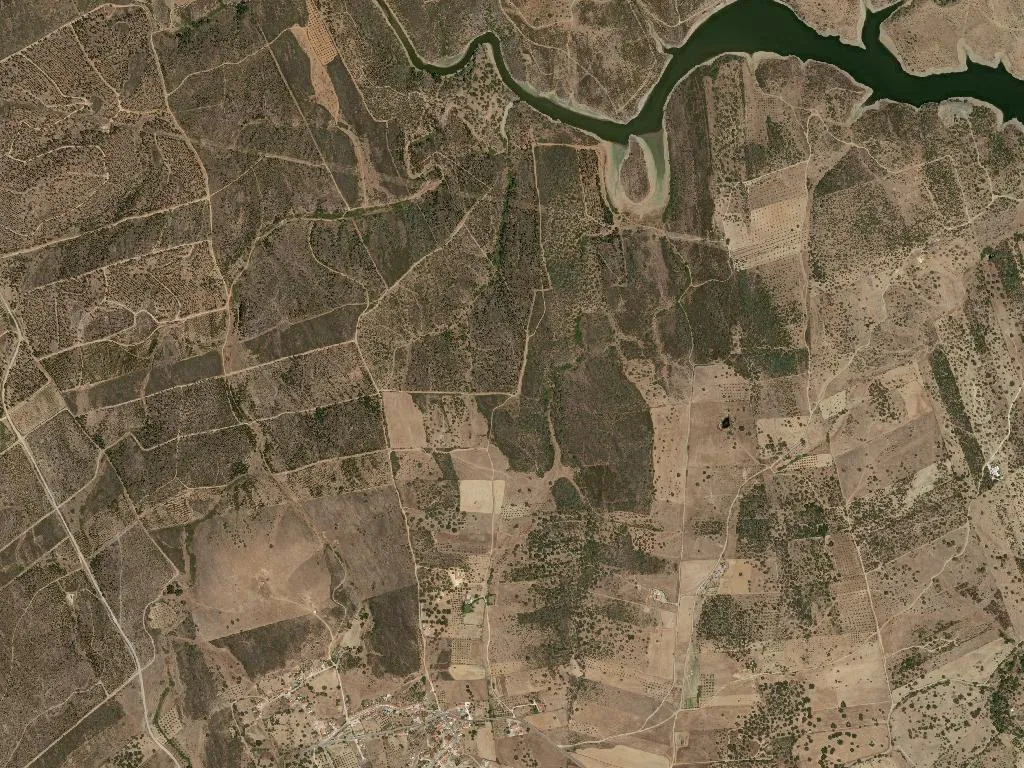
A kilometre away the Lucefecit reservoir glints petrol-blue. Launch a kayak and you glide over the ghost village drowned in 1951: potters’ kilns, a threshing floor, the stone bed of the old Ribeira de Lucefecit. Joaquim “O Oleiro”, 94, keeps the GPS co-ordinates of his father’s kiln on a folded slip of paper. On the 11-km circular walking route approved in 2018, dry-stone walls – 847 of them counted in 2020 – parcel the landscape into heirs of the 1654 Aldeia estate. Dawn fog turns cork oaks into paper-cut silhouettes; acorns clatter onto schist, 15–20 kg per tree each autumn, the same mast that fed the pigs that flavoured the chouriço now dangling in the village smoke.
First Sunday of the month
By 9 a.m. the Jardim da República is already an antiques fair sanctioned by Alandroal town hall in 1997. Cracked- glaze jars from S. Pedro do Corval – 12 km away and potting since 1865 – sit beside rusted ploughs Antonio hauled from the farm where he was born in 1936. Between stalls the village choir, ages 52 to 78, launches an impromptu desafio: “Ó Terena, minha terra gentil / onde o Alentejo começa a nascer”. Children weave through knees; elders guard paper bags of sun-dried plums at €3 a kilo. At Café “O Celeiro”, open since the Carnation Revolution, espresso still costs 60 cêntimos – the cheapest in the municipality.
When the afternoon heat draws the shade tight under the almonds, climb the battlement one last time. The plain unrolls like tawny corduroy to the Spanish horizon, and the only moving thing is the glint on the reservoir eight centuries after the first Templar stones were laid. The church bell – cast in 1923 at Cacilhas, three minutes slow and nobody bothering to correct it – tolls across the empty air, measuring time the village has never rushed to keep.