Full article about Sun-Scorched Silence in Gafanhoeira
Gafanhoeira (São Pedro) bakes under Alentejo light: 16th-century church, oak montado, thistle-set Queijo de Évora and a café that measures the day.
Hide article Read full article
Sunlight on Whitewash
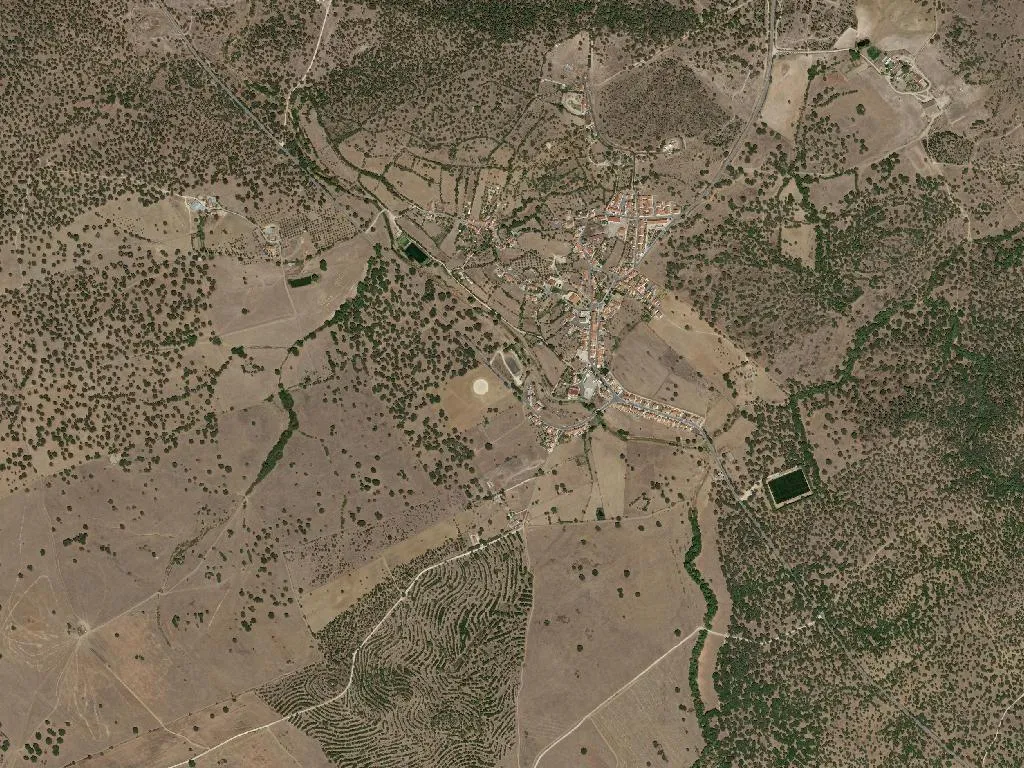
The Alentejo light hits the walls of Gafanhoeira (São Pedro) like a slap: bright, abrasive, almost white-hot. At two o’clock in the afternoon the village is an acoustic vacuum – not emptiness, but a dense hush that presses against the ears. Three hundred and seventy souls are scattered across forty-six square kilometres of wheat stubble and montado; each farmhouse, olive grove and rusted gate is given its own generous hectare of silence. The land lies at 238 m, high enough to let the horizon stretch without theatrical cliffs or river gorges, only the low swell of cork oak and dry-stone wall rolling eastwards until the sky folds over itself.
Stone and Accumulated Hours
Igreja de São Pedro, listed since 1957, squats at the crossroads like a veteran farmhand taking a breather. No ropes, no audio guide, just a sixteenth-century skin of schist and lime that has absorbed four centuries of sun and incense. The Manueline doorway survived the 1858 earthquake; a side porch still holds the jumble of bones of long-gone parishioners, neatly labelled but unashamedly visible. Inside, the air smells of candle wax and the cool breath of stone; fresco fragments flake above the altar like dried eucalyptus bark.
Demographics read like a medieval ledger: 123 residents over sixty-five, 34 under fourteen, the middle generation largely absent. Everyone is on first-name terms with the wind. The only commerce is Zé’s café, whose metal shutter rattles up at 07:00 to dispense the first bica to the men heading for the wheat and oats. By 10:30 the counter is a constellation of half-finished espressos and gossip that will dictate the day’s rhythm.
Taste of Territory
In the stone cellar beneath Quinta das Covas, Mariazinha turns 06:00 milk from three goats and twenty Merino ewes into Queijo de Évora DOP. The raw milk is coagulated with cardoon thistle, hand-ladled into cylindrical moulds, then left to cure on rough-sawn pine racks for ninety days. The rind wrinkles from parchment to battleship grey; the paste moves from spreadable to brittle, acquiring the faint citric bite that makes Alentejo reds taste almost sweet by comparison. On the Feast of São Pedro (29 June) the same flocks reappear as Borrego de Montemor-o-Novo IGP – lamb that has grazed only on cork-oak pasture and wild herbs, roasted with peppery spearmint rice and poured into bowls heavy enough to keep the mistral at bay.
António Carvalho, an Évora oenologist, hand-picks Aragonez and Trincadeira from eight hectares of schist at Herdade do Pinheiro. Yields are a miserly 15 000 bottles a year; potential alcohol is stopped at 14.5 % to keep the tannic spine straight. Locals claim the whites – Antão Vaz, mostly – carry a salinity that shouldn’t exist this far from the Atlantic, a reminder that the ocean’s breath once reached this far inland.
Slowing to Standstill
There is no programme here. The single guesthouse, Casa da Eira, is a converted threshing barn with two bedrooms and a salt-water pool that reflects the Milky Way like polished pewter. Days are spent walking the red-dust tracks to Pego da Moura, a former livestock pond now colonised by teal and the occasional egret. The only soundtrack is the dry rattle of oak leaves and the soft percussion of your own footfall. At dusk the sky performs its daily colour-wheel – vermilion dissolving into bruised violet – while a village dog called Manel gives a single, half-hearted bark, then thinks better of it. By the time the stars surface, unpolluted and extravagant, you have already forgotten the speed of everywhere else.