Full article about São Gregório & Santa Justa: Alentejo’s 437-Soul Silence
União de São Gregório e Santa Justa hides raw-goat cheese, medieval views and a 17th-century church served by a weather-dependent priest.
Hide article Read full article
The Silence Has Weight
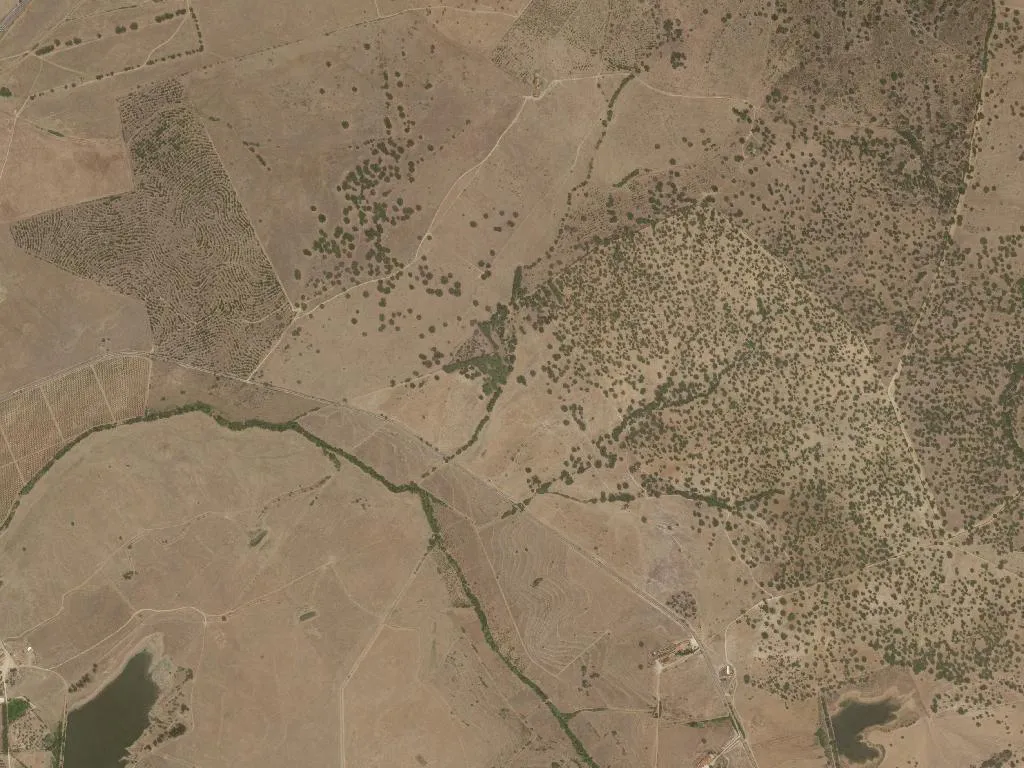
The air is so still it feels upholstered. Over 117 km² of montado only 437 souls are scattered, giving each resident the breathing room of a small London borough. A black kite tilts overhead; its wing-tips scuff the sky like chalk on slate. Otherwise nothing moves except the slow peeling of lime-wash from estate walls – flakes so thin you could roll a cigarette with them.
What the merger left behind
In 2013 the government stitched São Gregório and Santa Justa together to save money. The marriage changed nothing on the ground. São Gregorio still orbits the medieval belt of Arraiolos castle three kilometres away; Santa Justa remains a loose confederation of smallholdings whose only public house is a roadside café on the way to Mora. There are no patron-saint processions, no summer fairs. A priest drives out from Évora when the weather permits, unlocks the single-aisled 17th-century church, and celebrates mass for a congregation that averages twelve. The sole listed monument is the old threshing floor: a ring of granite slabs where dogs now nap and octogenarians point at the stone they once trod barefoot to winnow wheat.
Cork, holm oak and cheese that tastes of straw
The parish lies inside the Natura 2000 site “Mourão, Moura e Barrancos”. Cork and holm oak open like savannah, interrupted only by seasonal streams that speak in winter and fall mute by June. Children use the dry stony bed of the Ribeira de São Gregório as a Scalextric track. At 256 m the ridge gives a pilot’s view: wheat-coloured plain dissolving into a blue-brown seam. Wild boar plough the dusk; storks clatter like loose scaffolding whenever the wind rocks their nests.
Food follows Alentejo syntax: coriander-sharp açorda, lamb stew set on the hearth before dawn, migas that drink the juices of home-made sausage. The cheese is raw-goat, cloth-bound, without DOP protection yet tasting of warm milk and barn air. When Dona Lurdes fires the wood oven the village wakes to the smell of crust the size of truck wheels. Sweets appear only for visitors: queijinhos do céu traced to a sister who entered the Évora convent in 1952, and honey cake that keeps for months inside a terracotta pot.
Low-intensity encounters
No way-marked trails exist, but farm tracks link estates well enough for mapless walking. The sunken lane between São Gregório and Herdade do Pinheiro passes 500-year-old olives scarred by Civil-War bullets. Arraiolos – famous for its circular castle and hand-stitched rugs – is fifteen minutes away by car; coming back, the tarmac dwindles to dust among the oaks and you remember how thinly the world is peopled here. A handful of blue-doored workshops still produce the wool-on-linen carpets: knock and Dona Fé, 78 years at the frame, will show you the Arraiolos stitch if the day is mild. Nine houses are registered for rural tourism; at Herdade da Samqueiro João serves breakfast with bacon from the pig killed at Christmas and fig jam his wife stirs before first light.
The church opens Wednesdays and Sundays. Inside, high windows project pale rectangles onto flagstones dished by centuries of knees. Outside, the wind combs the branches and carries the tang of burnt eucalyptus when farmers clear their plots. Emptiness here is not absence – it is the place’s working material, stretched like bread dough and audible as music.