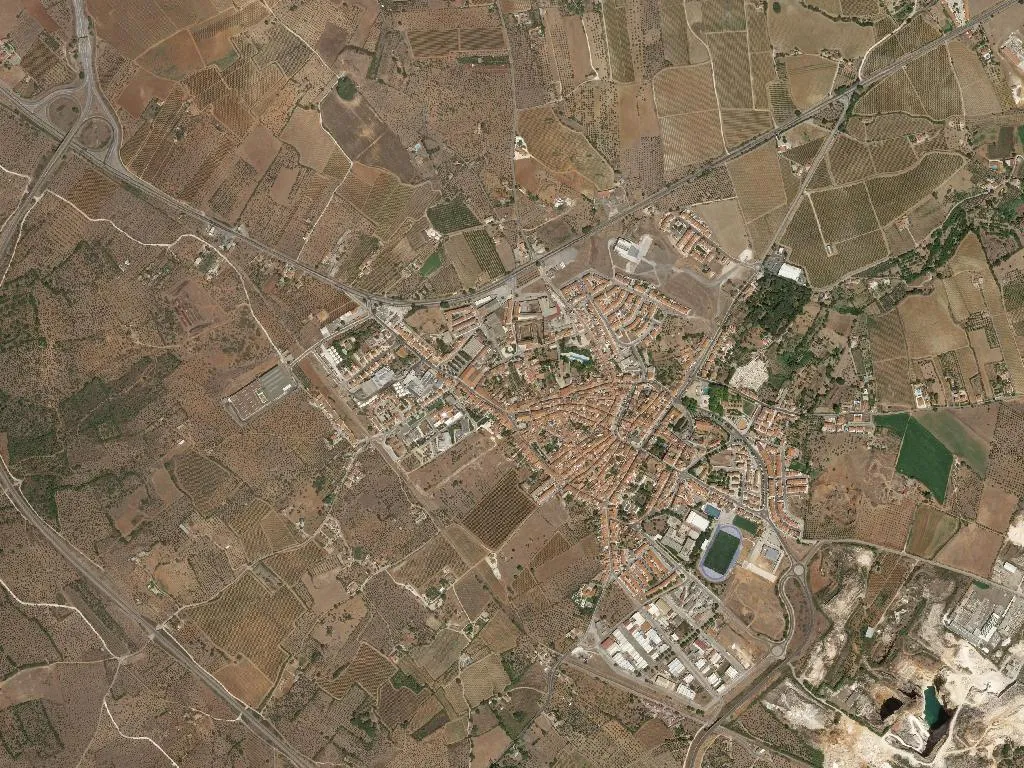
Full article about Borba’s Marble Dawn: Footsteps on Alentejo Stone
São Bartolomeu parish wakes to chill light glancing off marble streets older than its 604 souls.
Hide article Read full article
White underfoot: marble as morning light
The first thing you notice is the glare. Not the blinding, sun-on-chalk sort that belongs to the coast, but the chill, bone-white gleam of marble that has been sliced, planed and laid as pavement, doorstep, windowsill and drinking fountain. At dawn, when the sun is still skimming the terracotta roofs of Borba, the stone drinks in the light and gives it back as a cool, almost damp shimmer. Footsteps snap against the slabs with a dry clarity you rarely hear outside a cloister. The air, 416 m above sea level, carries a snap you do not expect this far south in Alentejo – a thin blade of cold that nips the ears until the sun hauls itself higher.
São Bartolomeu, the medieval kernel of a parish numbering exactly 604 souls, is silent at this hour. A single dog barks behind a wall; a wooden shutter groans. Nothing more.
Thirteen monuments, six hundred neighbours
The arithmetic is disarming. Twenty-odd hectares, 258 residents over the age of 65, only 56 under 14, yet the parish safeguards thirteen listed buildings – one National Monument, four Properties of Public Interest. Such density of patrimony is usually reserved for cathedral towns. It is explained by centuries of revenue from marble and wine: every carved portal, every dressed-stone façade, every corner chapel is capital made visible, petrified in situ.
Walking here feels like leafing through a pattern book of stone. Marble is not merely building material; it is dialect. In the door jambs, the worn steps, the cemetery crosses, the white stone threaded with grey veins tells a story of extraction and craft that predates the 1512 foral (charter) granted by Manuel I. Touch the surface that centuries of shoes have burnished and it feels almost organic – warm in afternoon sun, icy in shade.
Smoke in the air, slow milk in the kitchen
The roll call of protected produce reads like a winter lunch that demands a wooden table, crusty bread and a bottle you do not stand on ceremony to open. Chouriço Grosso de Estremoz e Borba IGP arrives in thick coins that bleed paprika and garlic onto the fingers. Farinheira, a flour-based sausage, collapses into airy flakes the moment the pan is hot. Blood morcela, lean paio loin, streaky toucinho – each exhibits a different ratio of lean to fat, a different week of curing. Nothing of the pig is wasted; everything is timed by the cool, dry January air that drifts down from the Serra d’Ossa.
Then comes Queijo de Évora DOP – small, firm, sheep’s-milk, sharp enough to make a red wine taste instantly sweeter. The plums that carry the name of neighbouring Elvas are grown in the same limestone soils; their sugars concentrate behind ancient city walls before becoming Ameixa d’Elvas DOP. Finally, cold-pressed Azeite do Norte Alentejano DOP lands on the table in an unlabelled bottle that never quite empties.
Red that stains the glass
Borba is one of the Alentejo’s four sub-regions whose name appears on bottles in every Lisbon wine bar. The local calendar is still governed by pruning, harvest and lees-stirring; the marble you stand on in the street is the same stone that lines the lagares where grapes are trodden. Altitude tempers the summer furnace: daytime heat hovers around 35 °C, nights drop to 14 °C, locking colour and tannin into the skins. The resulting tint is almost opaque – ruby turning to soldered violet. Sit on one of the four small guest-house balconies that overlook the square, swirl the glass and the wine tastes exactly like the air smelled at midday: warm schist, rosemary, distant woodsmoke.
Quiet as structure
With roughly 3,000 inhabitants per km² – a statistic that sounds urban until you realise the entire parish could fit inside Regent’s Park – São Bartolomeu is built for walking slowly. You will meet one, perhaps two, people in an entire street. Doors stand ajar; interiors remain in sepia darkness. The rhythm is not imposed; it is absorbed.
Accommodation is limited to four small properties: two manor-townhouses, one wine-maker’s loft, one cottage tucked into the old city wall. No spa, no infinity pool, no imported Carrara in the bathrooms. The marble is already under your feet, in the public fountain, on the church floor – everyday, not exhibition.
Last light, first ember
Towards six o’clock the sun slips into amber, shadowing the façades across the polished pavement. A wisp of smoke – holm-oak from a hearth, perhaps the last sigh of a bakery oven where a farinheira has just split – drifts above the eaves. Stand still, soles on stone that is still giving back the day’s heat, nose sorting chimney from cellar, and Borba fixes itself in memory not as an image but as a temperature: the precise moment when the cold descending from 416 m meets the last warmth rising from white marble that refuses, quite yet, to let the day end.