Full article about Orada
Orada (Borba, Évora) offers slow Alentejo life: hand-cured *fumeiros*, DOP cheese, cork groves and hush only footsteps break
Hide article Read full article
The Weight of Years and the Taste of the Land
The first thing you register in Orada is the hush. Not the vacant quiet of the Alentejo’s endless wheat belt, but a listening silence, stitched together by a blackbird somewhere in the distance and the slow groan of a wooden door being pulled shut at the far end of the lane. Five-hundred-and-seventy-seven souls are scattered across 5,200 hectares; population density is measured here in bootsteps between houses and the seconds an echo takes to die on whitewashed walls.
At 336 m above sea level, the village gives you Alentejo without the brochure. No marble façades flash in the sun, no baroque palace demands to be ticked off. Orada is built from reticence—single-storey cottages the colour of old bone, low doorways, window slits that trap cool air in July and keep it there until October. The parish technically belongs to Borba, yet it follows its own lunar clock, miles from the coach parties queuing for cellar-door tastings in Vila Viçosa.
Smokehouses and Slow Curd
One hundred and seventy-two residents are older than 65, and they are the archive. Ask about fumeiros—the little smoke-blackened sheds behind every cottage—and they’ll tell you how the family pig once lived under the same roof as the chickens until November, when the air turned metallic and the killing season began. Thick chouriço, blood-slick morcela, farinheira sausages the colour of burnt earth: all still carry the IGP shield of Estremoz–Borba, and all still appear on lunchtime tables without ceremony.
Breakfast is a wedge of Queijo de Évora DOP, the centre shrinking to a sharp, milky tang as it ages, and green-gold olive oil from the cooperative at neighbouring Dom Miguel, dribbled over yesterday’s loaf. At the end of August the Ameixas de Elvas DOP are spread on rush mats to shrivel into sugar-rich prunes whose flavour is somewhere between Medjool date and Pedro Ximénez.
Vine Rows and Cork Shadows
The parish sits inside the Alentejo wine belt, yet its name never appears on back labels. Vines are trained low to the ground in strict rectangles; the harvest starts at dawn so the grapes reach the press before the day’s furnace is lit. What ends up in bottle is a taut red that tastes of graphite and sun-baked schist—more sinew than the plush reds Borba trades on, a wine that needs a decanter and patience.
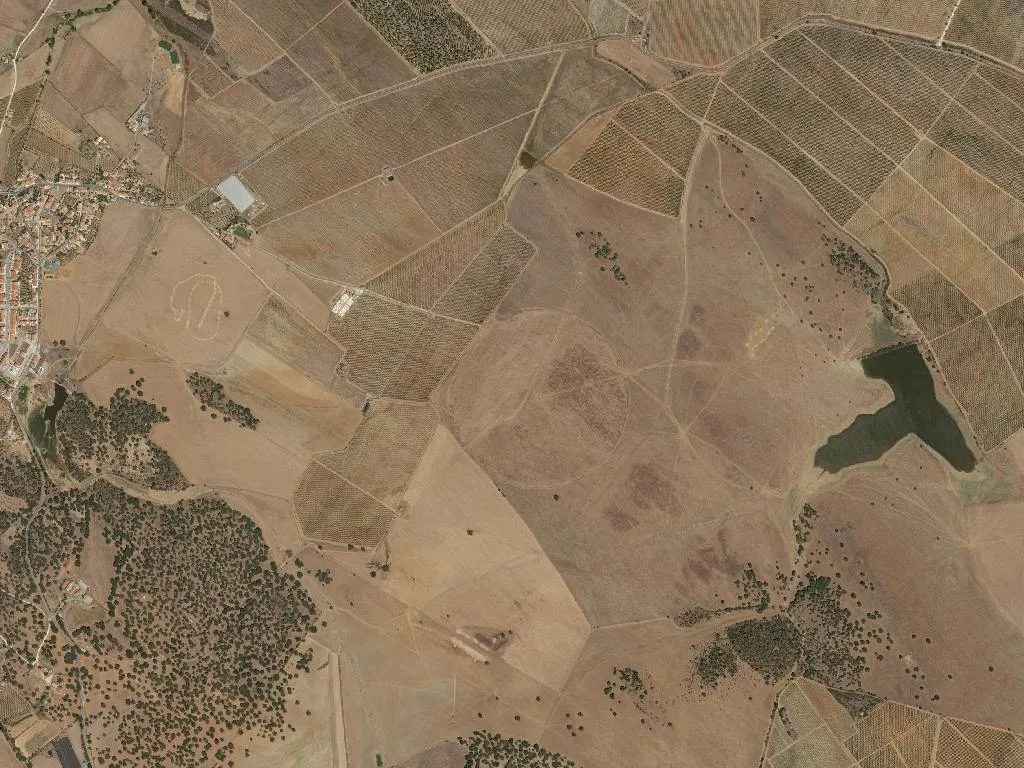
Beyond the vineyard the land arranges itself in repeating stripes: olive, cork, pasture, olive, cork, pasture. The beauty is horizontal and cumulative. At six o’clock the low sun ignites the orange trunks of the cork oaks and every tree throws a shadow twice its height, as if the montado were trying to escape its own roots.
What Remains
There is only one place to stay: a rambling country house on the edge of the village, booked by word of mouth and paid for with a bank transfer that may or may not clear before you leave. Guests don’t come for “experiences”; they come for the inverse of experience—waking when the room fills with light, walking until the track turns to dust, sitting under an olive whose trunk resembles melted wax and doing absolutely nothing while a hoopoe ticks overhead.
With 11 inhabitants per square kilometre, the arithmetic is simple: you can drive for ten minutes and meet no one, only a gate topped with curling ironwork and a dog that refuses to bark. Orada yields itself slowly. It asks for an hour in the grocery-café while the owner finishes a phone call, for a conversation about rainfall that is really a conversation about who has left and who has stayed.
When you leave, what lingers is a scent you can’t bottle: woodsmoke sliding from a chimney at dusk, dry earth cooling, crushed rosemary along a stone wall. Weeks later it ambushes you on a London street, and for a moment you are back on that lane, bootsoles white with dust, the silence so complete you can hear the blood in your ears.