Full article about União das freguesias de Bacelo e Senhora da Saúde
Sun-baked granite chapels, wheat plains and zero traffic five minutes from Évora’s Roman heart
Hide article Read full article
The Plain That Feeds the City
Heat rises from the soil in visible shimmers. At 258 m above sea level, Alentejo light doesn’t merely illuminate—it presses down, settles on terracotta roofs, slips through shutter gaps, turns every patch of shade into currency. In the civil parish of Bacelo e Senhora da Saúde, 18,000 people begin the day with the rattle of roller-blinds, each household negotiating its own private truce with a sun that has been warming whitewashed walls since seven o’clock.
Two parishes, one invocation
The 2013 administrative merger stitched together two communities that had long shared the same red earth outside Évora’s Roman walls. Bacelo probably derives from “abacelo”, the old term for a wheat store, though no one can prove it. Senhora da Saúde is clearer: a plague-time chapel dedicated to the Virgin of Health, raised when prayer doubled as public-health policy. The epidemics retreated; the name stayed.
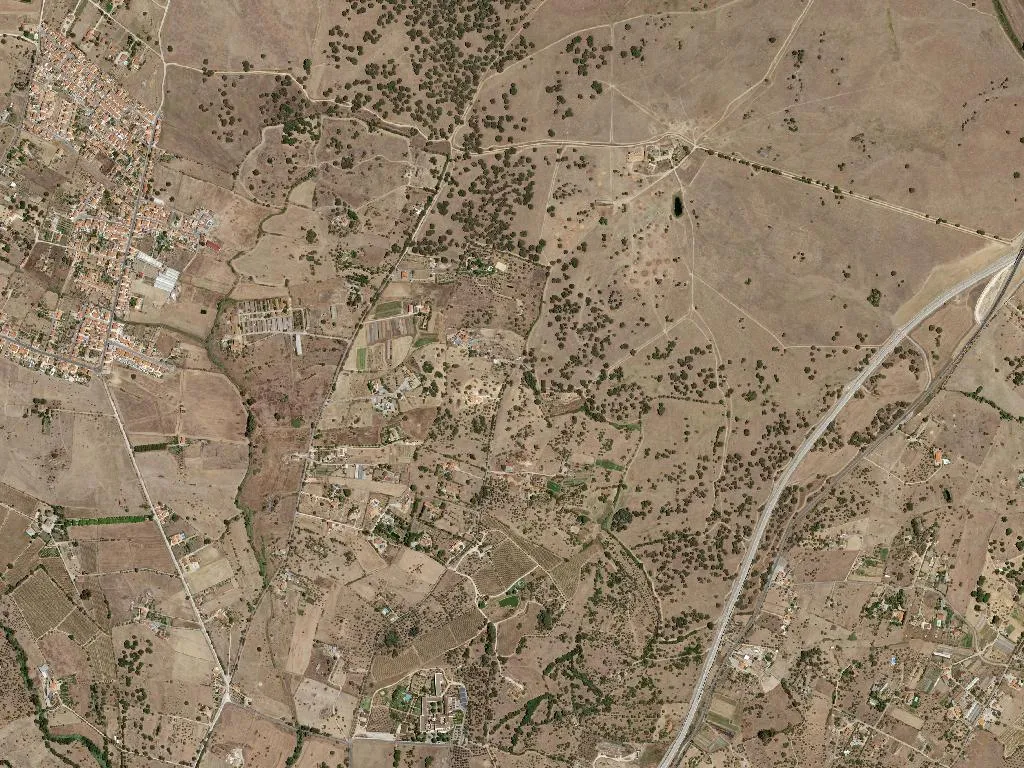
Today the parish covers 46 km² that function as the city’s lungs. It is not a suburb—it is where Évora comes up for air, where cockerels still keep time and where crossing the lane means waiting for one Citroën, not twenty.
Four national monuments and granite that refuses to crumble
Four classified monuments for a parish this size is the architectural equivalent of an extended family boasting four celebrities. The headline act is the ruined Convent of São Bento de Moçarache—despite the name, neither in Moçarache nor inhabited by monks for centuries. Granite blocks and lime mortar defy a sun that treats 40 °C as a casual greeting; the walls glow salmon-pink at dusk, dense enough to keep interiors deliciously cool.
Stay here and you gain two things: a five-minute drive to Évora’s Roman temple and a room bill half that of anywhere inside the city walls. The 24 legal lodgings range from locked-up-for-winter holiday flats to spare rooms let out by parents whose offspring have migrated to Lisbon. Night-time silence is absolute—only the occasional freight train rattling across the plains reminds you the 19th century passed this way.
What the land puts on the table
Queijo de Évora DOP arrives at table like a small, obstinate stone. It is thistle-set, not renneted, and delivers a sheep-milk punch that makes novices blink before they reach for more. Locals judge quality by watching foreigners pull exactly that face.
Beef in the parish butchers comes from cattle that grazed where a new roundabout now circles; Carnalentejana steak and Montemor lamb need nothing beyond rock salt, vine-pruning smoke and patience. Olive oils sting the throat when sipped neat—the mark of high polyphenols and careful cold-pressing. Wines are poured from unlabelled bottles kept in Uncle Fernando’s garage; they taste of schist, cork bark and grandparents’ weddings. Oenophiles raise eyebrows, then ask for the vineyard’s name.
Generational arithmetic
Open the demographics and you find 2,416 children under 14 and 4,104 residents over 65—roughly two primary schools of kids and almost five of pensioners. At 382 inhabitants per km² you actually meet neighbours; this is not one of those Alentejo hamlets where the nearest living soul is a 2 km drive away and Sundays resemble post-apocalypse films.
The health centre is permanently busy, the pharmacy dispenses half the parish’s medication from memory, and by 10 a.m. the Café Imperial is standing-room only. The missing middle—forty-somethings—mostly work in Lisbon or abroad, but they flood back each weekend to deposit children with grandparents and eat açorda bread soup the way their mothers insist it must be made: garlic-laden, coriander-green, egg-yolk-yellow.
Shade as destination
Late afternoon, when the thermometer finally drops a symbolic degree and the light turns the colour of aged Madeira, village verandas fill. The scent of wood-fired dinners drifts out before the day’s dust has settled.
On the corner of Rua da Escola, Zé Manel parks his plastic chair, a glass of tinto and a bowl of lupin beans within reach. He is not posing for tourists; he is doing what he does every day once the sun relents. That is what lingers long after guidebook monuments blur: the simple choreography of splitting a cheese, flooding it with olive oil, handing half to whoever appears. Nothing spectacular—just true, and round here that is more than enough.