Full article about Echoes of Évora: granite, gold & Roman bone
Walk São Mamede to Santo Antão where every cobble hums with 2,000 years of Lusitanian life.
Hide article Read full article
Évora: a city to be read in stone
The first thing you notice, before you’ve seen anything at all, is the echo. Shoe leather hits convex cobbles—stone planed smooth by Roman sandals, iron-shod hooves and the iron tyres of 19th-century carts—and the sound comes back hollow, as though the ground were several metres deeper than it looks. Early light slants down the funnelled lanes of the old centre and ignites the plasterwork: not white, but the colour of old Double-CRM, ochre where the render has flaked away, nicotine where the sun has baked it for decades and no one has repainted. At 305 m above the Alentejo plain the air outside is wide-open; inside the walls it is thicker, scented with hot granite and something older you can’t name.
Where Rome still stands
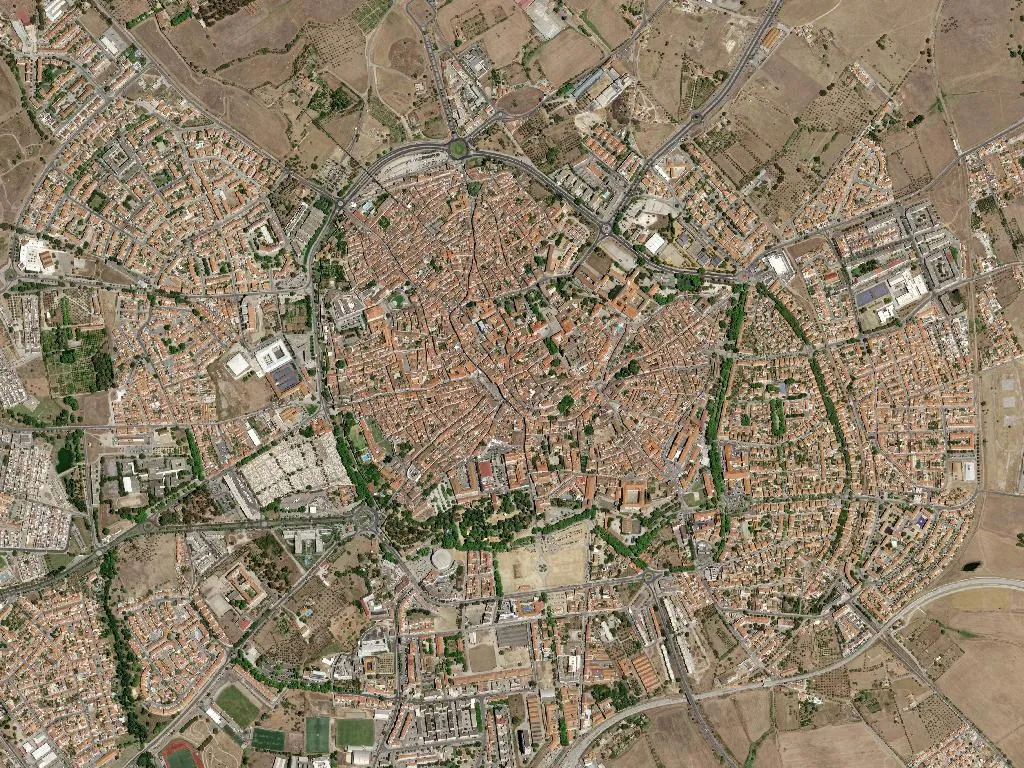
Évora’s so-called Temple of Diana doesn’t ask permission—it simply arrives. Fourteen pink-granite Corinthian columns carry a fragment of architrave the wind has failed to erase. The Romantic label (Diana) is nonsense; the stonework is first-century AD, from the days when the town styled itself Ebora Liberalitas Julia. The province of Lusitania turned this hill into an administrative hub, and the skeleton that survives is still load-bearing, not museum-ready. Around it the city rewrote itself for the next two millennia: Visigoths (5th–8th C), Moors (712–1165), medieval kings, bishops, friars, students. Forty-eight listed monuments are crammed into the civil parish union of São Mamede, Sé, São Pedro and Santo Antão—an area only a third the size of Regent’s Park. Twenty-nine of them carry Portugal’s top “National Monument” tier. History is underfoot before you go looking for it.
Granite that weighs on the soul
Work on the cathedral began in 1186, two decades after the Christian reconquest, and the bulk is still in charge. The west front, a slab of rose-coloured granite flanked by mismatched towers, drinks the late-afternoon light and gives it back the metallic hue of iron ore. Inside, the nave is wider than the fortress exterior suggests, its elevation stripped back to Romanesque bones. Évora’s bishop has held court here since 1250, when the city rivalled Lisbon: King Afonso IV kept court in the adjacent royal palace (now the Colégio do Espírito Santo), and the government shuttled between convents and chapter houses. A three-minute walk south, the Convento dos Lóios (founded 1487) offers cloisters where silence has body; a five-minute walk north, the university—opened in 1559 by the future Cardinal-King Henrique—preserves tiled classrooms from the period when Évora, not Coimbra, set the intellectual pace of the kingdom.
Bones that talk back
The Church of São Francisco, built between 1475 and 1510, contains the Chapel of Bones—a space you don’t visit, you receive. Skulls and femora of some five thousand monks, exhumed from city cemeteries in 1816, are laid in tidy courses that turn the macabre into geometry. Light squeezes through slit windows; the air is cellar-cool, a degree or two below the summer outside. Conversation dies not from reverence but from physiology: the body registers the place before the mind catches up. UNESCO listed Évora’s historic centre as a World Heritage Site in 1986, citing it as Portugal’s best ensemble of Renaissance urbanism, yet it is here, among the anonymous dead, that you realise the city is a palimpsest—every period has scribbled over the last, including the uncomfortable ones.
The taste of the Alentejo
Leave the churches and sit at an adega table and you swap one form of reverence for another. Açorda arrives in a clay bowl: Alentejo mountain bread soaked in local Galega olive oil, garlic and coriander, an egg trembling on top. Ensopado de borrego—a paprika-scented lamb stew—yields spoonfuls of clean fat that coat the throat; the meat is IGP-certified from Montemor-o-Novo, 30 km north. Carnalentejana beef, raised on the cork-and-holm-oak montado around the city, is grilled simply and served with chestnut-smoked farinheira sausage. Pair it with a bottle of Cartuxa or Esporão Reserva—dark-fruit Alentejo reds whose tannins dry the cheeks. Finish with sericaia, a conventual pudding flavoured with cinnamon and lemon peel: the recipe survived the 1834 dissolution of the monasteries because the nuns simply walked across the street and taught the local bakers.
Four thousand souls inside the walls
The 2021 census records 4,315 inhabitants in the merged parish—an area no larger than Hampstead Heath. Four in ten residents are over 65; children under 14 number fewer than 500. Density is close to 4,000 per km², medieval walls squeezing a modern population. Yet this is no open-air museum. Almost 300 short-let apartments, guest-houses and hostels keep the economy breathing, while 4,500 University of Évora students guarantee noise in the bars along Rua da República. You can cover the entire nucleus on foot: pause in the fourteenth-century church of São Mamede, nose around the sixteenth-century Igreja de Santo Antão, slip through the female cloister of Santa Clara (founded 1452), browse cork handbags and indigo textiles in the artisan shops on Rua Cinco de Outubro. Tour buses are banned from the core; the loudest sound is still the echo of your own footsteps.
At day’s end, when oblique light gilds the Roman granite and swifts describe arcs between the Corinthian capitals, the Alentejo night chill arrives without warning. What stays with you is the after-image: fourteen columns still aligned as they were eight centuries before Portugal had a king, and a city that has never stopped writing over itself in stone.