Full article about Foros de Vale de Figueira: Woodsmoke & Wheat Horizons
Cork oak shadows, lamb-scented ovens and silent wheat plains beneath Alentejo skies
Hide article Read full article
The Smell of Woodsmoke
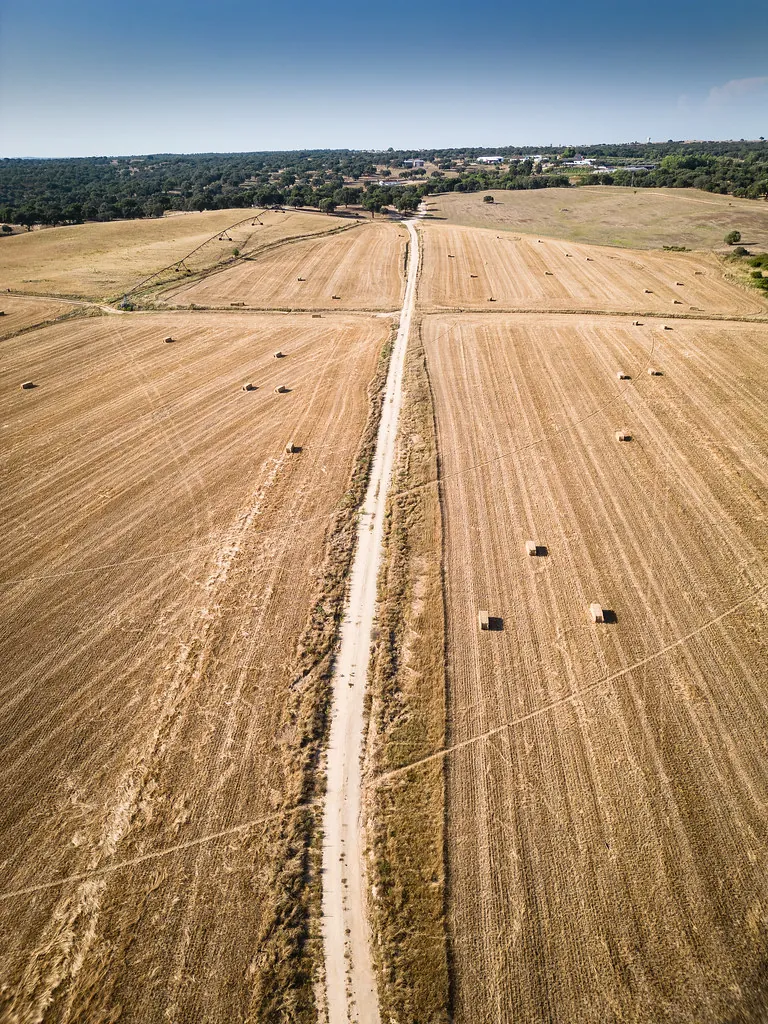
On winter mornings the scent arrives before the village does. Thin white columns rise from low terracotta chimneys, sketching perpendicular lines against the high Alentejo sky. Only then does Foros de Vale de Figueira reveal itself—sixty-seven square kilometres of rolling plain at 171 metres, where cork oak montado alternates with wheat that turns from emerald in March to burnished gold by July.
Fewer than 1,100 people share that space, so silence is the default soundtrack. Walk the single-track lanes and your own footfall keeps pace, interrupted only by a skylark or the far-off bark of a mastiff. The village obeys an agricultural clock: sowing, lambing, cork stripping, harvest. Time is told by what is happening in the fields, not by the hour on a phone.
A Landscape You Can Taste
“Borrego de Montemor-o-Novo” is not a restaurant slogan; it is what appears on the plate when you are invited for dinner. Lambs graze the open montado, flavouring themselves on rock-rose, lavender and cistus. In local kitchens the meat is slid into wood-fired ovens with nothing more than garlic, pork lard and coarse salt. The result needs no garnish.
Évora DOP sheep’s cheese matures in cool larders until it reaches the texture of thick custard and a peppery finish. Cut a wedge, add a disc of crusty Alentejo bread, a drizzle of green-gold olive oil and a bowl of crushed-olive seasoning: lunch is sorted. Honey from the same scrub carries the perfume of rosemary, thyme and strawberry tree—wild aromatics that survive because the cork harvest forbids pesticides.
Between Vine and Horizon
Alentejo’s wine map now stretches across the parish. Low, head-pruned vines are trained into tight baskets that shrug off summer heat and Atlantic wind; from above they look like dark green buttons stitched onto red earth. During the September vendima the air smells almost fermentingly sweet, and pickers appear for a fortnight before the calm reasserts itself.
Late-afternoon light is the optimum filter. A gentle rise just outside the village gives a 270-degree panorama—no climb required—where the only verticals are cork oaks and the only border is a heat-shimmered horizon. Cyclists use the dirt roads as rolling time-trial tracks; the 95 km loop from Foros to the São Pedro chapel and back is a favourite among Lisbon riders who want empty tarmac and 1,000 m of gentle ascent.
Clock-Off Country
Accommodation is measured in single figures: three self-catering cottages, two B&Bs and a cork-estate guesthouse. Visitors book precisely because there is nothing massive to do. Evening meals are arranged house by house; you sit at the family table while the cook transfers a clay pot directly from oven to tabletop. The alternative is to bring your own supplies—there is no delivery app to rescue you.
Demography tells the rest of the story: 376 residents over 65, only 87 under 20. In the café opposite the parish council, octogenarians recall whole summers spent hand-cutting wheat, sleeping in straw lofts and moving the threshing floor on bullock carts. Their anecdotes surface unbidden as shadows lengthen across whitewashed walls, and the conversation pauses only when the church bell tolls the hour—though everyone already knows what time it is.