Full article about Lavre: Where Granite Fountains Whisper 1755 Tales
Alentejo hamlet of 655 souls, cobalt-trimmed walls, lamb & honey DOP, earthquake-proof church.
Hide article Read full article
The granite still runs with water
Dawn slips over the granite rim of Lavre’s village fountain and the same eight spouts that served laundresses in 1755 still deliver a steady silver thread. The only accompaniment is the soft scuff of leather on schist and, somewhere in the olive canopy, a Dartford warbler testing its voice. Whitewashed façades carry cobalt and ochre trim – the Alentejo’s version of a signature, written in lime wash rather than ink.
This was once Portugal’s tiniest municipality: 18 km², 655 souls today, six inhabitants per square kilometre. King Afonso III elevated the settlement in 1257, but the 1755 earthquake erased most records; what remains is a pocket of ageing memory where pensioners outnumber schoolchildren five to one.
A church that rode out the quake
The parish church of Nossa Senhora da Assunção stands exactly where it did before November 1755, its Manueline doorway grafted onto a Renaissance body. Inside, eighteenth-century azulejos narrate the life of the Virgin in midnight blue, while a gilded altarpiece drinks candlelight and throws it back as liquid gold. Local potter Mário Santiago spent a decade lifting the church’s botanical scrolls onto clay tiles that now travel as far as Lisbon galleries.
Outside the nucleus, the Baroque chapel of São Brás keeps solitary vigil among cork and holm oak. In July the surrounding wheat is already stubble and the wind combs it like hair.
Lamb, honey and cheese that carry passports
Lavre’s cooks do not invent; they rehearse. Tomato açorda arrives with an egg still collapsing in the centre, the bread soaked in estate-pressed olive oil and torn coriander. Montemor-o-Novo IGP lamb stews until the meat sighs off the bone; winter brings chickpea and pork-rib cocido that warms the hands as much as the stomach. The chewy, small-format Queijo de Évora DOP and caramel-coloured Mel do Alentejo DOP are never absent from the table – both carry the same protected status as Stilton or Parma ham.
On 15 August the village honours its patron with midnight bonfires; the Círio circles the streets to the call-and-response of Cante Alentejano, Portugal’s polyphonic answer to the blues. Ash Wednesday sends off Carnival with the Entrudo’s “Burial of the Cod”, a parade of papier-mâché big-heads and satirical verses sharp enough to make the parish priest blush.
Cork, pigs and a house that never burns
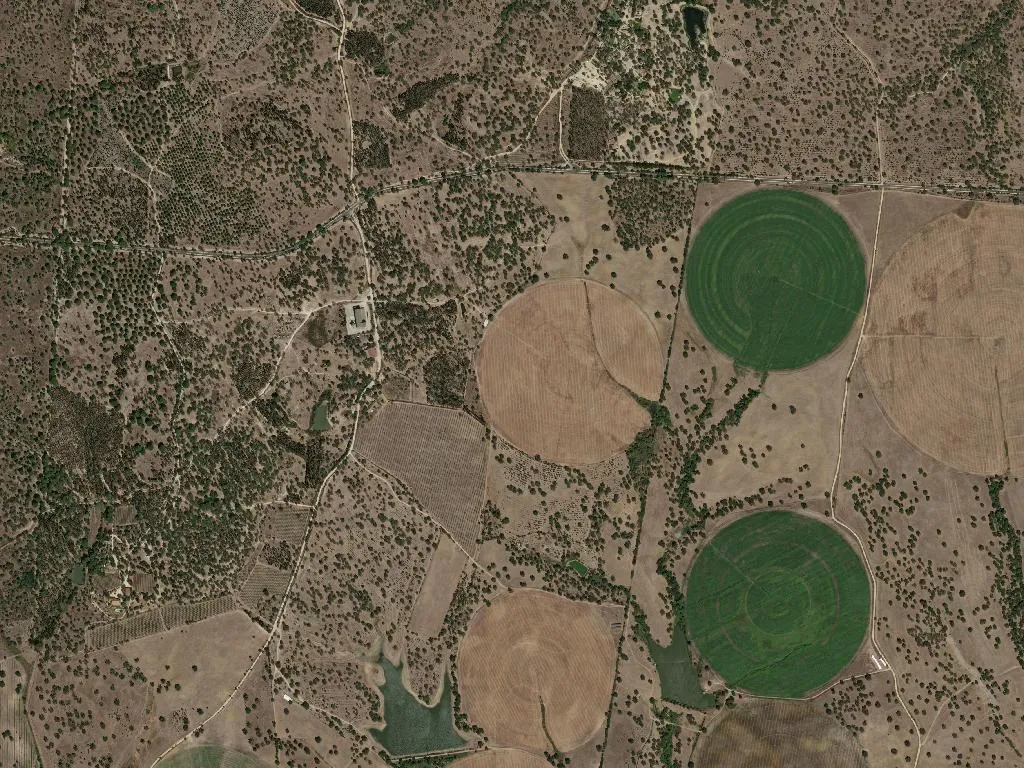
Lavre spreads across 11,437 hectares of cork and holm-oak montado, olive groves and grass where wild boar and red-legged partridge move at their own tempo. At 147 m above sea-level the climate is transitional: mild winters, summers that acquiesce to shade. A three-kilometre way-marked trail follows the Lavre stream through poplar and alder galleries where grey herons stage stopovers on their way to Africa. Abandoned windmills and dry-stone walls map out estates that predate the Peninsular Wars.
On the Herdade da Cascata the county’s only complete cork-block house survives – walls of raw cork mortared with clay, thatched roof. Built as a hayloft, it never needed a hearth; the bark insulated against both January frost and August glare.
At dusk the air is braided with wood-smoke and the scent of first rain on dust. Lavre offers no spectacle, only the slow density of an Alentejo day measured out in bread loaves, olive prunings and stories that finish only when the teller decides the night has earned its silence.