Full article about Dawn silence over Montemor-o-Novo’s castle ridge
Nossa Senhora da Vila wakes to cork-scented air, saffron lichen walls and 1390 stone memories
Hide article Read full article
Nossa Senhora da Vila: Where the Alentejo Exhales
The silence arrives before anything else. Not the view, not the light, not even the cold that settles on your skin like damp linen—just silence. Dawn in Nossa Senhora da Vila is a subtraction exercise: no traffic, no wind, only the slow creak of a wooden shutter and, somewhere among the cork oaks, a single blackbird rehearsing a four-note solo. The air smells of crushed grass, holm-oak resin and something older that has no English name. Then the sun lifts behind the fractured walls of Montemor-o-Novo’s castle and throws long, pink shadows over terracotta roofs, and the 3,613 inhabitants begin their day without any appearance of urgency.
Stones that Remember
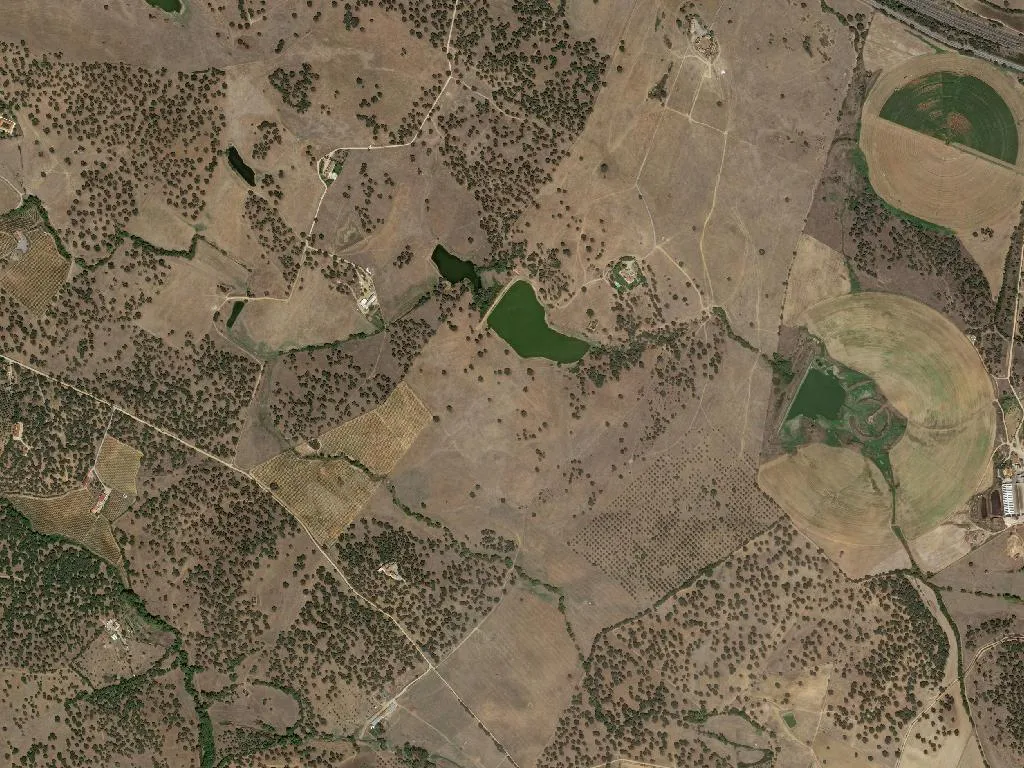
Scale is the first lesson taught by the castle. What looks from the lane like a weathered outcrop resolves, once you climb the goat-track, into schist battlements stitched together with lime mortar and lichen the colour of saffron. From the ramparts the Alentejo rolls away in every direction—soft hills patched with cork montado, olive rows drawn by a drunk cartographer, vineyards that buckle until the earth meets sky. Romans quarried here first; later the Moors raised a fort; in 1390 Dom Nuno Álvares Pereira ordered a granite cross planted on the ridge in memory of his brother, killed at the Battle of Atoleiros. The place became Aldeia da Cruz, then Vila Nova de Ourém for seven confusing years after Queen Maria II upgraded it to a municipal seat in 1841, then quietly reverted to the name everyone had kept using anyway.
Back in the compact square, the sixteenth-century pillory stands as a carved stone exclamation mark—Manuelo knots and spheres announcing that this was once judicial ground. Inside the parish church, Baroque takes over: a 1726 gilded altarpiece drinks in the thin light, while cobalt-on-white azulejos run a comic strip of the Virgin’s life along the nave. Your eyes adjust slowly, the way they do in a cinema.
Tracks through Cork and Dry Streams
Covering 187.9 sq km but only 19 souls per sq km, the parish has room to spare. Old transhumance trails still braid the hills, turning underfoot from compact red clay to loose river sand, then to the crackle of last year’s holm-oak leaves. At the Quinta dos Namorados a trickle of water slips from a moss-lined spout; legend says two young muleteers forgot their cargo here, enchanted by conversation, and the spring has murmured conspiratorially ever since. Eagles wheel overhead; wild boar snap twigs in the thicker scrub; merino sheep and Algarvian goats graze unguarded, bell-notes drifting like slow Morse.
Lamb, Cheese, Honey—In That Order
Lunch is a surrender. Montemor-o-Novo IGP lamb—wood-oven roasted until the skin lacquers and the meat subsides at the nudge of a fork—arrives with a glass of local red whose tannins sand the palate just enough to demand another mouthful. Either prelude or epilogue will be Queijo de Évora DOP: merino ewe’s milk, hard rind, interior the colour of old ivory, flavour that lingers like a church bell. Pour over it a thread of Alentejo rosemary honey, thick and topaz, and even the air feels edible. Açorda bread soups and asparagus migas fill the gaps, all anchored by peppery early-harvest olive oil and garlic from São Matias. Nothing on the table needs a passport.
White Chapels, Thick Walls, Slow Afternoons
Country chapels punctuate the landscape—São Sebastião (rebuilt 1726 after the plague), São Pedro with its 1778 gilded rococo retable—each a dab of whitewash against the ochre. Manor houses follow: rammed-earth walls 80 cm thick, triple-flue chimneys, grape arbours throwing lacework over the courtyard. Several open for tastings: cheese, honey, perhaps a late-harvest dessert wine that tastes of dried figs and burnt caramel. With only 31 guest beds scattered through cottages and converted barns, overnight numbers stay low; silence remains the dominant amenity.
In the village centre the Castle Interpretation Centre occupies the 1557 town hall. Inside, stratigraphy is made plain: Roman tile, Visigoth post-hole, Moorish pottery fragment, Manueline window jamb—history as layer cake.
The Sound You Take Home
Dusk stains the castle copper. Long after the sun drops behind the Alentejo escarpment, a single sheep bell keeps clinking somewhere in the valley, irregular as a heartbeat. Weeks later, back in a city that never pauses, the same faint metallic note will arrive uninvited and you’ll realise it never really left you.