Full article about Luz, Mourão: white heat & numbered stones
Alentejo light carves geometry on displaced village walls above Alqueva’s drowned fields.
Hide article Read full article
Light Falls
The whitewash throws the sun straight back at the sky. In Luz, the name is not poetic licence—it is meteorological fact. Alentejo light lands perpendicular to the village, incising noonday shadows into the white façades, drafting geometry on every wall. Silence has mass here, broken only by a dog barking somewhere beyond the olive groves or the scrape of a chair on a doorstep.
Two hundred and ninety-five souls share just under 5,300 hectares of rolling plain: fewer than six people per square kilometre. The census adds that eighty-six of them are over sixty-five and only thirty-one are children, but it cannot explain how it feels to live at this amplitude, on conversational terms with the horizon.
What the past left behind
The castle of Luz, made a National Monument in 1910, rises from a ridge above the Guadiana, 15 km east of Mourão. Afonso Henriques is said to have wrenched the fortress from the Moors in 1160 and handed it to the Knights of St John; what stands today is Manuel I’s rebuild of 1512, the king’s emblematic rope-carved stone coiled around the keep. From the battlements the plain unfurls like a tawny map: wheat squares, olive grids, the distant glint of Europe’s largest reservoir where once there were fields.
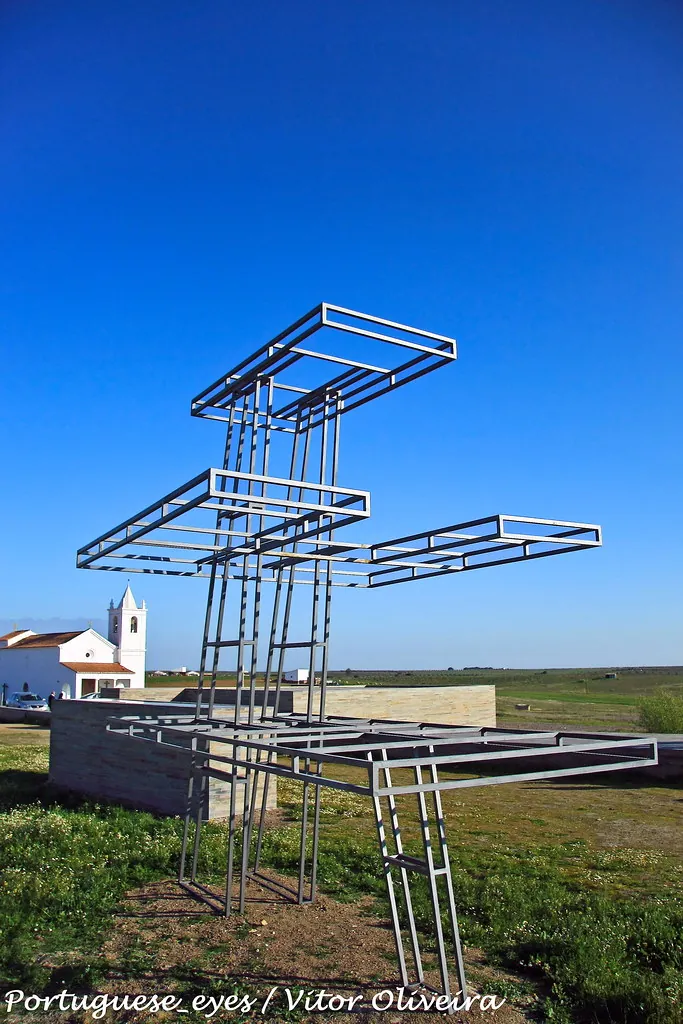
In 2002 the Alqueva dam crested, swallowing the original village. Every stone was numbered, every street re-measured, and Luz was reconstructed three kilometres back from the waterline. The new lanes follow the old alignments; even the church altar sits exactly where it always did, only the view from the door has changed.
Tastes with postcodes
The pantry is dictated by what the montado gives. Lambs stamped Borrego do Baixo Alentejo IGP graze on cistus and lavender; their meat arrives at table faintly resinous, slow-roasted with garlic and bay. Cheese is the raw-milk Queijo de Évora DOP, aged six weeks until it can be sliced like fudge, then drizzled with honey from the same holm-oak pasture. In the single grocery, morning deliveries of pão alentejano—a domed loaf with a chestnut-coloured crust—sell out before the loaves are cool. Locals tear off the ears while they queue, scattering crumbs like seed.
Vines share the same schist that roofs the houses. At 160 m altitude the diurnal swing is brutal—40 °C days, 15 °C nights—locking aromatics into Aragonez and Antão Vaz. The resulting reds smell of hot slate and thyme; the whites taste like bruised peach and salt. Both need the regional soundtrack: cicadas, clacking storks, a cork being drawn at 7 p.m. sharp.
Geometry of the plain
Walking Luz is a lesson in negative space. Streets are wider than the traffic warrants; houses are aligned but not identical, their white planes mirroring the sun. Geraniums in blue pots provide the only deliberate colour, a Pantone argument against the monochrome. On Rua da Igreja the sixteenth-century chapel of Our Lady of Light hides a gilded altarpiece most visitors never hear about; the caretaker will fetch the key if you ask in Portuguese and look willing to wait.
By late afternoon the light skims in sideways, gilding the castle stone and stretching shadows across the dust. Wood smoke drifts from chimneys—someone is grilling the evening’s suckling lamb. Time is told by temperature and tint: when the walls turn butter, it’s time to head home; when they fade to parchment, the day is done. Footsteps echo, a kettle whistles, the plain reclaims its quiet.