Full article about São Bartolomeu do Outeiro: Alentejo’s quiet equation
Eleven souls per km², thyme-scented air and a bench that doubles as the village square
Hide article Read full article
The mathematics of quiet
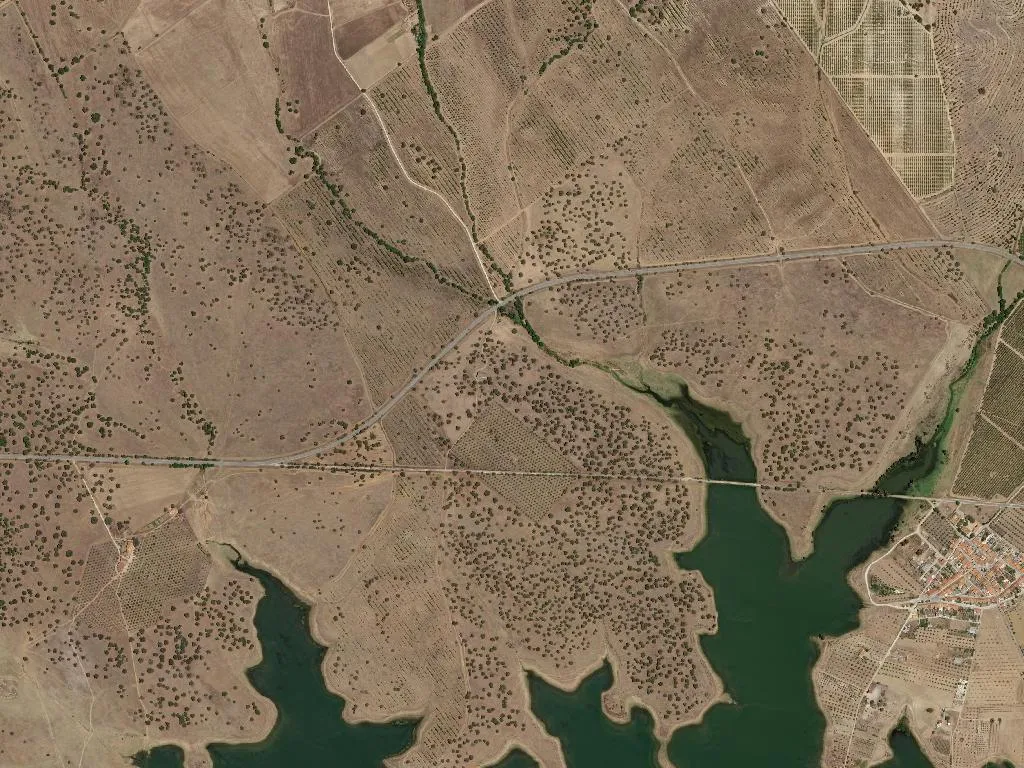
Sunlight ricochets off low whitewashed walls with such force you walk half-blind through São Bartolomeu do Outeiro. Four hundred and two people are scattered across forty square kilometres of Alentejo plateau, a ratio – eleven humans per km² – that turns every chance meeting into a minor event. At 209 m above sea level the air is thin enough to carry the smell of wild thyme intact, thick enough to muffle your own footfall on chipped limestone.
Everyday geometry
Houses cluster without hurry, some newly limed, others revealing ochre earth in their 200-year-old mortar. There are no crowds to negotiate, no queue for coffee; density itself is a luxury good. Forty-seven children grow up here learning the exact slope of the horizon, while 113 pensioners remember when wheat sheaves stood where olive rows now run. A single bench under a strawberry-tree is parish central; if you sit long enough the parish councillor, the baker and the tractor mechanic will all pass by, usually in that order.
Tastes that carry a post-code
Flavour is parcelled out by Protected Designation of Origin. Azeite do Alentejo Interior DOP arrives green and peppery from groves you can point to from the breakfast table. Queijo de Évora DOP, a sheep’s-milk cheese aged on rye straw, tastes of thistle rennet and summer drought. Borrego do Baixo Alentejo IGP lamb, raised on oak-sprinkled pasture, appears only when the season and a neighbour’s invitation align; the nearest restaurant is 18 km away, so dinner happens in kitchens where the television stays off and the wine is poured from unlabelled bottles.
Vines and volume control
The parish lies inside the Alentejo wine region, but you will not find visitor centres or tutored tastings. Vineyards are laid out like military grids, the cordons kept low to dodge Atlantic winds that roll across the Guadiana. Come mid-September the population temporarily doubles; German backpackers, French oenology students and the owner’s cousins from Lisbon all stoop among the arinto and antão vaz grapes, and for two weeks the silence is fractured by harvest banter in four languages.
What disappeared
Until 1925 this was municipal seat of the vanished concelho of Granja. The town hall is gone, yet the 16th-century parish church survives, its Manueline doorway still announcing civic pride that no longer exists. On Rua de Cima the old Guard House keeps 1891 carved into its façade, the year before Granja was absorbed by Portel and São Bartolomeu found itself demoted to a footnote. Inside the single-nave interior, azulejo panels map a diocese that once stretched to the Spanish border; worshippers read the blue-and-white tiles like a pre-digital GPS.
The luxury of small numbers
There are two legal places to sleep: Casa do Ribeiro, a converted olive-press, and Horta da Fonte, a farmhouse where swallows nest above the pool filter. Both have only three guest rooms, so booking is advisable but not competitive. Phone signal is patchy, Wi-Fi philosophical. What you come for cannot be framed in an Instagram carousel: the midday hush that makes your heartbeat audible, the way crushed rosemary releases its camphor note before you have even identified the plant, the realisation that a car approaching two kilometres away is still the loudest thing around.
When the sun drops behind the cork oaks and the asphalt exhales its stored heat, São Bartolomeu do Outeiro offers the one commodity metropolitan resorts can no longer manufacture: temporal slack. Four hundred neighbours have chosen to remain, pruning olives, ladling rennet, remembering aloud the year the wheat failed and the river ran backwards. Nothing here announces itself as spectacle; instead, the parish hands you the more durable gift of ground solid enough to stand on while the rest of the world quick-scrolls past.