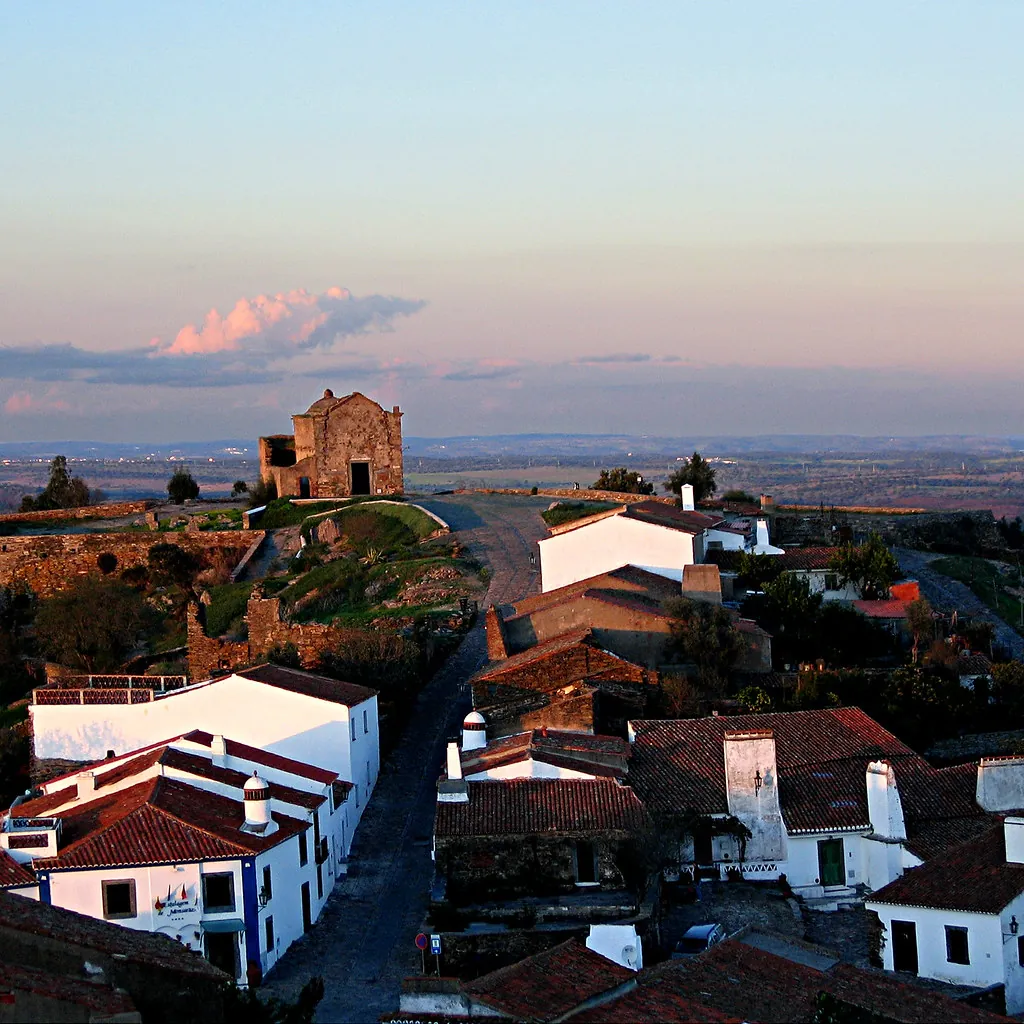
Full article about Sunset over Monsaraz: Alentejo’s whispering castle-village
Monsaraz crowns a 182 m ridge above Europe’s largest reservoir; inside medieval walls, acoustic chapels, Manueline tombs and dusk-lit schist alleys deliver
Hide article Read full article
Slate and silence
The late sun strikes the schist slabs and prints long, angular shadows between the lime-washed houses. In Monsaraz’s single-track lanes the hush is so complete you can follow the progress of a wooden door creaking open three houses away. A breeze climbs the escarpment, carrying the scent of baked earth and resin from the cork oak below; when it slips through the crenels it whistles a note that sounds centuries older than the stones themselves.
The village was founded in 1234, mid-Reconquista, when “mons” met “raz” – mountain and ruin – on a ridge 182 m above the Alentejo wheat belt. Seven centuries of battlement still girdle the houses, uninterrupted by later architectural moods. Walk the parapet at dusk and you understand why the Templars, who finished the keep in the 14th century, refused to cede the site even during Spain’s 17th-century push for the border.
Stone that speaks
From the castle’s roof the view is a ledger of Alentejo geography: stubble fields the colour of pale sherry, holm-oak dehesas, silver-green olive grids and, south-eastwards, the matte-blue sheet of the 250 km² Alqueva reservoir – Europe’s largest artificial lake. Inside the parish church of Nossa Senhora da Lagoa, rebuilt after the 1755 earthquake, Manueline ribs twist above a marble tomb carved for Gomes Martins Silvestre, first mayor and Templar knight. Step into the annexed chapel of São João Baptista and whisper against the north wall; someone on the south side will hear you as if you were at their shoulder – a side-effect of the stone’s acoustic curve that tour guides still fail to explain.
Water that rewrote the map
Before the dam closed in 2002 Monsaraz looked only inland. Now sailing dinghies, SUP boards and houseboats nudge former hilltops, and greylag geese outnumber tractors. The shift brought birdwatchers tracing the margins for ospreys and black-winged stilts, and week-enders from Lisbon who arrive at the car park outside the walls, climb the 200 m granite ramp and drift through streets where 658 souls are registered – 221 of them over 65. Population density is 7.45 per km², lower than the Mongolian steppe; shut-up cottages with warped doors spell the slow exodus that closed the primary school in 2019. Children leave for Reguengos or Évora at ten, and many never return.
Clay ovens and clay pots
Alentejo cooking is not performance; it is ballast. Lamb stew, perfumed with garlic and coriander, collapses from the bone after three hours over a wood fire. Açorda – a bread-thickened soup – arrives still bubbling, local DOP olive oil shimmering like liquid topaz on its surface. Black pigs fattened on acorns from the montado furnish thick pork cheeks with wilted greens and roasted potatoes. Finish with Queijo de Évora DOP, a semi-hard ewe’s milk cheese that smells of thyme and lanolin, or toucinho-do-céu, an almond-yolk confection that dissolves like shortbread on the tongue. All of it is washed down with reds from Casa Relves or Herdade do Esporão, estates barely 25 km away. Reserve in July or August or expect an hour’s wait on the flagstones outside Taverna Os Templários or Sem Fim; service is unhurried because time is considered part of the seasoning.
Night without a curtain
When darkness falls Monsaraz reveals its second heritage site: the sky. The Dark Sky Alqueva Reserve, the world’s first Starlight Tourism Destination, keeps artificial light to a minimum. Spread a blanket on the churchyard of Misericórdia and the Milky Way arcs from battlement to reservoir like a silver bridge. An occasional satellite threads the constellations; owls trade calls across the rooftops. The village observatory, opened in 2017 beside the cemetery, will train a 12-inch reflector on Saturn’s rings, but most visitors simply lie on the stone bench outside the castle gate and let the night do the talking.
By midnight the streets empty again. A single window glows here, another there. The wind resumes its conversation with the merlons; somewhere an olive-wood fire pops in a hearth. Monsaraz asks nothing of its guests except that they walk slowly, look twice, and allow the stone to speak first.