Full article about Aguiar
Cobalt-trimmed cottages, clay talhas beneath cork oaks—Aguiar keeps its stories in 60 cm walls
Hide article Read full article
A white village in a heat hush
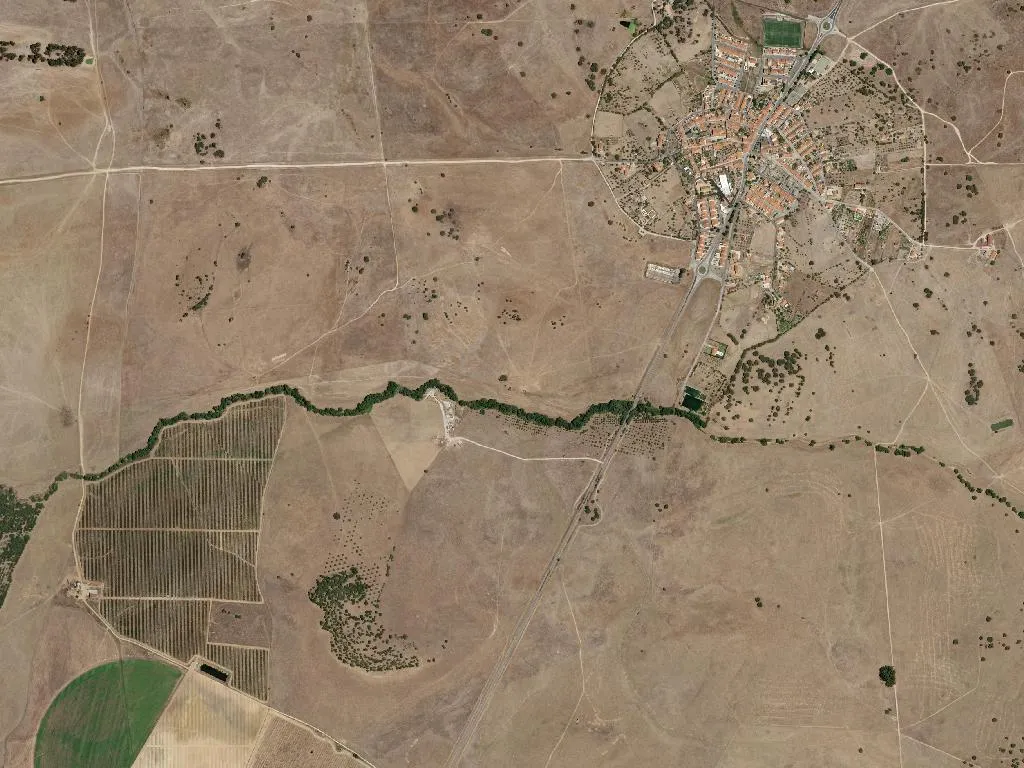
The N114 drifts south-east from Évora, peeling off the Lisbon road until the tarmac feels like it’s softening. By 6 a.m. the plain already trembles; cork oaks throw bruise-coloured shadows and the holm oaks sit in dark clumps, as if someone has dropped green ink on parchment. Then Aguiar surfaces – not a mirage, but a low heap of lime-washed houses with cobalt skirting, their terracotta roofs still holding last night’s chill. Eight-hundred-and-fifty-nine people, one café, zero traffic lights, altitude 195 m: a parish that could fit inside Hyde Park and still leave room for the Serpentine.
Triangle of parish memories
In the 1758 royal census Aguiar was the smallest of three autonomous villages—Viana do Alentejo and Alcáçovas the others—its name clipped from the Latin agrius, meaning rough land. No palace, no convent, just a modest 16th-century chapel whose bell was cast from Ottoman scrap seized at Alcácer-Quibir. The faithful once walked 7 km across wheat stubble to the Marian sanctuary in Viana for the September pilgrimage; the footpath survives, now more used by John Deere tractors than by penitents. Heritage here is measured in wall thickness (60 cm keeps August at bay), in doors that force a courteous bow, in bread ovens fired while the stars are still out. Commemorative plaques haven’t arrived yet; memory is kneaded daily into dough and pruned into olive wood.
Cork, clay and copper
Landscape stacks in horizontal layers: open-canopy montado on the skyline, then regimented vines, then centenary olives fingering the red soil. Aguiar sits inside the Alentejo DOC, where a handful of producers still ferment in buried clay talhas—eggs of terracotta sealed with olive oil and beeswax, giving white wines a faint struck-flint note and reds a suede-like grip. Olive oil carries the Alentejo Interior DOP seal; olives are picked green and early, so the oil tastes of tomato leaf and green banana. Évora DOP sheep’s-cheese matures in cool cellars until its rind turns the colour of a fox’s coat and the paste smells of wet straw and thyme. Black-footed pigs still fatten on acorns in the adjoining holm-oak parklands; their hams arrive in January, slow-stewed with coriander, garlic and a splash of last year’s talha wine. At Café Central—part grocer, part gossip exchange—António will plate migas de espargos (breadcrumbs wilted with wild asparagus) if he happens to be in the mood, which is usually Thursdays.
Horse hooves and Tuesday bread
Leave the village on any radial lane and silence is measured in kilometres. The houses turn inward, their windows the size of post-cards, framing courtyards where jasmine scents the night. Come the fourth weekend of April, the Romaria a Cavalo clatters past: several hundred riders in broad-brimmed hats, escorting the village priest to Viana’s sanctuary, hooves drumming the dust like muted castanets. Six months later the Feira de Aires reverses the flow, bringing fairground lights and accordion trios to within earshot of Aguiar’s church tower. Demographics tilt gently towards extinction—118 children under 14 share the territory with 165 residents over 65—so the Tuesday bread van from Viana is treated like a minor festival: white loaves vanish before 10 a.m., and the queue becomes an informal parish council. At dusk the oblique light sets the walls on fire, the scent of dry earth mingles with cypress resin, and somewhere a bell meant for another village drifts across the plain. Aguiar answers only with its own dense, horizon-wide silence.