Full article about Pardais: where sparrows outnumber people 2:1
In Vila Viçosa’s smallest parish, marble quarries sleep and church clocks still sulk over 1987
Hide article Read full article
The sacristy clock in São Brás’ single-nave church is still sulking over a half-hour grievance that began in 1987. At 3.30 p.m. on an over-bright February Tuesday its hands insist it is only three, while the whitewash renewed three decades ago with lime from the now-crumbling Montes Claros kiln bounces the light back so fiercely that restorer Rui Mário Dias once claimed he had to paint the gilded altarpiece by memory alone.
Pardais is the only parish in Portugal whose name is a perfect mirror of the house sparrow. Latinists trace it to pardus; old villagers simply point to the birds that have always flickered across these 17.5 km² of Alentejo scrub. With just 457 residents—26 per square kilometre—sound travels uncluttered. Even Joaquim Palma’s tractor, the last that still rattled to the marble quarries, has stood silent since 2018 for want of orders.
Marble, schist and gold leaf
The baroque altarpiece, carved in 1743, cost parishioners 28,500 réis, a sum noted in the same leather-bound ledger that Rosa Martins pored over for her 1987 dissertation on Alentejo woodcarving. After the 1858 earthquake cracked the north wall, 14 azulejos stencilled with birds were carted in from Redondo by potter Manuel Ruivo; they still balance between pilasters like a frozen flock.
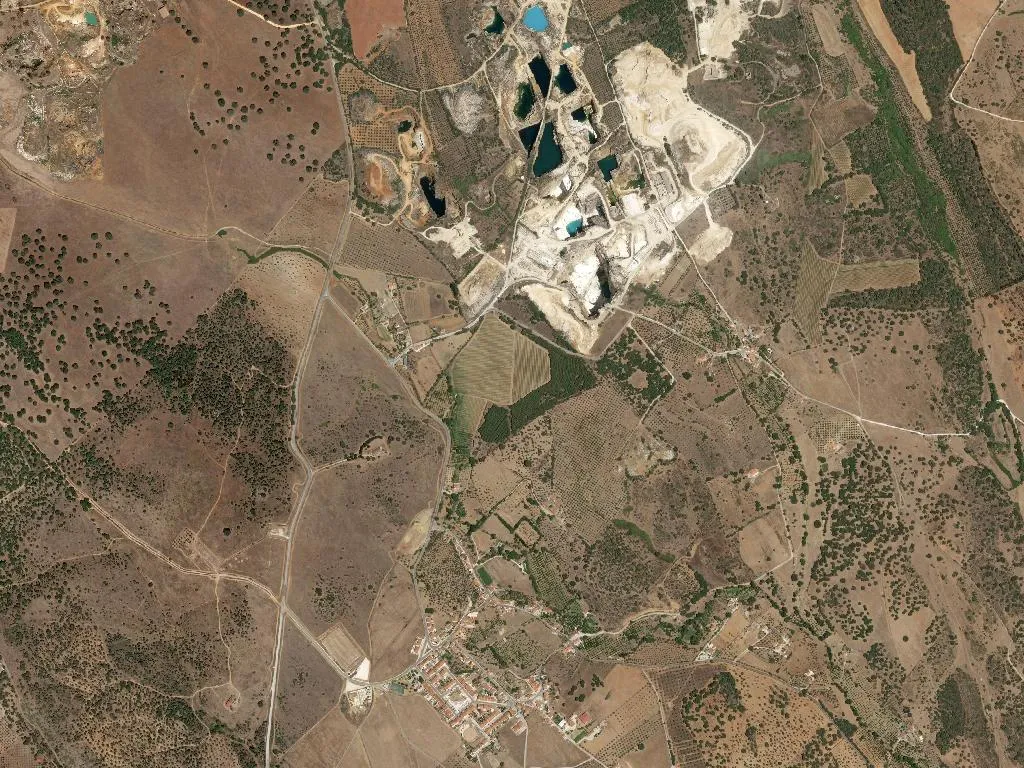
The quarries—Santa Bárbara, Fonte Soeiro, Azenha Cimeira—shut in 2004 when Marmoraria Alentejana folded. Blocks cut here paved the Palace of Belém in 1942 and later lined the Marble Museum in Vila Viçosa. Walk the vertiginous faces of Fonte Soeiro and you can read the 3-lb pick marks of José “Graveto”, who once extracted twelve cubic metres a month single-handedly through the 1970s.
At table in the inner Alentejo
Maria do Céu opened “O Cantinho” in 1983 and closed it exactly 36 years later on her 75th birthday. Her coriander açorda was finished with eggs from the one black hen in her yard, nicknamed Pintadinha. Seven cloves of garlic still go into every lamb stew at the Casa Agrícola, the measurement bequeathed by cook D. Agostinha (1956-1992). Wednesdays mean Estremoz market, where the parish buys its Queijaria do Redondo wheels of Évora DOP cheese; olive oil comes from Borba’s co-op press, to which 23 of the 45 local growers delivered fruit last autumn.
Between stones and birds
The Marble Route way-marked by local surveyor João Luís Carrilho threads 4.3 km through the parish: 27 schist posts, each etched with his initials. At km 2.1 the Fonte Nova well drops 14 m—António Rosa measured it in 1974 with a triple-twist rope. Eight households still draw water here, preferring its iron bite to the mains that arrived in 2001.
At 5.45 p.m. the 783 bus from Vila Viçosa to Estremoz sweeps past without stopping; it hasn’t carried a passenger since 2019. A blackbird nesting in the neighbouring cork oak repeats the same three-note phrase, a metronome for the sacristan who locks São Brás with an iron key forged in 1832 and sighs at the sacristy clock—motionless again.